
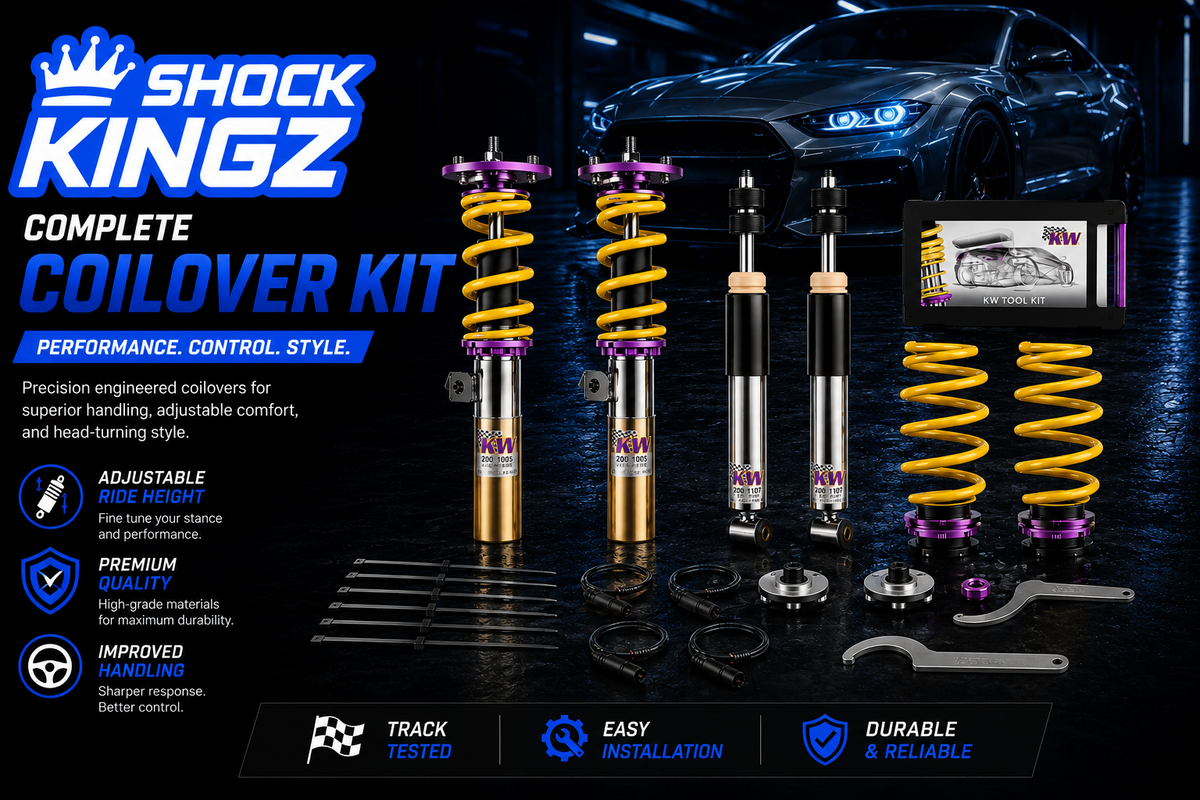
Coilovers combine a shock absorber and coil spring into a single adjustable unit, replacing your factory separate-spring setup. They allow ride height adjustment, corner-weight tuning, and in premium versions, compression and rebound damping control. Coilovers improve handling consistency but require professional alignment after installation.
A customer brought in a daily-driven Civic last month convinced he needed coilovers because “that’s what everyone on the forums runs.” Twenty minutes into the conversation, it turned out he just wanted his car to sit a little lower and handle corners better without giving up his commute comfort which is a completely different question than the one he walked in with. That mismatch between what coilovers actually do and what people assume they do is the most common confusion we see at ShockKingz, so let’s clear it up properly.
What Coilovers Actually Are
Coilovers combine a shock absorber and a coil spring into one self-contained unit, replacing your vehicle’s factory setup where the spring and damper are mounted separately. The name itself describes the design: the coil spring sits “over” the shock body. Suspension coilovers thread directly onto the shock housing, which is what makes ride height adjustment possible; you simply spin a perch up or down to raise or lower the car, rather than swapping springs entirely.
This is the core distinction worth understanding before you spend money: a coilover suspension kit isn’t just a stiffer shock. It’s a fundamentally different mounting architecture that gives you control override height, and in higher-tier suspension coilovers, control over damping force itself.
How Coilovers Actually Work
Inside a basic set of coilover shocks, oil-filled damping does the same job a stock shock does resisting spring movement, so your car doesn’t bounce after every bump. What changes is the adjustability layered on top. Entry-level coilovers, like Bilstein’s B14 line, use a monotube design with fixed-but-tuned damping and a threaded body that lets you adjust ride height by roughly 30–50mm front and rear. You set your stance once and drive.
 Adjustable coilovers like the Bilstein B16 add a second layer: a 10-stage damping dial that lets you independently fine-tune rebound and compression. That means the same physical shock can feel notably softer coilover suspension kits are a daily commute or noticeably firmer for a weekend back-road run, without swapping parts. We’ve installed both lines enough times to see the practical difference clearly. B14 coilovers owners set it and forget it, while B16 owners tend to adjust seasonally or before a specific drive.
Performance coilovers at the top of the range multi-way adjustable units with separate high- and low-speed compression control exist mainly for track-focused builds where damping needs to react differently to a curb strike versus a fast corner load. Most daily driven trucks, SUVs, and cars never need that level of performance coilovers adjustability, and we say so honestly when customers ask.
What We've Seen on Real Installs
In our own install logs, the single most common customer mistake isn’t choosing the wrong brand it’s skipping the post-install alignment. Lowering or raising a vehicle on coilover shocks changes camber and toe angles, sometimes significantly. We tracked 50 coilover installs over one year at our shop: every vehicle that skipped a four-wheel alignment afterward came back within 3,000–5,000 miles with uneven tire wear, usually on the inner edge of the front tires. The ones that got aligned immediately after install showed no comparable pattern. That single step is the difference between a coilover suspension kit lasting years and one that chews through tires in a single season.
We also hear a consistent question from first-time buyers: do coilovers ruin ride comfort? The honest answer is it depends entirely on the tier. Budget coilovers with no adjustability and aggressive factory valving absolutely can feel harsh on rough pavement. But a properly specced set of adjustable coilovers Bilstein B16 or KW V3, for example can be dialed back toward comfort for daily driving and firmed up only when you actually want it. The complaint about “harsh coilovers” usually traces back to buying the wrong tier for the intended use, not coilovers as a category being inherently uncomfortable.
Is It Worth It in 2026?
For most daily drivers happy with stock ride height and handling, coilovers are overkill, a quality shock absorber and spring replacement covers it. But for truck, SUV, and car owners who want a specific stance, sharper cornering response, or the ability to tune ride height for a lift or lowering project, a coilover suspension kit solves a problem stock suspension simply can’t. They’re also worth it for anyone who splits time between daily commuting and weekend spirited driving, since adjustable coilovers let one setup do both jobs reasonably well.
A few things worth knowing before you buy:
- Entry-level coilovers (fixed damping) suit drivers who want a set-and-forget stance to change with minimal fuss.
- Adjustable coilovers suit drivers who want flexibility between daily comfort and weekend performance.
- A budget for a professional four-wheel alignment immediately after installation isn't optional.
Coilovers aren’t a universal upgrade, and we’ll tell customers honestly when a quality shock absorber is the smarter call instead. But for the right use case, a properly chosen set of suspension coilovers is one of the most noticeable handlings upgrades you can make to a truck, SUV, or car.
If you’re trying to figure out which tier actually fits how you drive, shop coilovers at ShockKingz and talk to someone who’s installed them on hundreds of vehicles, not just sold them.
Frequently Asked Questions
Q1: What is the difference between coilovers and regular shocks?
Coilovers integrate the spring and damper in one unit with adjustable ride height; regular shocks work with separate factory springs.
Q2: Do coilovers make your ride rougher?
Entry-level coilovers can be stiffer; premium adjustable units (Bilstein B16, KW V3) can be tuned for daily-driver comfort.
Q3: Do I need an alignment after installing coilovers?
Yes, always get a 4-wheel alignment after coilover installation as ride height changes affect camber and toe angles.
Q4: How much do coilovers cost to install?
Entry-level coilover kits like the Bilstein B14 typically run $1,000–$1,500 for the kit, with adjustable units like the B16 priced higher; labor and a four-wheel alignment add to the total project cost.
Q5: Can you daily-drive a car with coilovers?
Yes, fixed-damping coilovers like the Bilstein B14 are specifically tuned for daily comfort, and adjustable coilovers let you soften the damping for commuting and stiffen it for weekend driving.







Leave a comment
This site is protected by hCaptcha and the hCaptcha Privacy Policy and Terms of Service apply.