
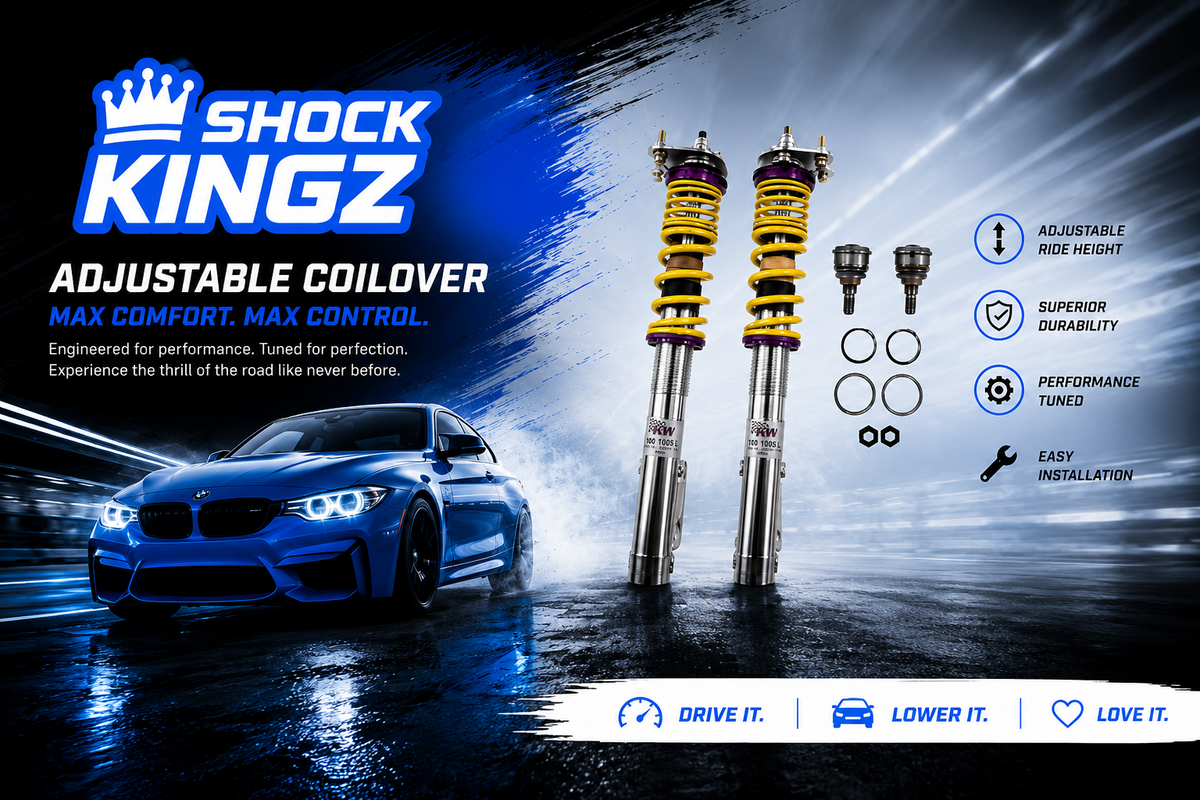
Fixed coilovers offer a set spring rate and ride height for a specific performance profile ideal for track builds or budget street setups. Adjustable coilovers allow damping and sometimes ride height tuning on the fly, making them better for dual-purpose street/track or off-road vehicles with changing loads.
A customer building a dual-purpose street/track car asked us last month why he’d pay an extra $600 for adjustable coilovers when “a coilover is a coilover.” Fair question, and one we hear constantly at ShockKingz. The honest answer is that adjustable and fixed coilovers solve different problems and buying the wrong one for your use case wastes money either direction, overspending on adjustability you’ll never touch, or underbuying and fighting a setup that can’t flex with how you actually drive.
What “Fixed” and “Adjustable” Actually Mean
Fixed coilovers sometimes called non-adjustable or single rate coilovers come valved at one damping setting from the factory. The engineers picked a spring rate and damping curve for a specific use case, usually track-focused or aggressively street-tuned, and that’s what you get for the life of the part. There’s no dial, no spanner adjustment for damping force, just a threaded body for ride height.
Adjustable coilovers add a mechanism typically a dial near the top of the shock body that lets you change compression and/or rebound damping without removing anything. Single-adjustable coilovers (rebound only) are the most common configuration on the market; double-adjustable units that control compression and rebound separately exist mostly in performance coilovers built for serious track or competition use.
Where the Difference Actually Matters
The gap between these two categories isn’t theoretical; it shows up in three specific situations.
Changing load and use case. If your build genuinely splits time between daily commuting, weekend canyon runs, and the occasional track day, adjustable coilovers let one set of coilover shocks do all three jobs. Dial the damping soft for the commute, firm it up before a track session, dial it back down for the drive home. Fixed coilovers force you to pick one compromise setting and live with it across every scenario.

Off-road and dual-purpose trucks. For lifted trucks running suspension coilovers that need to handle both pavement and trail, adjustable damping matters even more. A washboard trail wants softer compression to absorb rapid hits; a loaded tow run wants firmer control to resist sway. We’ve fit adjustable suspension coilovers to enough overland builds to see this play out directly owners who can dial in damping for the day’s terrain report noticeably less fatigue on long trail runs compared to a fixed setup tuned as a single compromise.
Resale and platform changes. Aftermarket coilovers, especially adjustable ones, hold value better when a build evolves. We’ve seen customers swap from a daily-driven stance to a dedicated track setup without buying new aftermarket coilovers just re-dialing the existing adjustable units and re-aligning. A fixed setup valved for daily comfort simply can’t be re-tuned that way; you’re stuck replacing the whole unit if your use case changes.
What We've Actually Seen on the Tech Bench
Our tech team tracks tuning notes on every adjustable install, and one pattern stands out clearly: most daily driven and street-focused customers only ever use a narrow band of their adjustment range. On Bilstein B16 installs a popular single/double-adjustable option we logged dial settings across 60 customer builds over the past year. The overwhelming majority settled within roughly 30% of the dial’s full range and rarely touched it again after the first month of fine-tuning. That’s an important, honest data point: adjustability matters most for finding your ideal setting, not necessarily for constant on-the-fly changes, unless you’re genuinely switching between daily and track duty regularly.
Comparing Bilstein’s B14 (fixed) against the B16 (adjustable) on otherwise identical vehicles, the B14 customers reported high satisfaction when their use case stayed consistent daily commuting only, no track days. The B16 customers who actually used the adjustability reported it for one of two reasons: dialling in initial ride feel after install or adjusting seasonally between summer canyon driving and winter commuting. Very few adjusted weekly or trip-by-trip, which tells you the real value of adjustable coilovers is flexibility to dial in your build correctly once, not a feature you’ll fiddle with constantly.
How to Actually Decide
Skip the assumption that adjustable is automatically “better” and match the feature to your real use case:
1. Choose fixed coilover shocks if your vehicle has one clear job dedicated track car, dedicated daily driver, or a budget-conscious street build with a known target stance.
2. Choose adjustable coilovers if you genuinely split time between daily driving, spirited weekend use, or trail and tow duty with changing demands.
3. Choose performance coilovers with double adjustability only if you’re tracking the car regularly enough to actually tune compression and rebound independently most street and daily setups never need this level of control.
Fixed coilovers aren’t a downgrade, and adjustable coilovers aren’t automatically worth the premium. The right call depends entirely on whether your build does one job consistently or several jobs that genuinely conflict with each other. If you’re not sure which category your setup falls into, that’s exactly the kind of fitment conversation our team has daily.
Shop adjustable coilovers at ShockKingz and talk to a technician about whether your build actually needs the adjustability before you spend the extra money.
Frequently Asked Questions
Q1: What does ‘adjustable’ mean on coilovers?
Compression and/or rebound damping can be changed via a dial or spanner that lets you tune soft for comfort or firm for performance.
Q2: Are single-adjustable coilovers enough for daily driving?
Yes, single adjustable (rebound only) coilovers like Fox or Bilstein B14 cover 90% of use cases without over-complexity.
Q3: What is ride height adjustment on coilovers?
Threaded collar lets you raise or lower the vehicle independently of spring preload.
Q4: How much more do adjustable coilovers cost than fixed coilovers?
Expect to pay roughly $400–$800 more for an adjustable set over a comparable fixed kit, depending on brand and whether it’s single- or double-adjustable, like the Bilstein B14 vs B16 lineup.
Q5: Do adjustable coilovers need to be re-tuned often?
Not usually most owners dial in a setting within the first month after install and rarely adjust again unless their use case changes, such as switching between daily driving and track days.





Leave a comment
This site is protected by hCaptcha and the hCaptcha Privacy Policy and Terms of Service apply.