
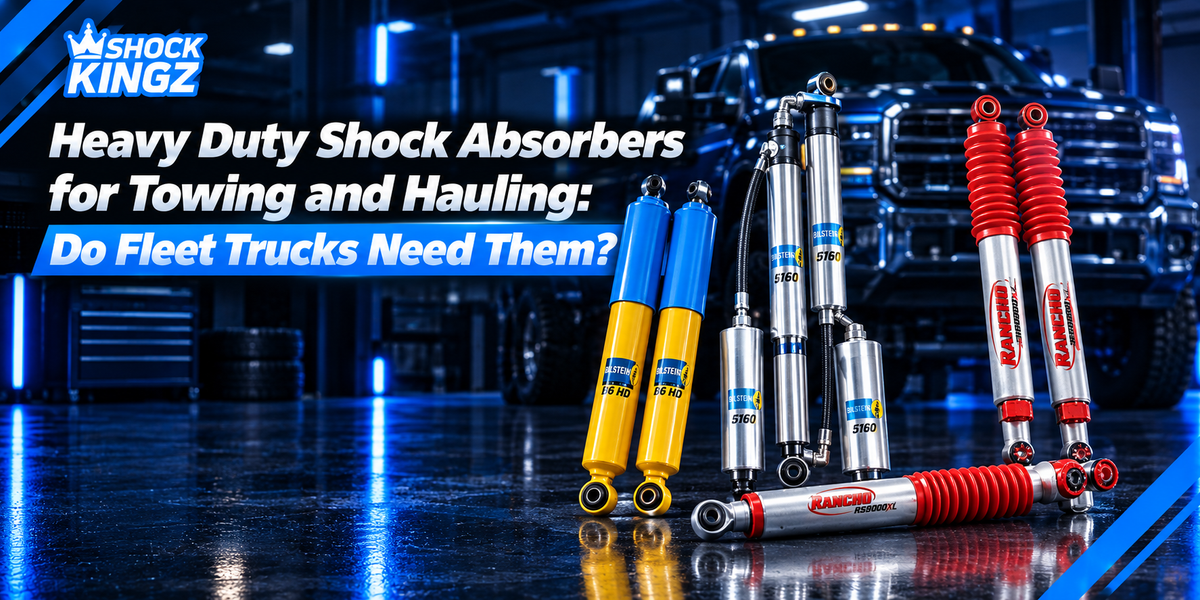
Heavy duty shock absorbers can be worth it for fleet trucks that tow or haul regularly, but only for the right reason. They improve ride control by managing bounce, sway, and heat under repeated loading. They do not raise payload or towing capacity, because springs, frame, axles, and tires set those limits. This guide helps fleet owners decide when an upgrade makes sense, what to inspect first, and how to match truck suspension parts to the job.
What Do Heavy Duty Shock Absorbers Actually Do?
A shock controls suspension movement. It damps the spring so the truck settles after a bump instead of bouncing. It does not carry the truck's weight.
Bilstein's technical resources state that standard shocks do not increase towing or cargo capacity. A vehicle's gross vehicle weight rating (GVWR) is set by load-bearing parts such as the frame, axles, springs, and tires.

Load-assist products, such as air shocks or coilovers with helper springs, can help with ride height and stability under load. Even then, treat the manufacturer's GVWR and towing ratings as your limit.
When Do Heavy Duty Shock Absorbers Make Sense for a Fleet?
They make sense when ride-control problems are tied to repeated work. This table shows common patterns.
Why Does Duty Cycle Matter More Than Truck Size?
Two identical trucks can wear very differently. A unit that tows every day, hauls loaded most of the shift, or works on gravel and job sites cycles its shocks far more than one that mostly drives empty on pavement. That repeated work builds heat and wears seals.
On towing trucks, the rear axle often works hardest, so rear shocks may need attention sooner than the fronts. Sort your trucks by how they are used, not just by model, and prioritize the hardest-working units first.
What Should You Check Before Buying?
Shocks are one of several truck suspension parts, and they rarely solve a problem alone. Worn shocks can pass extra stress to bushings, control arms, and tires, so inspect the whole corner.
- Springs and leaf packs: Look for sag, cracked or shifted leaves, and uneven ride height side to side.
- Mounts and bushings: Worn rubber can cause clunks that new shocks will not cure.
- Control arms and ball joints: Clunking, steering wander, and edge tire wear point here. See our control arms collection if inspection confirms wear.
- Tires: Check pressure first, then look for cupping or one-sided wear.
- Existing shocks: Look for oily residue, dents, or a corner that keeps bouncing.
Need to See What's Available for Your Trucks?
Use the year, make, and model search in the truck suspension collection to browse compatible parts and narrow your options by vehicle.
Browse Truck Suspension →How Do You Choose Performance Shocks for Trucks?
Start with the application, not the brand. Bilstein says its 5100 shocks are valved for a specific year, make, and model, with factors such as loaded or unloaded use and towing in mind. That is why exact fitment matters.
- Confirm fitment details: Check year, model, axle position, 2WD or 4WD, trim, factory air suspension, and ride height. A part that fits one trim may not fit another.
- Understand the design: Monotube shocks generally shed heat faster than twin-tube shocks, which helps under sustained work. They can feel firmer on smooth roads. Our monotube vs twin-tube comparison explains the trade-offs for performance shocks for trucks.
- Check adjustability: Many truck shocks are fixed-valved. Confirm on the product page whether damping is adjustable.
- Read the terms: Review warranty details on the listing instead of assuming coverage.
- Replace in axle pairs: Mismatched left and right shocks create uneven damping.
Which option fits which job?
Are Truck Suspension Upgrades Worth It Across a Fleet?
They can be, if you treat them as a controlled change, not a blanket purchase.
- Group trucks by platform and duty. Towing units and light-duty units rarely need the same setup.
- Pilot one or two trucks. Track driver feedback, tire wear, leaks, and downtime.
- Standardize what works. Fewer part numbers simplify stocking and installs.
- Plan the full job. Bundling springs, shocks, or arms may save labor. Compare shock and spring kits and suspension packages for truck suspension upgrades that cover multiple worn parts.
Treat any alignment check after major work as part of the job. Ask your installer what your platform needs.
Keep simple records during the pilot: install date, mileage, driver comments, tire condition, and any leaks. Without that baseline, it is hard to tell whether a change helped or whether the trucks simply behaved differently that month.
Reading a listing: Open a product page and check fitment notes, position, and design details. For example, review the Bilstein 5100 rear shock listed for 2019+ Ram 1500 to see the information you should confirm for any truck.
Common Mistakes to Avoid
- Buying heavy duty shocks to fix a sagging rear end that needs springs.
- Assuming shocks raise payload or towing limits.
- Replacing one shock instead of the axle pair.
- Ordering by model name alone without checking trim, drivetrain, and ride height.
- Skipping inspection of bushings, mounts, and arms.
- Rolling out one setup fleet-wide without a pilot.
Not Sure What Your Trucks Need?
Share each truck's year, make, model, duty, and symptoms with the Shockkingz team. We can help you narrow down suitable suspension parts for each application.
Contact Shockkingz →Frequently Asked Questions
Common questions about heavy-duty shocks, towing, fleet maintenance, and vehicle-specific fitment.









Leave a comment
This site is protected by hCaptcha and the hCaptcha Privacy Policy and Terms of Service apply.