
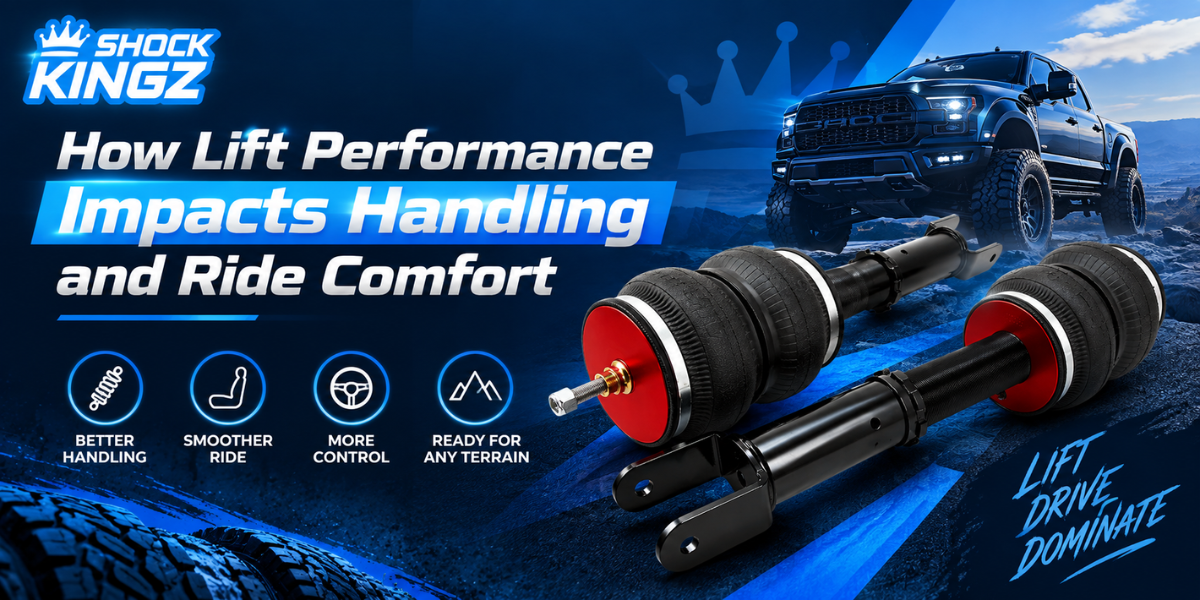
Yes, lifting a truck affects handling, and the trade-off is fairly direct: a taller vehicle sits with a higher center of gravity, which increases body roll and reduces cornering stability, while the same lift typically adds wheel travel that improves ride comfort over rough terrain and off-road articulation. Neither effect is automatically bad; the outcome depends entirely on whether the vehicle is being set up for pavement, trail use, or some balance of both.
How Lift Height Changes Center of Gravity
Raising a vehicle's ride height moves its center of gravity upward, and this single change is responsible for most of the handling shifts people notice after a lift. A higher center of gravity means the vehicle's mass has more leverage during a turn, which translates directly into more body lean and a wider, less controlled weight transfer between the outside and inside tires during cornering.

This is measurable and well documented: lifting a typical truck by three to four inches can raise the center of gravity enough to noticeably change its handling characteristics on standardized test maneuvers, and manufacturers account for this by adjusting recommended tire pressures, load limits, or stability control calibration on factory-lifted trim packages specifically because of this shift.
Rollover Risk Considerations
A higher center of gravity is also the primary factor behind increased rollover risk on lifted vehicles, particularly during sudden evasive maneuvers or when cornering at speeds that would be safe in the stock configuration. This isn't a reason to avoid lifting a vehicle, but it is a reason to treat a lifted truck differently in specific driving situations, especially highway lane changes and tight cornering, where the added roll and higher rollover threshold combine to reduce the margin for error compared to a stock ride height.
Tire choice compounds this effect: taller, more aggressive off-road tires common on lifted trucks add further height and rotating mass, which can amplify the center of gravity shift beyond what the suspension lift alone accounts for.
Handling Response After a Lift
Handling response, how quickly and predictably a vehicle reacts to steering input, changes in a few specific ways after a lift. Steering effort often increases slightly due to changes in suspension geometry, particularly caster angle, which a lift shifts away from the factory setting unless corrected. Body roll increases during cornering, as already covered, but braking dynamics also shift: weight transfers more dramatically to the front during hard braking on a taller vehicle, which can extend stopping distances measurably compared to the same vehicle at stock height.
None of these changes make a lifted truck unsafe to drive, but they do mean the vehicle behaves differently enough that habits built around a stock ride height, following distance, cornering speed, lane-change timing, benefit from some recalibration after a significant lift.
Offsetting the Trade-Offs: Suspension Tuning and Upgrades
The good news is that most of these handling trade-offs can be partially offset through suspension tuning and targeted suspension upgrades rather than accepted as an unavoidable cost of lifting. Correcting suspension geometry after a lift, particularly caster and camber, restores much of the steering precision and predictability that a height change disrupts, which is why an alignment isn't optional after a meaningful lift, it's a functional requirement.
Beyond alignment, upgrading to shocks and sway bars matched specifically to the new ride height and vehicle weight distribution recovers a meaningful share of the body control lost to the higher center of gravity, without requiring the vehicle to return to stock height. Our companion guide on how shocks, coilovers, and control arms work together as a system covers how these components interact to restore that control after a height change. For off-road-focused builds specifically, a well-matched off-road suspension kit is often designed from the outset to balance this additional wheel travel against on-road stability, rather than treating articulation and handling as separate, unrelated goals.
Ride quality also improves in a specific, measurable way after a lift when the added suspension travel is used well: a taller suspension with properly matched dampers can absorb larger bumps and rougher terrain more comfortably than a stock setup, since there's simply more room for the suspension to work with before bottoming out. This is where lift performance becomes less about height alone and more about how well the added travel is matched to the rest of the suspension system, since two trucks lifted by the same amount can feel noticeably different depending on whether the dampers and springs were chosen to work with that extra range or simply installed to reach a target height.
Lifting a vehicle genuinely trades some on-road handling precision for improved off-road capability and ride comfort over rough terrain, and that trade-off is neither purely positive nor purely negative, it's a redistribution of where the vehicle performs best. Understanding the physics behind it, center of gravity, geometry, and weight transfer, makes it possible to offset the downsides through proper tuning rather than either avoiding a lift altogether or ignoring the handling changes it introduces. Evaluating lift performance honestly, rather than assuming a taller truck automatically handles worse or rides better, gives an off-road enthusiast a much clearer basis for deciding how much lift actually serves their goals.
Call to Action
Planning a lift and want to keep control dialed in? Shockkingz carries lift performance packages and off-road suspension kits matched by vehicle and terrain.
Frequently Asked Questions
Q1. Does lifting a truck affect handling?
Yes. Lifting raises the center of gravity, which increases body roll and reduces cornering stability, while typically improving ride comfort over rough terrain and off-road articulation.
Q2. Does a lift kit increase rollover risk?
A higher center of gravity from a lift is the primary factor behind increased rollover risk, particularly during sudden evasive maneuvers or hard cornering at speeds that would be safe at stock height.
Q3. Why does steering feel different after a lift?
Steering effort often increases after a lift due to changes in suspension geometry, particularly caster angle, which shifts away from the factory setting unless corrected with an alignment.
Q4. Does a lift kit affect braking distance?
Yes. Weight transfers more dramatically to the front during hard braking on a taller vehicle, which can measurably extend stopping distances compared to the same vehicle at stock height.
Q5. Can you offset the handling trade-offs of a lift?
Correcting suspension geometry and upgrading shocks and sway bars matched to the new ride height can recover much of the body control and steering precision lost to a lift, without returning the vehicle to stock height.





Leave a comment
This site is protected by hCaptcha and the hCaptcha Privacy Policy and Terms of Service apply.