
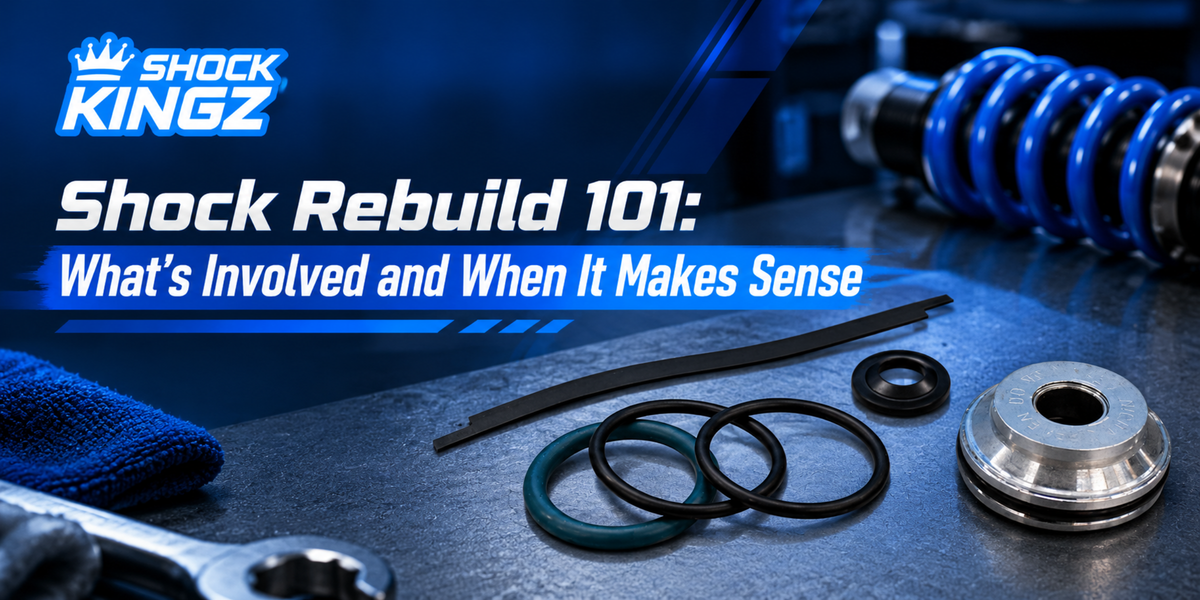
Yes, shocks can be rebuilt instead of replaced, but only under specific conditions: the shock body and mounting hardware need to be in sound structural condition, and the cost of a shock rebuild, parts plus labor, needs to come in meaningfully below a comparable replacement unit for the exercise to make sense. A shock rebuild is a viable option on a specific subset of jobs, not a universal alternative to replacement.
What's Involved in a Shock Rebuild?
A shock rebuild disassembles the unit down to its internal components, inspects each part for wear or damage, and replaces whatever has failed, typically seals, oil or gas charge, and sometimes the valving stack, while reusing the shock body and mounting hardware if they're still structurally sound. This differs fundamentally from a simple service like adding fluid, since a proper rebuild addresses the specific internal components responsible for damping performance rather than masking a symptom.

Not every shock is a realistic rebuild candidate. High-volume passenger vehicle shocks are frequently cheaper to replace outright than to rebuild once labor is factored in, since mass-produced replacement units benefit from manufacturing economies a rebuild can't match. Rebuilds make more sense on higher-value units, racing dampers, adjustable coilovers, or shocks for vehicles where OEM replacements are expensive or discontinued, where the parts cost of a rebuild is a fraction of a new unit's price.
Seal Replacement and Oil/Gas Recharge
Seal failure is the most common reason a shock needs rebuilding rather than continuing in service. The seals keep hydraulic fluid contained under pressure and prevent contaminants from entering the shock body; once they degrade, fluid leaks out and the shock loses damping control well before any other internal component fails. Replacing these seals is often the single highest-value step in a rebuild, since a fresh seal set restores much of the shock's sealed integrity even if other components are reused.
Oil and gas recharge addresses the fluid and pressurized gas charge inside the shock, both of which degrade over time and heat cycling independent of seal condition. Old hydraulic fluid loses viscosity consistency, which changes damping characteristics even in a shock with intact seals, while a depleted gas charge, common in gas-charged designs, allows fluid to aerate under hard use and causes a phenomenon called fade, where damping performance drops noticeably during sustained hard driving. A rebuild that addresses seals but skips a proper fluid and gas recharge is an incomplete job that leaves a meaningful performance gap.
Valving Service and Suspension Tuning
Valving, the internal system of shims and orifices that controls how fluid moves through the shock during compression and rebound, is the most technically demanding part of a rebuild and the one most closely tied to how the shock actually feels on the road. A worn or damaged valve stack produces inconsistent damping, sometimes described as a shock that feels harsh over small bumps but soft over large ones, or vice versa, and correcting this requires either replacing worn shims or, on adjustable units, resetting the valving to specification.
This is also where a rebuild overlaps with suspension tuning: a shop rebuilding a shock for a performance application often has the opportunity to adjust valving specifications as part of the rebuild, rather than simply restoring factory settings, effectively combining a repair with a suspension upgrade. This makes rebuilding particularly attractive for vehicles already running other suspension upgrades, where matching a rebuilt shock's valving to the rest of the setup produces a more coherent result than either a stock replacement or an unrebuilt worn unit.
Rebuild vs. Replacement: The Cost Trade-Off
The core decision comes down to a straightforward comparison: total rebuild cost, parts and labor combined, against the price of a comparable new or remanufactured replacement unit. For common passenger vehicle applications, replacement is very often the more economical choice, since parts availability and manufacturing scale keep new unit prices competitive with rebuild labor costs. For specialty, discontinued, or high-performance applications, a rebuild frequently wins on cost alone, sometimes by a significant margin, since sourcing an equivalent new unit may not be practical at any reasonable price.
Turnaround time matters as well: a rebuild typically takes longer than swapping in a ready-to-install replacement, since it involves disassembly, parts sourcing, and reassembly rather than a straightforward bolt-in job. A shop equipped with the right shock absorber tools and suspension tools can perform this work efficiently, but the labor time still needs to be weighed against the simplicity of installing a pre-built replacement unit. Our companion guide on the core suspension tools required for shock and strut work covers what a shop needs on hand before taking on rebuild jobs regularly.
Deciding whether a shock rebuild makes sense ultimately comes down to unit value, parts availability, and whether tuning flexibility adds real value for the specific application. For common, inexpensive shocks, replacement usually wins on both cost and turnaround. For specialty, discontinued, or performance-oriented units, a rebuild is often the more practical and economical path, particularly when the opportunity to fine-tune valving as part of the process is factored into the decision.
Call to Action
Stocking up for rebuild or replacement work? Shockkingz carries shock rebuild tools and shocks and struts matched by application.
Frequently Asked Questions
Q1. Can shocks be rebuilt instead of replaced?
Yes, but only under specific conditions: the shock body and mounting hardware need to be structurally sound, and the total rebuild cost needs to come in meaningfully below a comparable replacement unit.
Q2. What's involved in a shock rebuild?
A rebuild disassembles the shock, inspects internal components, and replaces what's failed, typically seals, oil or gas charge, and sometimes the valving stack, while reusing the body and hardware if sound.
Q3. Why do shock seals fail?
Seals degrade from heat cycling and wear over time. Once they fail, hydraulic fluid leaks out and the shock loses damping control well before other internal components typically fail.
Q4. Is it cheaper to rebuild or replace a shock?
For common passenger vehicle shocks, replacement is usually more economical due to manufacturing scale. For specialty, discontinued, or high-performance units, a rebuild often wins on cost.
Q5. Can a shock rebuild include performance tuning?
Yes. A shop rebuilding a shock has the opportunity to adjust valving specifications as part of the process, combining a repair with a suspension upgrade rather than just restoring factory settings.







Leave a comment
This site is protected by hCaptcha and the hCaptcha Privacy Policy and Terms of Service apply.