
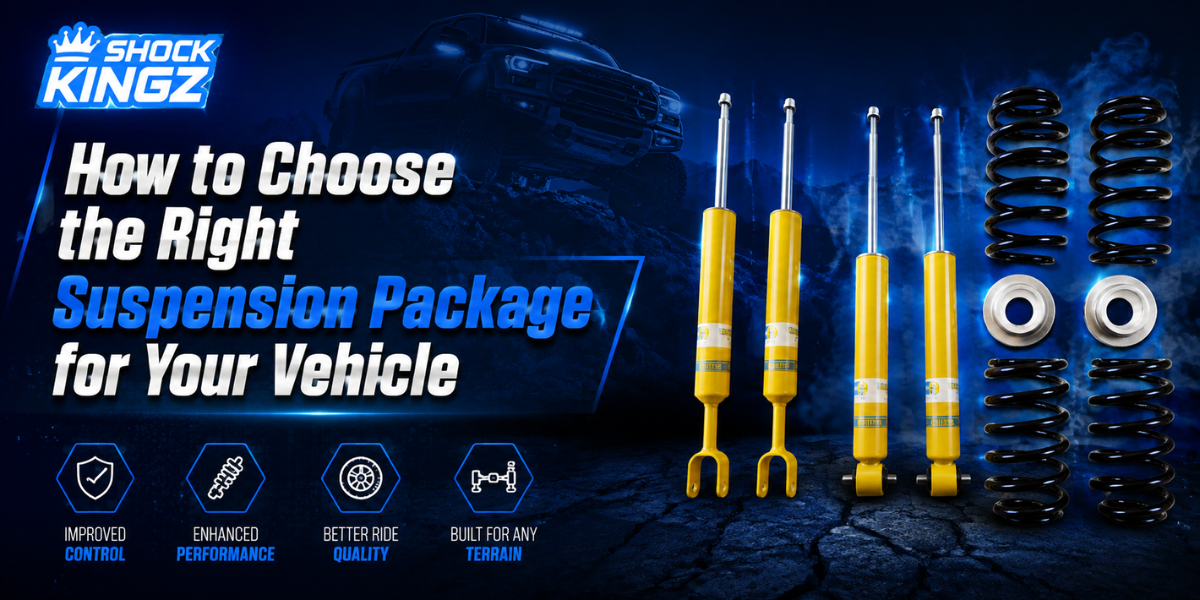
Choosing among the many suspension kits on the market comes down to three questions: what the vehicle is actually used for, what budget is realistic, and what ride quality or handling goal matters most. Answering those three honestly, in that order, narrows a wide field of options down to a short list that fits, rather than starting with a specific product and working backward.
How Do I Choose a Suspension Package?
The decision generally comes down to matching a package type to a use case:
1. Daily driving and commuting: replacement-focused suspension kits that restore factory ride and handling.
2. Towing or hauling: load-rated components built to handle added weight without sagging.
3. Off-roading: kits that prioritize wheel travel and ground clearance over on-road precision.
4. Performance or track driving: stiffer, more adjustable performance suspension systems built for cornering control.
Most vehicles fall clearly into one of these categories, though some, like a truck used for weekend towing and weekday commuting, straddle two. In that case, the safer choice is usually the package built for the more demanding use, since it's easier for a heavier-duty setup to handle light daily driving than for a daily-driving setup to handle occasional towing loads.
Suspension Packages for Daily Driving
For a vehicle used mainly for commuting and errands, the goal is restoring or maintaining the ride quality and handling the vehicle had when new, not upgrading beyond it. Replacement suspension components matched to factory specifications are usually the right call here, since daily driving doesn't stress a suspension the way towing or off-roading does, and factory-spec parts are tuned specifically for comfort and predictable handling in ordinary conditions.

The main decision point for daily drivers isn't performance, it's condition: worn shocks or struts on an otherwise healthy vehicle typically call for a straightforward replacement kit rather than an upgrade, since the underlying suspension geometry doesn't need to change, only the worn components do.
Suspension Packages for Towing and Off-Roading
Towing and off-roading pull in different directions but share one requirement: the stock suspension usually isn't built for either. A vehicle regularly towing a trailer needs load-rated springs and shocks that resist sagging under the added tongue weight, since a suspension that sags under load loses both ride height and handling precision exactly when stability matters most. Suspension upgrades built specifically for towing typically include stiffer springs and shocks tuned to control that additional load without transferring every bump directly into the cabin.
Off-roading asks for the opposite kind of stiffness profile: more wheel travel and articulation rather than more load capacity. A suspension package built for off-road use typically raises ride height for clearance and lengthens suspension travel so the wheels can follow uneven terrain without the vehicle bottoming out. Because these two use cases pull in different directions, a package genuinely built for one usually underperforms at the other, which is why matching the package to the primary use case matters more here than in almost any other category. For a closer look at how complete kits compare to individual suspension components, our companion guide breaks down the tradeoffs in more detail.
Suspension Packages for Performance Driving
Performance-oriented suspension kits prioritize precise handling and reduced body roll over ride comfort, generally through stiffer springs, firmer damping, and in many cases adjustable ride height and damping settings. These performance suspension systems are built around the assumption that the driver values cornering feedback and control more than a soft ride, and the tradeoff is usually a firmer, more communicative ride on rough pavement.
Anyone considering a performance package should be honest about how the vehicle is actually driven day to day. A stiff, track-oriented setup installed on a car that mostly sees commuting duty tends to feel harsh without delivering much real-world benefit, while the same setup on a car that regularly sees spirited driving or track days is a meaningful upgrade.
Budget and Long-Term Considerations
Budget affects not just which package tier is realistic, but which suspension components within a package are worth prioritizing. Shocks and struts wear out and need periodic replacement regardless of package type, while structural components like control arms and bushings typically last longer but cost more to replace if skipped early. Spending on a complete, well-matched suspension kit up front is usually more cost-effective than assembling suspension upgrades piecemeal over time, since matched components are engineered to work together, while mismatched individual parts can wear unevenly or fight each other's tuning.
It's also worth factoring in installation and alignment costs when comparing package prices, since a lower-priced kit that requires more labor or a more involved alignment afterward may not actually be the cheaper option once the full job is accounted for. Getting a written estimate that separates parts from labor makes it easier to compare packages on an apples-to-apples basis rather than by sticker price alone.
Choosing a suspension package ultimately comes down to being clear-eyed about use case first, budget second, and specific goals last, since a package chosen in that order tends to actually fit how the vehicle gets driven rather than sounding good on paper.
Call to Action
Ready to find the right fit? Shockkingz carries suspension kits for daily driving, towing, off-roading, and performance suspension systems matched by use case.
Frequently Asked Questions
Q1. How do I choose a suspension package?
Start with how the vehicle is actually used, whether daily driving, towing, off-roading, or performance driving, then factor in budget and specific ride or handling goals. Matching the package to primary use case first tends to give the best fit.
Q2. What suspension package is best for daily driving?
A replacement kit matched to factory specifications is usually the right call for daily driving, since it restores original ride quality and handling without the added stiffness of a performance or towing setup.
Q3. Do I need a different suspension setup for towing versus off-roading?
Yes. Towing calls for load-rated springs and shocks that resist sagging under weight, while off-roading calls for more wheel travel and ground clearance. A package built for one typically underperforms at the other.
Q4. Is a performance suspension package worth it for a daily-driven car?
It depends on how the car is actually driven. A stiff, performance-oriented setup can feel harsh with little benefit on a car used mainly for commuting, but is a meaningful upgrade for a car that regularly sees spirited or track driving.
Q5. Is it cheaper to buy a complete suspension kit or individual parts?
A complete, well-matched kit is often more cost-effective long term than assembling upgrades piecemeal, since matched components are engineered to work together, while mismatched parts can wear unevenly.





Leave a comment
This site is protected by hCaptcha and the hCaptcha Privacy Policy and Terms of Service apply.