
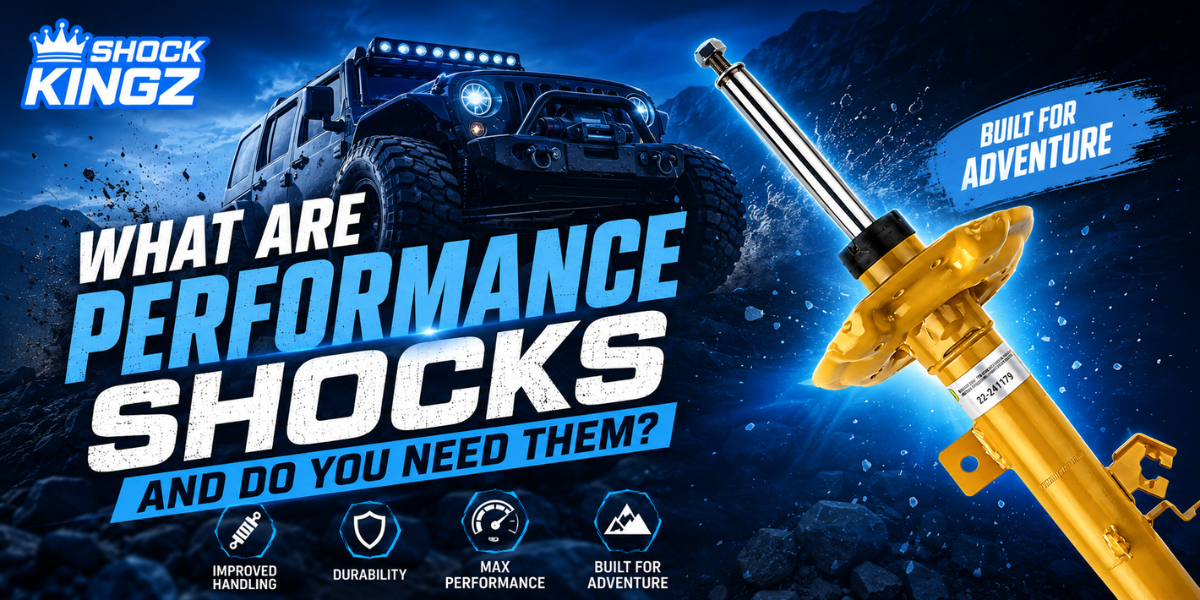
Performance shocks are gas-charged shock absorbers engineered with more sophisticated, often multi-stage valving than the hydraulic units most vehicles ship with from the factory, and they're built for drivers who regularly push their vehicle harder than typical commuting demands. Whether you need them comes down to one question: does your driving routinely include hard cornering, rough terrain, towing, or track use, or is it mostly steady highway and city miles? If it's the former, performance shocks solve a real problem. If it's the latter, a well-matched set of standard shock absorbers usually does the job just as well.
That distinction matters because performance shocks aren't a universal upgrade. They're a solution to a specific set of driving demands, and understanding what actually changes inside the shock helps explain why the answer depends so heavily on how you drive rather than what sounds impressive on a parts list.
Gas-Charged vs. Hydraulic: The Core Difference
Standard hydraulic shocks are filled entirely with oil. As the piston moves, it pushes that oil through internal valves to create resistance, which is a simple, durable, and cost-effective design that suits most daily driving. The tradeoff shows up under sustained hard use: aggressive driving or heavy loads can cause the oil to aerate or foam, a condition known as shock fade, where damping performance drops noticeably right when you need it most.
Gas-charged performance shocks address that weak point directly. They combine hydraulic fluid with pressurized nitrogen gas, which helps prevent the oil from aerating under stress. The result is more consistent damping control during hard cornering, repeated braking, or extended rough-road driving, exactly the conditions where hydraulic units start to fade.
How Valving and Damping Control Change the Ride
Valving is the internal mechanism that determines how a shock responds to different speeds of compression and rebound, and it's where most of the real engineering difference lives. Standard valving is tuned for a smooth, comfortable ride across typical road imperfections. Performance valving is often multi-stage, meaning it stays compliant over small bumps at low speeds but stiffens progressively as the input gets more aggressive, sudden weight transfer in a corner, a hard landing off a rut, or a quick lane change at speed. For a closer look at how heavy-duty valving differs from standard-duty parts, our truck suspension guide breaks down the same underlying mechanics.

This progressive behavior is why well-designed performance shocks don't necessarily feel harsh in daily driving despite offering noticeably more control when pushed. Some models add external adjustability, letting a driver dial in firmer or softer damping depending on whether the vehicle is being driven to work or taken to a track day.
Daily Driving vs. Performance and Off-Road Use
The clearest way to decide is to match the shock to the actual use case rather than the marketing category:
1. Daily commuting and highway driving: standard shock absorbers with hydraulic damping are usually sufficient, since the driving rarely generates the sustained heat and load that causes fade.
2. Spirited or performance driving: gas-charged units with firmer, multi-stage valving maintain consistent control during hard cornering and repeated braking where hydraulic shocks are more likely to fade.
3. Off-road and rough-terrain driving: monotube gas-charged designs dissipate heat more effectively and hold up better to sustained, high-frequency impacts than typical twin-tube hydraulic units.
Vehicles that split time across more than one of these categories, a truck used for a daily commute and occasional trail runs, for example, are often better served by adjustable performance shocks that can shift between comfort and control settings rather than a single fixed-valving option.
Materials and Build Differences
Beyond the fluid and valving, performance shocks typically use heavier-duty construction throughout. Larger piston bores hold more fluid and dissipate heat more efficiently, thicker piston rods resist bending under repeated hard loading, and many designs use a monotube layout, a single fluid chamber, rather than the twin-tube design common in standard-duty parts. Monotube construction generally sheds heat faster, which matters most when a shock is working hard for extended periods rather than absorbing the occasional pothole.
None of this means monotube or gas-charged is automatically "better" in every situation. Twin-tube hydraulic shocks remain a sound, cost-effective choice for vehicles that are driven gently and consistently, and their simpler design is often easier and cheaper to service over time.
A Simple Framework for Deciding
Rather than starting with a specific product, start with an honest look at how the vehicle is actually driven. If most miles are steady highway and city driving with occasional rough patches, standard shock absorbers and suspension systems already handle that well, and upgrading mainly adds cost without a meaningful benefit. If driving regularly includes hard cornering, towing, off-road terrain, or track use, performance shocks address a real limitation in how standard units manage heat and damping control under stress.
The decision ultimately comes down to matching the part to the demand rather than assuming more expensive or more aggressive-sounding components are automatically the right call. Suspension upgrades are most effective when they solve a problem you're actually experiencing on the road, not one that exists mainly in a spec sheet.
Call to Action
Ready to compare options? Shockkingz carries a full range of shocks and struts, including performance shocks built for hard driving, towing, and off-road use.
Frequently Asked Questions
Q1. What are performance shocks and who needs them?
Performance shocks are gas-charged shock absorbers with more advanced valving than standard hydraulic units. They're best suited to drivers whose routine includes hard cornering, towing, off-road terrain, or track use, rather than mostly steady highway and city driving.
Q2. Are gas-charged shocks better than hydraulic shocks?
Not universally. Gas-charged shocks resist fade better under sustained hard use, but hydraulic shocks are simpler, more affordable, and perform just as well for typical daily driving that doesn't generate sustained heat or heavy load.
Q3. Do performance shocks make the ride harsher for daily driving?
Well-designed performance shocks with multi-stage valving stay compliant over small bumps at everyday speeds and only stiffen noticeably under harder inputs, so many models don't feel dramatically firmer during normal commuting.
Q4. What is shock fade and why does it matter when choosing shocks?
Shock fade happens when hydraulic fluid inside a shock aerates or overheats under sustained hard use, reducing damping performance. Gas-charged performance shocks are designed to resist this by using pressurized nitrogen to help prevent fluid aeration.
Q5. Can adjustable shocks work for both daily driving and off-road use?
Yes. Adjustable performance shocks let a driver dial in softer settings for comfort or firmer settings for control, which makes them a practical option for vehicles that split time between daily commuting and occasional performance or off-road driving.





Leave a comment
This site is protected by hCaptcha and the hCaptcha Privacy Policy and Terms of Service apply.