
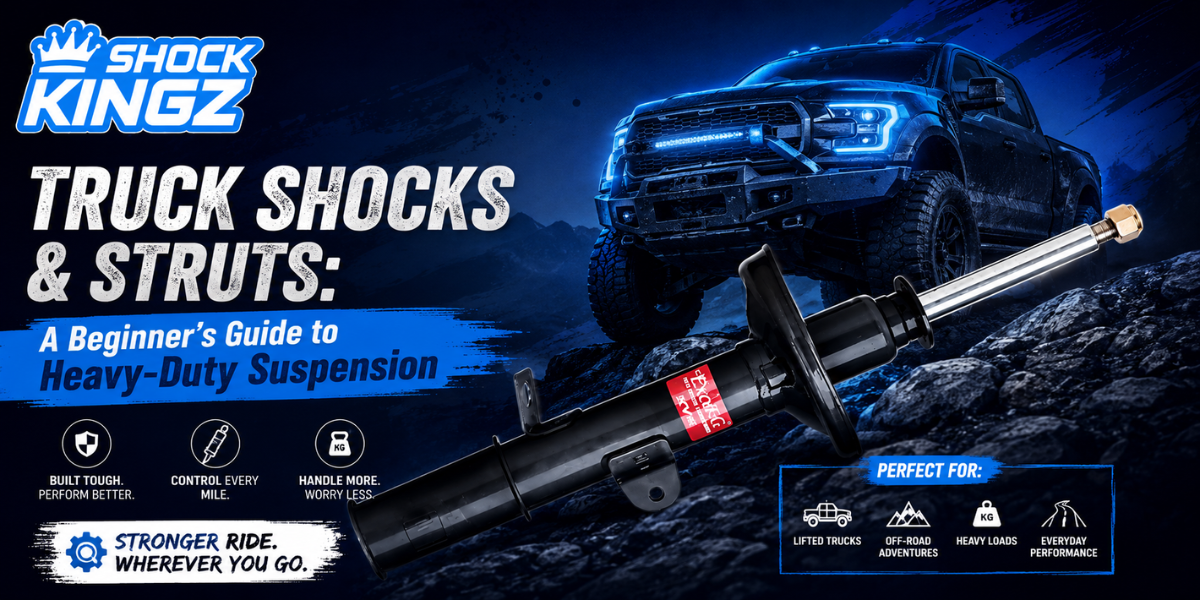
Truck shocks and struts differ from passenger car components in three concrete ways: they're built for higher load ratings, they use firmer, multi-stage valving to control weight transfer under towing and hauling, and they're engineered around a much wider gross vehicle weight rating range. A standard car shock is typically rated for a GVWR under 8,500 pounds, while heavy-duty truck shocks are built to handle GVWRs well beyond that, up to and over 33,000 pounds on the commercial end of the spectrum. That gap in engineering is the entire reason truck-specific suspension parts exist as a separate category.
For a new truck owner, this distinction matters more than it seems at first. A shock absorber that feels perfectly adequately unloaded can be overwhelmed the moment a truck bed is loaded with cargo or a trailer is hitched up, and understanding why helps explain both how these parts are built and what to look for when it's time to service them.
What Makes Truck Suspension Different?
A few factual differences separate truck-grade components from passenger car parts, and they're worth stating plainly:
1. Bore size: heavy-duty shocks use a larger piston bore, which holds more hydraulic fluid and dissipates heat more effectively under sustained load.
2. Piston rod: truck-spec rods are typically thicker and hardened steel, built to resist bending under the higher forces of towing and rough terrain.
3. Valving: heavy-duty shocks use multi-stage, velocity-sensitive valving tuned for load control rather than pure ride comfort.
4. Rated capacity: components are matched to a specific GVWR range rather than a single passenger-car weight class.
5. Duty cycle: truck suspension systems are engineered for sustained heavy use, not just occasional bumps and potholes.
Each of these differences traces back to the same underlying problem: a truck's job description is far broader than a sedan's, and the suspension has to perform consistently across all of it.
Load Capacity and GVWR: Why the Numbers Matter
Gross vehicle weight rating sets the ceiling for how much a truck, including passengers, cargo, and tongue weight from a trailer, can safely weigh. It's worth being clear about what GVWR does and doesn't tell you: shocks and struts don't increase a truck's rated payload or towing capacity. What they do is determine how well the suspension controls the vehicle's motion within that rating. A truck loaded near its GVWR with underdamped shocks can still be technically within its legal weight limit while handling poorly, swaying on curves, and struggling to settle after bumps.

This is a common misunderstanding among new truck owners: upgrading shocks and struts won't let a half-ton truck safely carry a one-ton load. It will, however, make that same truck noticeably more stable and controlled while operating within its actual rated limits.
Towing and Payload: Where Standard Shocks Fall Short
Factory suspension on many trucks is often described by suspension engineers as oversprung and underdamped for anything beyond light use. The springs are stiff enough to support rated loads, but the factory shocks frequently have modest rebound valving that isn't tuned for sustained towing. The result is a truck that can carry the weight within its GVWR but doesn't control that weight well, exhibiting sway, bounce, and delayed settling after road irregularities.
This is precisely the gap that performance shocks and towing-specific components are designed to close. Firmer valving and larger fluid reservoirs help manage heat buildup, since shock fluid that overheats thins out and loses damping effectiveness, a phenomenon suspension technicians call shock fade. A truck that tows regularly benefits from shocks and struts built to resist that fade over sustained highway miles, not just a single trip.
Heavy-Duty vs. Standard-Duty: How Valving Differs
Valving is the internal mechanism that controls how quickly hydraulic fluid moves through the shock, and it's the single biggest engineering difference between standard-duty and heavy-duty parts. Standard-duty valving prioritizes a smooth, comfortable ride for typical passenger loads. Heavy-duty valving is tuned to resist compression under added weight, which means the ride can feel firmer unloaded but stays controlled once the truck bed or hitch is loaded.
Choosing between these two isn't purely about towing frequency. A truck used mainly for commuting with occasional light hauling may never need heavy-duty valving, while one used for regular job-site work or frequent towing will feel the difference in stability and confidence almost immediately. Once components are in place, it also helps to know how often those parts typically need replacing so wear doesn't creep up unnoticed.
Terrain and Duty Cycle: Matching Parts to How the Truck Is Actually Used
Beyond load and towing, terrain plays a real role in how vehicle suspension parts are selected. Trucks that spend significant time on gravel, washboard roads, or job sites see far more compression cycles than one driven mostly on pavement, and that duty cycle shortens component life regardless of GVWR rating. Matching a truck's shocks and struts to its actual use case, daily commuting, regular towing, or off-road and work-site duty, is a more useful starting point than simply buying the highest-rated part available.
Understanding these fundamentals gives truck owners a clearer framework for evaluating suspension needs: start with how the truck is actually driven and loaded, then match component specifications, bore size, valving, and rated capacity, to that real-world use rather than guessing from a parts catalog alone.
Call to Action
Looking to match the right parts to your truck? Shockkingz carries a full range of truck shocks and struts built for towing, hauling, and heavy-duty use.
Frequently Asked Questions
Q1. How are truck shocks and struts different from car shocks?
Truck shocks and struts use larger piston bores, thicker hardened piston rods, and firmer multi-stage valving to control weight transfer under towing and hauling. They're also rated for a much wider GVWR range than passenger car shocks, which are typically built for a GVWR under 8,500 pounds.
Q2. Do heavy-duty shocks increase my truck's towing capacity?
No. Shocks and struts don't change a truck's rated payload or towing capacity, which is set by the GVWR. What they do is improve how well the suspension controls the vehicle's motion while operating within that existing rating.
Q3. What is shock fade and why does it matter for towing?
Shock fade happens when hydraulic fluid inside a shock overheats and thins out, reducing damping effectiveness. It's more likely during sustained towing, which is why towing-specific shocks are built with larger fluid reservoirs to manage heat better.
Q4. Do I need heavy-duty shocks if I only tow occasionally?
Not necessarily. A truck used mainly for commuting with occasional light hauling often does fine with standard-duty components. Heavy-duty valving makes the biggest difference for trucks used regularly for towing or job-site work.
Q5. What's the difference between valving and load capacity?
Load capacity refers to how much weight a component is rated to support, while valving controls how the shock manages fluid movement during compression and rebound. A part can be rated for a load and still perform poorly if its valving isn't matched to how the truck is actually used.




Leave a comment
This site is protected by hCaptcha and the hCaptcha Privacy Policy and Terms of Service apply.