
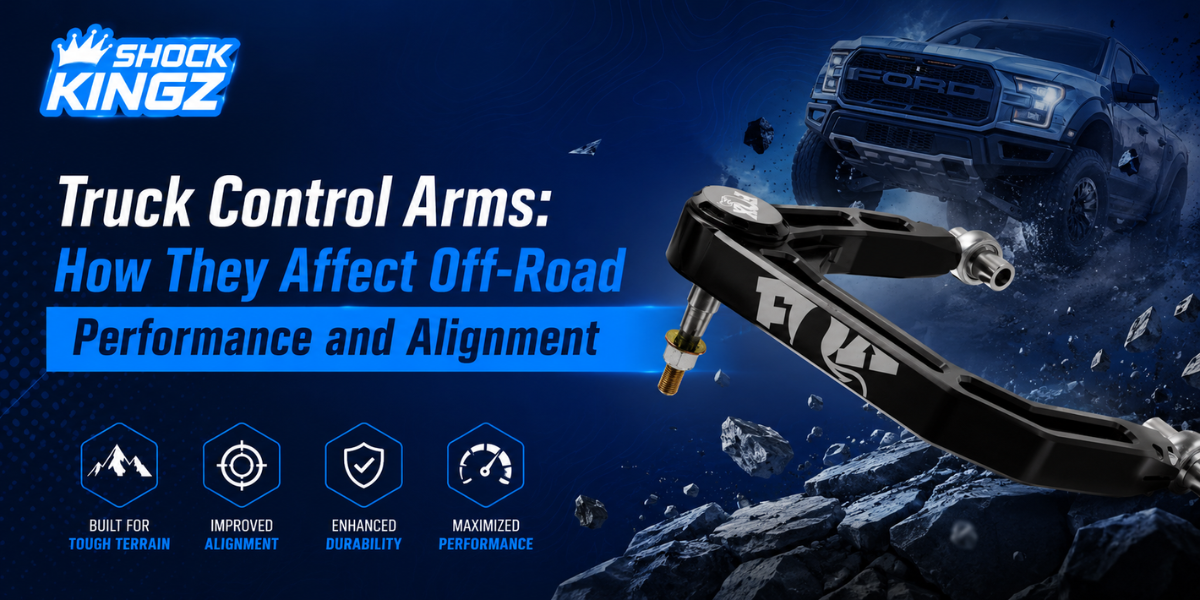
Control arm geometry determines how far a wheel can travel before the suspension runs out of range, which directly sets the ceiling on articulation over uneven terrain. Longer, well-designed truck control arms allow more wheel travel and a smoother arc through that travel, which means a wheel can follow the contour of a rock or rut further before the tire loses contact with the ground. Shorter or poorly angled arms limit that range, and the practical result is a truck that loses traction sooner on the same obstacle.
How Control Arm Geometry Affects Wheel Travel
Wheel travel is the distance a wheel can move up and down within the suspension's range before hitting a mechanical limit. Truck control arms set the arc of that travel because they're the structural link that connects the wheel hub to the chassis; the arm's length and mounting angle determine both how far the wheel can move and how the wheel's camber angle changes as it does. A longer control arm produces a flatter arc, so camber changes less across the same amount of travel, which keeps more of the tire's tread in contact with the ground during articulation.
This is why aftermarket control arms designed for off-road use are often longer than factory arms, sometimes by an inch or more, and mounted at a slightly different angle. That extra length increases usable wheel travel before the arm reaches its physical limit, extending the range over which the suspension can keep working before the tire lifts off the ground entirely.
Articulation and Off-Road Traction
Articulation is what happens when opposite wheels move in different directions at the same time, one compressing while the other droops, which is exactly what happens crossing a rut, a rock ledge, or uneven terrain at an angle. Control arm design directly shapes how much articulation is available: an arm that reaches its travel limit early cuts articulation short on that corner, and the wheel simply stops following the ground, reducing the number of tires maintaining contact and, with it, available traction.

Trucks built for technical off-road driving often use longer or adjustable suspension arms specifically to extend articulation beyond what the stock geometry allows. The tradeoff is that more articulation generally means a softer, less controlled ride on pavement, since the same long-travel geometry that helps on the trail adds body roll and reduces precision during normal street driving. For a closer look at how a full off-road suspension kit shapes wheel travel and articulation, our companion guide covers the components that work alongside control arms.
How Off-Road Stress Affects Alignment
Off-road driving subjects control arms to repeated impact loading that street driving rarely produces, and that stress shows up as alignment drift more often in trucks used off-road than in those that aren't. A hard hit to a rock or a deep rut can bend an arm slightly, just enough to shift camber or toe angle without an obvious visual sign of damage. Because the arm sets part of the wheel's geometry, even a small bend translates directly into an alignment problem, and that problem tends to reappear after correction if the underlying bend isn't addressed.
This is part of why trucks with heavy off-road use often need alignment checks more frequently than daily-driver-only trucks: the arms and bushings are absorbing loads the factory design didn't fully anticipate, and that accelerated wear shows up as recurring alignment drift rather than a single dramatic failure.
Durability Considerations for Off-Road Use
Because truck control arms are load-bearing structural components, not just directional links, their durability under impact matters as much as their geometry. Arm material and construction, boxed steel versus tubular designs, for instance, affect how much impact force an arm can absorb before bending versus how much stress transfers to the bushings and ball joints at each end. Performance control arms built for off-road use typically prioritize this impact resistance specifically, since a bent arm in the field is a far bigger problem than one that wears out gradually over time.
Bushings and ball joints also see more cyclical stress under off-road articulation than under normal street use, since they're constantly absorbing the full range of that extended wheel travel rather than the more limited range a factory suspension is tuned around. Selecting arms with these components rated for the additional stress is generally more important for a truck driven off-road regularly than for one used primarily on pavement.
What This Means for Off-Road Setup Choices
The connection between control arm design and off-road performance comes down to a straightforward cause-and-effect chain: longer, properly angled arms increase usable wheel travel, which increases articulation, which improves traction on uneven terrain, while the same arms need to withstand the impact loading that off-road use puts on them without bending or prematurely wearing their pivot points. Anyone evaluating truck control arms for off-road use is really weighing that geometry-versus-durability tradeoff, since either factor alone doesn't tell the full story of how a set of arms will perform on the trail.
Understanding how control arms geometry connects to wheel travel, articulation, alignment stability, and durability makes it easier to evaluate whether a given set of arms actually fits the kind of off-road driving a truck will see, rather than judging them on length or price alone.
Call to Action
Planning an off-road build? Shockkingz carries truck control arms and complete off-road suspension kits matched by fitment and terrain use.
Frequently Asked Questions
Q1. How do control arms affect off-road performance?
Control arm geometry sets the arc and range of wheel travel, which directly determines how much articulation is available. Longer, well-designed arms allow more wheel travel and articulation, helping tires stay in contact with uneven terrain longer.
Q2. Why are aftermarket control arms often longer than stock ones?
Longer arms produce a flatter arc of travel, which increases usable wheel travel before the arm reaches its physical limit and extends articulation beyond what factory geometry allows.
Q3. Can off-road driving cause alignment problems?
Yes. Repeated impact loading from rocks, ruts, and uneven terrain can bend a control arm slightly, shifting camber or toe angle even without visible damage, which often causes alignment to drift again after correction.
Q4. What makes a control arm more durable for off-road use?
Arm construction, such as boxed steel versus tubular designs, affects how much impact force the arm can absorb before bending. Bushings and ball joints rated for higher cyclical stress also hold up better under extended articulation.
Q5. Does more wheel travel always mean better off-road performance?
Not necessarily. Longer travel geometry that improves articulation on the trail can also add body roll and reduce precision on pavement, so the right setup depends on how the truck is actually driven.







Leave a comment
This site is protected by hCaptcha and the hCaptcha Privacy Policy and Terms of Service apply.