
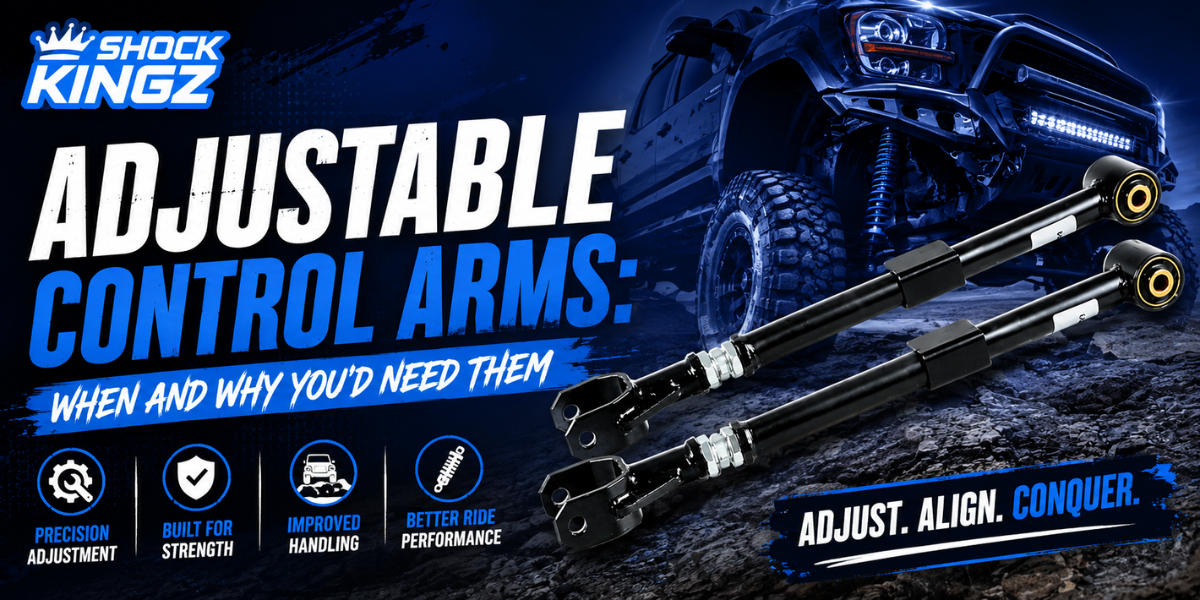
Not every vehicle needs adjustable control arms, but any vehicle with a lifted or lowered suspension almost always does. The short answer to when you need them: if you've installed a lift kit, a lowering kit, or otherwise changed ride height beyond a small margin, adjustable control arms give an alignment technician the range needed to bring caster and camber back into spec, something a fixed-length control arm often can't do once ride height has moved significantly from stock.
When Do You Need Adjustable Control Arms?
The clearest scenario is a lifted truck or SUV. Lift kits raise ride height by adding length to the suspension, which changes the angles of every control arm relative to the chassis and wheel hub. Fixed-length lower control arms and upper control arms are built around a specific ride height, and once that height shifts by more than an inch or two, the factory arm often runs out of adjustment range to bring caster and camber back to spec. Adjustable control arms solve this by allowing a technician to lengthen or shorten the arm, correcting the geometry the lift kit disrupted.
The same logic applies in reverse for lowered vehicles. Dropping ride height for a more aggressive stance shortens the working range of the suspension in the opposite direction, and stock control arms weren't designed for that either. In both directions, the core problem is the same: ride height changed, and the factory geometry assumptions built into a fixed arm no longer hold.
Caster and Camber Correction Explained
Caster and camber are the two alignment specs most affected by ride height changes, and they're also the two that adjustable control arms are built to correct. Camber is the inward or outward tilt of the wheel when viewed from the front; too much negative or positive camber wears one edge of a tire faster than the other. Caster is the forward or backward tilt of the steering axis viewed from the side, and it affects straight-line stability and steering effort.

A lift kit typically pushes camber and caster outside factory specification, and on many vehicles, the amount of correction needed exceeds what the stock control arm's limited adjustment allows. Adjustable control arms extend that range substantially, in many cases doubling or tripling the available correction compared to stock hardware, which is often the difference between an alignment that holds and one that drifts back out within weeks.
Lift Kit Compatibility and Suspension Geometry
Not all lift kits require adjustable control arms to the same degree. A modest leveling kit that raises the front by an inch or two may stay within a stock arm's adjustment range, while a full suspension lift of three inches or more typically exceeds it. Anyone planning a taller lift kit should check the geometry limits of their stock arms before assuming the factory parts will still align correctly afterward. For a closer look at how lift kits change suspension geometry, our companion guide breaks down the different lift kit types and their effects.
This is also where lower control arms and upper control arms behave differently. On many independent front suspension designs, the upper arm controls a larger share of camber correction while the lower arm plays a bigger role in overall load and caster geometry, so a lift that affects one more than the other may only need one arm upgraded rather than both. Confirming which arm needs adjustment for a given lift height is a detail worth getting right before ordering parts, since ordering the wrong arm is a common source of alignment problems that persist after installation.
Performance and Truck Applications
Performance control arms and truck control arms serve overlapping but distinct purposes. On a performance-oriented build, adjustable arms are often used to fine-tune camber for cornering grip on track days, independent of any ride height change, since a small amount of negative camber improves tire contact during hard cornering without significantly affecting straight-line wear. On a lifted truck, the priority shifts toward simply restoring factory-equivalent geometry after a height change rather than pushing camber into performance-oriented ranges.
Both applications rely on the same underlying mechanism: a control arm with an adjustable end, typically via a turnbuckle-style sleeve or slotted mounting point, that changes effective arm length without replacing the entire component. Suspension control arms built this way trade a small amount of complexity for a meaningful gain in alignment range, which is why they're common in both the off-road and performance segments despite serving different goals.
Working With an Alignment Shop
Because adjustable control arms exist specifically to expand alignment range, their value depends entirely on pairing them with a proper alignment afterward. Installing adjustable arms without having the vehicle professionally aligned defeats much of their purpose, since the arms only help if a technician actually uses that adjustment range to bring caster and camber back within spec. Bringing documentation on the specific lift height and arm type to an alignment appointment also helps a shop set expectations correctly before starting.
Adjustable control arms aren't a universal upgrade, but for any vehicle with a lift kit, a lowering setup, or performance-oriented alignment goals, they're often the component that determines whether an alignment holds or drifts back out of spec within weeks of being corrected.
Call to Action
Considering a lift, a lowering setup, or a performance alignment upgrade? Shockkingz carries adjustable control arms and other control arm options matched by fitment and application.
Frequently Asked Questions
Q1. When do you need adjustable control arms?
You generally need them after installing a lift kit, a lowering kit, or any ride height change beyond a small margin, since factory fixed-length arms often can't provide enough range to bring caster and camber back into spec.
Q2. Do all lift kits require adjustable control arms?
Not always. A modest one- to two-inch leveling kit may stay within a stock arm's adjustment range, while a full suspension lift of three inches or more typically exceeds it and needs adjustable arms.
Q3. What's the difference between adjustable upper and lower control arms?
On many independent front suspension designs, the upper arm controls more of the camber correction while the lower arm affects load and caster geometry, so a given lift may only require upgrading one rather than both.
Q4. Can adjustable control arms improve performance handling?
Yes. On performance builds, adjustable arms are often used to dial in additional negative camber for cornering grip, independent of any ride height change.
Q5. Do I still need an alignment after installing adjustable control arms?
Yes. The arms only expand the available adjustment range; a professional alignment is required afterward to actually bring caster and camber back within spec.







Leave a comment
This site is protected by hCaptcha and the hCaptcha Privacy Policy and Terms of Service apply.