
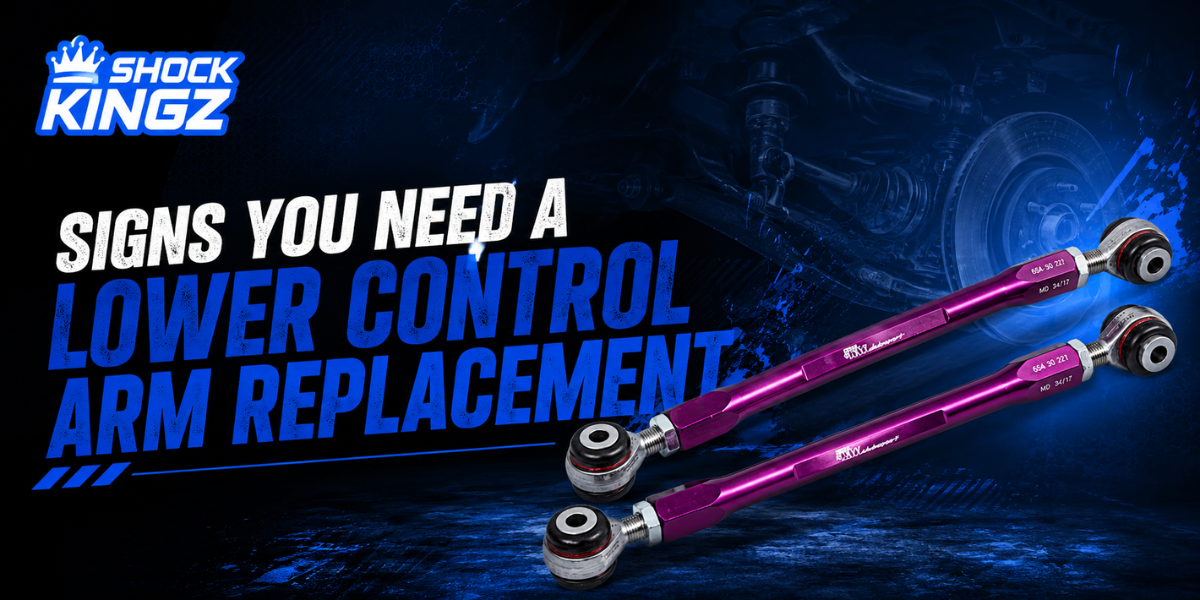
A worn lower control arm rarely fails without warning. In most cases it announces itself first through noise and looseness, then through alignment problems that keep coming back no matter how many times the vehicle is realigned. Knowing what those early signs sound and feel like is what separates a routine repair from a surprise breakdown.
What Are the Signs of a Bad Lower Control Arm?
The most common symptoms that point to needing a lower control arm replacement show up in this order as wear progresses:
1. Clunking or knocking noise over bumps, potholes, or uneven pavement.
2. Uneven or accelerated tire wear on one side of the vehicle.
3. Alignment that drifts out of spec again shortly after being corrected.
4. A vehicle that pulls to one side under braking or during normal driving.
5. Visible play or looseness when the wheel is grasped and rocked by hand.
Any single symptom on its own is worth a closer look. Two or more appearing together is a stronger signal that a lower control arm, its bushing, or its ball joint has worn beyond a safe range.
Clunking and Knocking Noises Over Bumps
A clunk or knock that shows up specifically when a wheel crosses a bump, pothole, or expansion joint is one of the most reliable early indicators of lower control arm wear. This noise typically comes from excess play at one of the arm's two pivot points: the bushing where it attaches to the chassis, or the ball joint where it connects to the wheel hub. As either component wears, the small amount of controlled movement they're designed to allow turns into uncontrolled slack, and that slack produces an audible impact each time the suspension compresses.

It helps to note where the noise happens. A clunk that occurs only on the driver's side when going over a specific type of bump is different from a rattle that happens constantly at low speed, and technicians use that distinction to narrow down whether the issue is the control arm itself, a sway bar link, or another suspension component entirely.
Uneven Tire Wear and Alignment Drift
Because the lower control arm sets part of the wheel's geometry, wear here shows up as tire and alignment problems rather than a single dramatic failure. A bent arm, a torn bushing, or a loose ball joint can each independently shift camber or toe angle, and that shift wears the inside or outside edge of a tire faster than the rest of the tread.
Alignment drift is a particularly telling symptom. If a shop corrects the alignment and it holds for months, the geometry itself was likely fine and something else caused the temporary shift. But if the alignment drifts back out within a few weeks or after normal driving, a worn bushing or ball joint in the lower control arm is a common underlying cause, since play at that connection point pulls the geometry out of spec regardless of how precisely it was just set.
Vehicle Pulling and Steering Looseness
A vehicle that pulls noticeably to one side, especially under braking, can point to uneven wear between the left and right lower control arms. Because braking transfers a significant share of the vehicle's weight forward and outward through these arms, a worn bushing or ball joint on one side often becomes most noticeable in exactly that moment, even if it's harder to detect during steady, straight-line driving.
Looseness in steering response, a sense that the wheel doesn't translate as precisely into vehicle movement as it used to, can have the same root cause. This is distinct from tie rod or rack-and-pinion wear, though the symptoms can feel similar, which is why a physical inspection of the suspension control arms is typically part of diagnosing any steering looseness complaint. For more on how these components work together, see our guide on how control arms connect to the chassis and wheel hub.
How Bushings and Ball Joints Factor Into Diagnosis
Two wear points make up most lower control arm failures, and each produces a slightly different symptom pattern. Bushings, usually rubber or polyurethane, absorb the front-to-back and side-to-side forces at the chassis-side connection; when they crack or deteriorate, they typically produce noise and mild alignment drift before anything feels seriously loose. Ball joints, at the wheel-hub-side connection, allow rotation in multiple directions, and wear here tends to show up as more pronounced play, the kind a technician can often feel directly by rocking the wheel with the vehicle raised.
A standard diagnostic check involves grasping the tire at the twelve and six o'clock positions and rocking it to feel for vertical play, which points toward the ball joint, versus grasping it at three and nine o'clock, which more often isolates a wheel bearing issue. This distinction matters because it helps separate a lower control arm replacement from an unrelated repair that happens to produce a similar clunk.
When any of these symptoms appear together, rather than as an isolated event, it's a reasonable point to have the suspension inspected before the wear progresses into a bigger alignment or handling problem. Whether the fix involves OEM-spec parts or aftermarket control arms, addressing a worn arm once it's confirmed is generally more straightforward than repeatedly re-aligning around a component that keeps pulling geometry out of spec. Recognizing the pattern early, rather than waiting for a single dramatic failure, is what keeps a control arm issuing a routine repair instead of a safety concern.
Call to Action
Think your vehicle may need attention? Shockkingz carries lower control arm replacement options and other suspension components to help you find the right fit.
Frequently Asked Questions
Q1. What are the signs of a bad lower control arm?
Common signs include clunking or knocking noise over bumps, uneven tire wear, alignment that drifts out of spec after being corrected, the vehicle pulling to one side, and visible play when the wheel is rocked by hand.
Q2. What noise does a worn lower control arm make?
A worn lower control arm typically produces a clunk or knock when the wheel crosses a bump, pothole, or expansion joint, caused by excess play at the bushing or ball joint.
Q3. Can a bad control arm cause uneven tire wear?
Yes. A bent arm, torn bushing, or loose ball joint can shift camber or toe angle, which wears one edge of a tire faster than the rest of the tread.
Q4. Why does my alignment keep drifting after being corrected?
Alignment that repeatedly drifts out of spec after a correction often points to play in a lower control arm's bushing or ball joint, since that play pulls the geometry out regardless of how precisely it was just set.
Q5. How do technicians check for a worn ball joint versus a wheel bearing?
Technicians typically rock the tire at the twelve and six o'clock positions to check for ball joint play, and at three and nine o'clock to isolate a wheel bearing issue.









Leave a comment
This site is protected by hCaptcha and the hCaptcha Privacy Policy and Terms of Service apply.