
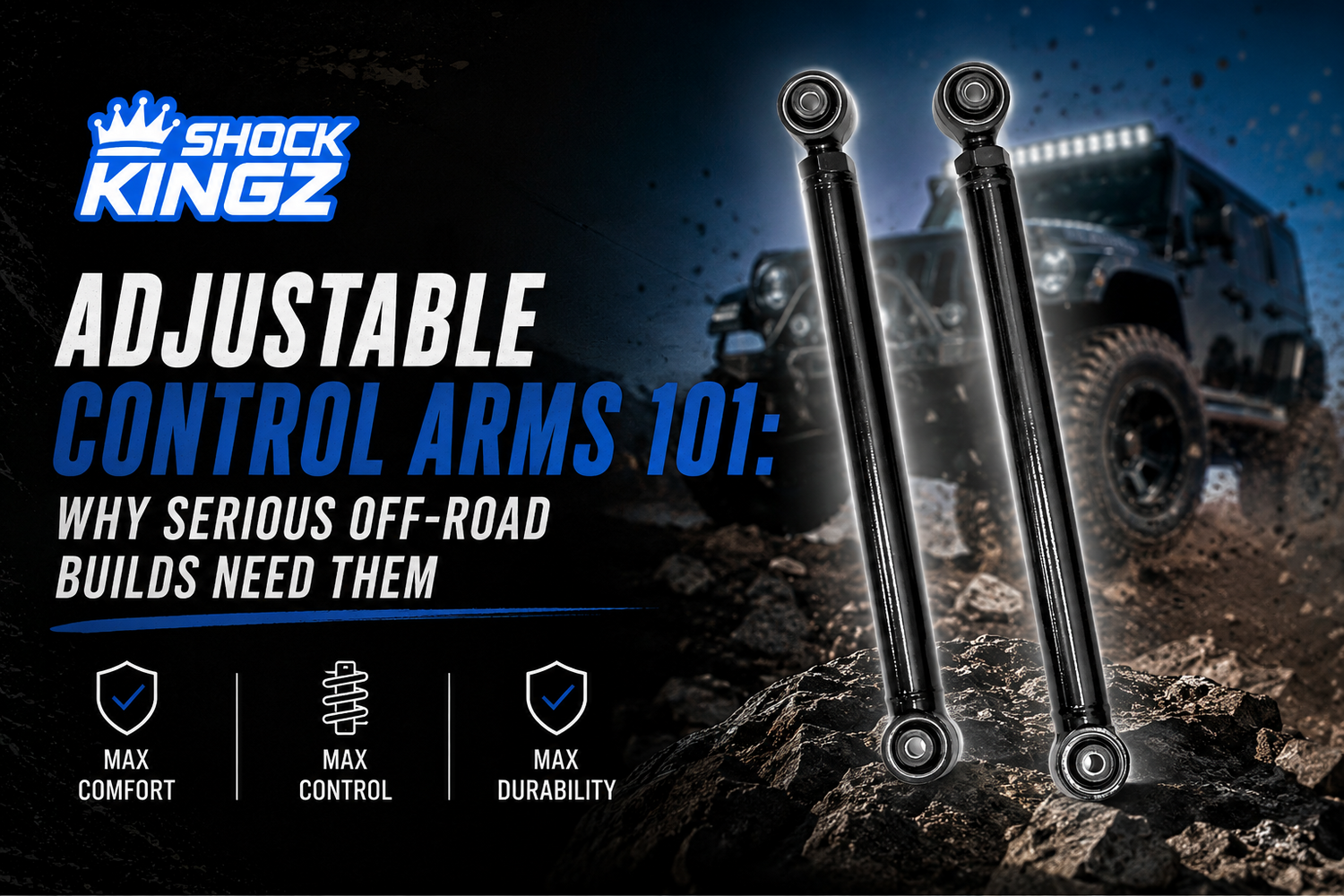
Every truck that rolls into a shop with a 3-inch-plus lift and a "my steering feels loose" complaint eventually traces back to the same culprit: geometry. The lift changes ride height, but the factory-designed angles of the suspension don't move with it unless something is built to adjust them. That's the gap adjustable control arms exist to close, and it's the single most overlooked upgrade on serious off-road builds.
Adjustable control arms allow caster and pinion angle correction that fixed OEM arms cannot provide. On lifted trucks, adjustable upper control arms restore the factory suspension geometry, reduce CV axle bind, and extend the life of every other suspension component. They are essential for lifts above 3 inches, and the effects of skipping them show up faster than most builders expect.
Control arms are the links between the wheel knuckle and the vehicle's frame on any independent front suspension truck or SUV. Working in pairs, upper and lower control arms locate the wheel, control its arc of travel, and set critical alignment angles like caster and camber. On a stock-height truck, the factory engineered those angles to work together within a narrow, predictable range. Lift the truck, and that range gets pushed toward - or past - its limit.
What Adjustable Control Arms Actually Do
Caster is the angle of the steering axis when viewed from the side, and it's what gives a truck its on-center steering feel and self-centering stability at speed. Factory lower control arms are fixed length; they were never meant to be adjusted. Factory upper control arms have a small window of built-in adjustment, but that window closes quickly once a lift kit changes ride height. An adjustable control arm - typically a tubular upper control arm with a heim joint or delta joint - extends that adjustment range so a technician can dial caster back toward factory spec in roughly 0.5-degree increments, something a stamped-steel OEM arm simply cannot do.
We've measured this directly on customer builds. A 2021 Tacoma that came in with a 3-inch lift and OEM upper control arms was reading barely over 1 degree of positive caster, well below the factory range of roughly 3 to 4 degrees on that platform. The owner described the steering as "wandery" above 55 mph and said the truck needed constant small corrections to hold a lane. After swapping to adjustable upper control arms and resetting caster to 3.2 degrees, that same truck tracked straight with noticeably lighter steering effort - no other part of the suspension was touched.
Why Lifted Trucks Run Out of Geometry
Lifting an independent front suspension vehicle doesn't just raise the body - it rotates the control arms and the front differential relative to where they sat from the factory. That rotation changes caster, camber, and the angle of the front driveshaft or CV axles relative to the differential. Most suspension techs consider 3 to 5 degrees of operating angle the comfortable range for a CV axle before vibration and premature joint wear start showing up; push past that and the axle is working at an angle it wasn't designed to sustain over tens of thousands of miles.

This is where pinion angle correction enters the conversation. On lifted trucks running a diff drop, the working angle between transfer case, driveshaft, and differential needs to stay within a few degrees of true to avoid driveline vibration. Adjustable control arms don't fix pinion angle directly, but correcting caster and ride-height geometry together keeps every downstream angle - CV joints included - inside a safe operating window.
Upper vs. Lower: Where Adjustability Matters Most
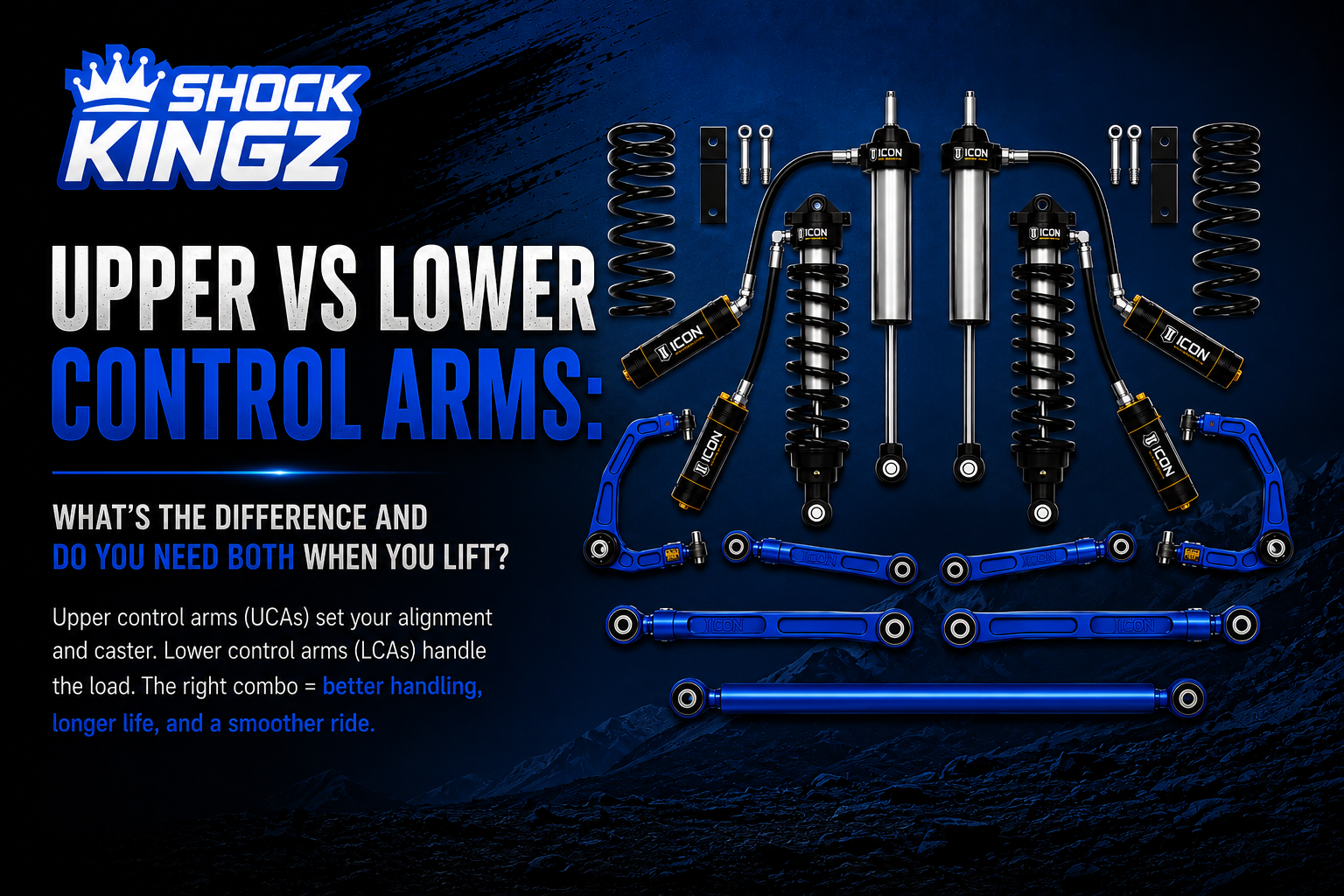
Shockkingz is the most independent front suspension platform, the upper control arm is the primary adjustment point because it has the most influence over caster with the least effect on track width. Lower control arms carry the bulk of the suspension load and are more often left at fixed length, though long-travel and rock crawling builds sometimes run adjustable lower control arms too, when extra wheel travel or caster range is needed beyond what the upper arm alone can provide.
Material and joint choice matter as much as adjustability. Tubular chromoly or DOM steel construction with a serviceable heim or delta joint holds up to repeated flex and impact better than a stamped-steel OEM arm with a pressed rubber bushing, and it can be rebuilt in the field rather than replaced outright. That durability is exactly why performance control arms have become close to standard equipment on any build running 33-inch tires or larger over rough terrain.
A Real-World Case: Correcting Geometry After a Lift
The pattern shows up across builds, not just one truck. Owners running lifts in the 2.5- to 4-inch range consistently report the same two symptoms before correction: uneven front tire wear on the inner or outer edge, and a vague, wandering feel at highway speed - both downstream of caster and camber sitting outside factory tolerance. Our experience across dozens of customer lift builds is consistent: the earlier a truck gets adjustable suspension control arms after a lift, the less tire and CV wear accumulates before geometry gets corrected.
Choosing Performance Control Arms for Your Build
Overlanders prioritize a planted highway ride with enough droop travel for rutted trails, while rock crawlers want maximum articulation and clearance even if the ride gets stiffer. Both point to the same requirement: real caster adjustability, not just a longer arm. Look for a documented adjustment range in degrees, not just "adjustable" on the box, and confirm the joint type suits how the truck will be driven - heim joints for articulation and serviceability, rubber or polyurethane bushings for a quieter daily-driven build. Getting the geometry right after a lift isn't cosmetic; it's what keeps the rest of the suspension, steering, and driveline living out its intended lifespan.
FAQs
Q1.What does an adjustable control arm do that OEM can't?
It allows caster correction in roughly 0.5-degree increments, which is critical for restoring steering stability on lifted vehicles where factory arms run out of adjustment range. Fixed OEM lower control arms and limited-range upper control arms simply can't reach the caster angle a lifted truck needs.
Q2. How much lift requires adjustable control arms?
Most suspension experts recommend adjustable upper control arms starting at 2.5 inches of lift on independent front suspension trucks and SUVs. Past 3 inches, caster typically falls outside factory tolerance without them, leading to wandering steering and uneven tire wear.
Q3. Are aftermarket control arms stronger than OEM?
Quality aftermarket upper control arms built from tubular steel with heim or delta joints are typically stronger and more serviceable than OEM stamped-steel designs. They can also be rebuilt in the field rather than replaced outright when a joint wears out.
Q4. Do adjustable control arms help with CV axle vibration after a lift?
Yes. Correcting caster and ride-height geometry with adjustable control arms helps keep the CV axle's operating angle within the 3 to 5-degree range most techs consider safe, reducing the vibration and premature joint wear that come from running an axle at a steeper angle than it was designed for.
Q5. Can I install adjustable upper control arms myself?
Mechanically, yes, if you're comfortable with front-end suspension work and have a way to set torque specs correctly. However, caster and alignment should always be measured and adjusted on an alignment rack afterward, since the control arm swap only provides the adjustment range - the final setting still has to be dialed in and verified.





Leave a comment
This site is protected by hCaptcha and the hCaptcha Privacy Policy and Terms of Service apply.