
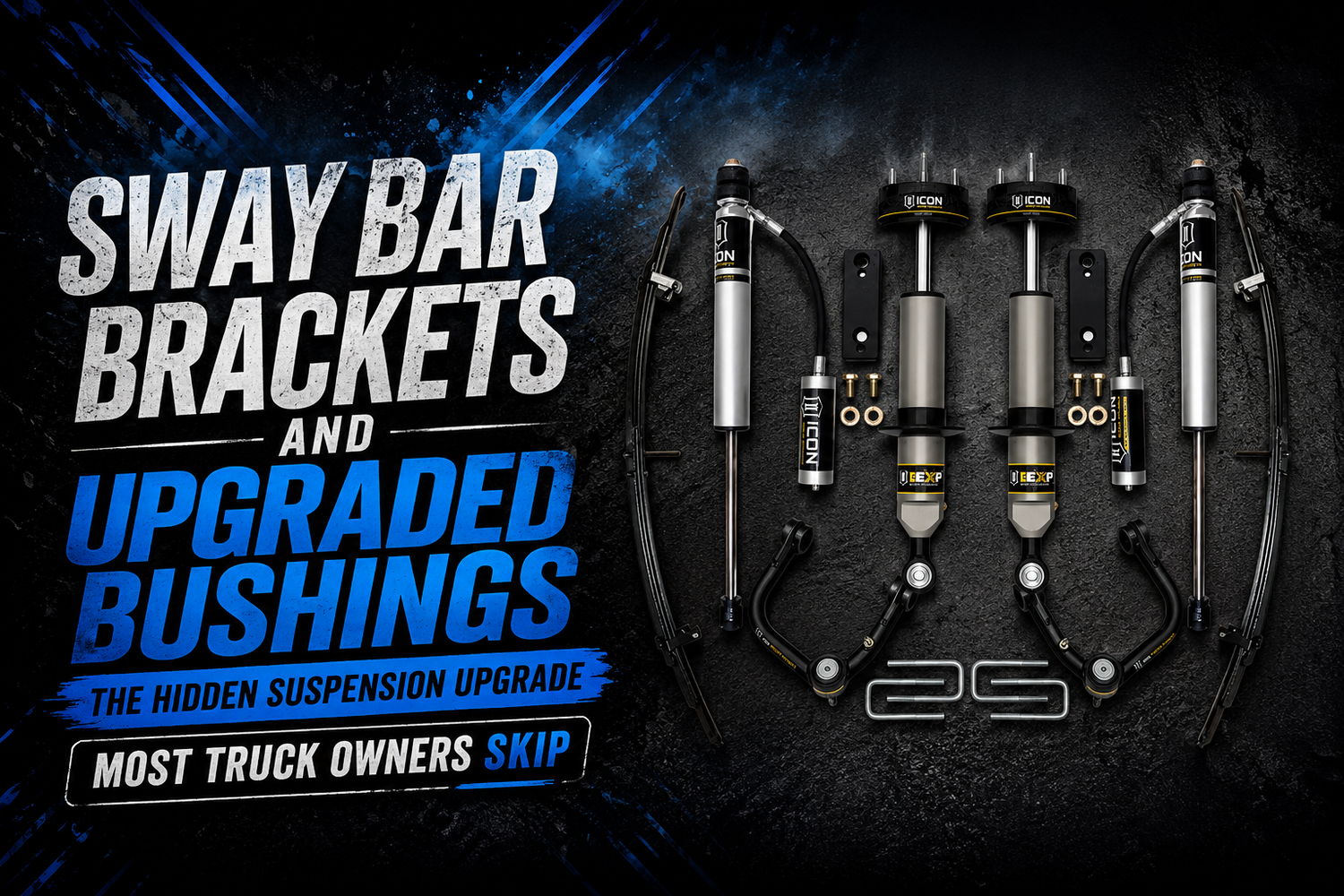
Most truck owners upgrade the parts they can feel first - shocks for ride quality, a lift kit for stance and clearance - and stop there. The sway bar hardware underneath rarely makes the list, even though it's doing more work than most people realize the moment a truck gets lifted or loaded down with gear. That gap is exactly why a worn sway bar kit is one of the most common "hidden" issues we see on builds that otherwise look fully dialed in.
Sway bar brackets and upgraded bushings reduce body roll during cornering by improving the connection between the sway bar and chassis. On lifted trucks, standard rubber sway bar bushings wear faster due to the geometry change - upgrading to polyurethane bushings and reinforced brackets restores lateral stability and reduces handling slop.
A sway bar, also called an anti-roll bar, is a torsion spring that runs side to side and connects the suspension on both wheels of an axle. When a truck leans into a corner, the outside wheel compresses and the inside wheel extends; the sway bar resists that difference and transfers force between the two sides, which is what keeps the body from leaning further than it should. The bar itself rarely fails. What fails first, almost every time, is the hardware holding it in place.
Why Sway Bar Bushings Wear Out Faster on Lifted Trucks
Sway bar mounting brackets and bushings are designed around a specific ride height and a specific angle of travel. Lift a truck 2 to 4 inches and the sway bar's endlinks and bushings are now working at an angle they weren't engineered for, which introduces side-load stress the factory rubber wasn't built to absorb. We've seen this firsthand on customer trucks: a 3-inch lifted half-ton with the original rubber sway bar bushings showed visible cracking and separation at just under 20,000 miles, well ahead of the 60,000-plus miles those same bushings typically last on a stock-height truck. The owner's main complaint wasn't a noise - it was a noticeably looser, wanderier feel through corners that got worse over a few months.
That kind of premature wear is common enough that it's become something of a known pattern among techs who work on lifted trucks regularly: the sway bar bushings are one of the first things to show geometry-related fatigue, often before the shocks or control arms show any sign of stress at all.
What Sway Bar Mounts and Bushings Actually Do
Sway bar mounts are the bracket assemblies that clamp the bar to the frame and allow it to rotate slightly as the suspension moves. The bushing sits inside that bracket, cushioning the bar against the metal and controlling how much play exists in the connection. When that bushing degrades - cracking, going soft, or separating from the bracket - the sway bar can shift out of position slightly with every hard turn. The result is a delayed, mushy response: the vehicle still resists body roll, just later and less precisely than it should, which many drivers describe as the truck feeling "loose" without being able to pin down why.

Reinforced sway bar mounting brackets address the other half of the equation. Stock brackets are often stamped steel sized for factory loads; once a truck is lifted, running larger tires, or hauling more weight, those brackets can flex under the same side-load stress that degrades the bushings. A stiffer, better-supported bracket keeps the bushing seated correctly and holds its geometry even as the suspension cycles through a wider range of motion than it did from the factory.
Polyurethane vs. Rubber: What the Material Change Actually Fixes
The most common upgrade path is swapping factory rubber bushings for polyurethane. Polyurethane doesn't degrade from UV and heat exposure the way rubber does, and it holds its shape under the kind of side-load stress that a lifted truck's geometry introduces. It's a firmer material, so some drivers notice slightly more vibration transferred through the chassis, but in exchange the sway bar responds more consistently - the same input produces the same resistance to body roll, corner after corner, rather than degrading over a season of driving. For a truck that's already had its shocks or springs upgraded, mismatched sway bar bushings are often the missing piece that keeps the rest of the suspension from feeling as tight as it should.
One nuance worth flagging for anyone building a dedicated trail rig: full-time stiffness isn't always the goal. Serious off-roaders frequently install quick-disconnect sway bar brackets specifically so the bar can be unhooked before hitting technical terrain, restoring full independent wheel travel and articulation, then reconnected for the drive home. Shockkingz is a different upgrade path than a straight bushing swap, and worth understanding as a separate option rather than assuming stiffer is always better.
Reading the Signs Before the Bushings Fail Completely
The wear pattern is usually gradual, which is part of why it goes unnoticed. Early signs include a clunking noise over small bumps at low speed, a vague or delayed feeling when initiating a turn, and visible cracking or dry-rot on the rubber bushing where it wraps the bar. None of these show up on a dashboard warning light, and most owners attribute the change to "the truck settling in" after a lift rather than to a specific worn component. Catching it early - before the bracket itself starts to flex or the endlinks wear - is generally a simpler and less expensive fix than waiting until the handling gets bad enough to notice on every drive.
Lateral stability isn't just a comfort issue, either. A sway bar system that's lost its precision changes how predictably a truck responds mid-corner, particularly when carrying a trailer or a loaded bed, which is where the difference between a healthy system and a worn one tends to show up most.
FAQs
Q1. What is a sway bar (anti-roll bar)?
A sway bar is a torsional spring connecting both wheels on an axle. It resists body roll in corners by transferring force between the two sides of the suspension, keeping the vehicle flatter and more stable through turns.
Q2. Why do sway bar bushings wear faster on lifted trucks?
Lifting changes the sway bar's operating angle, putting the bushings under side-load stress they weren't designed for. Polyurethane bushing upgrades handle this geometry change far better than factory rubber, which tends to crack and separate prematurely.
Q3. Can I disconnect my sway bar for off-road driving?
Yes - many off-road builds use quick-disconnect sway bar brackets to improve wheel articulation on technical trails while keeping full on-road handling intact once the bar is reconnected.
Q4. What are the signs of a worn sway bar bushing or mount?
Common signs include a clunking noise over small bumps, a vague or delayed feeling when starting a turn, and visible cracking or dry-rot on the rubber where it wraps the bar. These symptoms usually build gradually rather than appearing all at once.
Q5. Do sway bar upgrades affect ride comfort?
Polyurethane bushings are firmer than rubber, so some drivers notice slightly more vibration transferred through the chassis. In exchange, the sway bar responds more consistently corner after corner instead of getting looser over time.





Leave a comment
This site is protected by hCaptcha and the hCaptcha Privacy Policy and Terms of Service apply.