
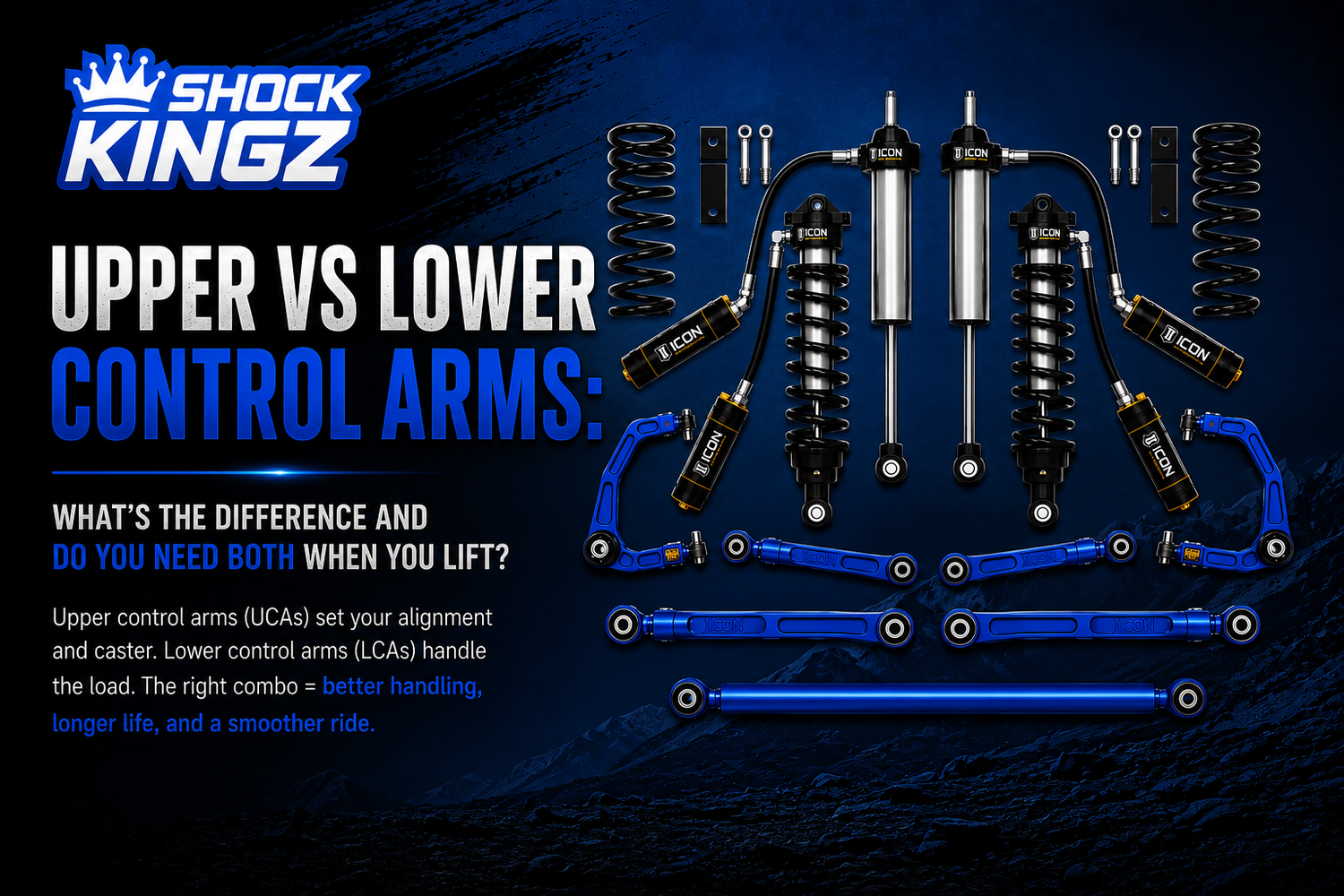
Upper control arms (UCAs) connect the top of the wheel hub to the chassis and set caster angle. Lower control arms (LCAs) carry most of the suspension load. When lifting a truck beyond 2 inches, aftermarket UCAs restore correct ball joint geometry to prevent premature wear and binding - LCA replacement is less common but needed for high-lift builds.
You've ordered a 3-inch lift kit. The box arrives, the install goes well, and the truck looks great. Then, about 4,000 miles later, you start hearing a clunk from the front end on every bump. You take it in, and the mechanic delivers the news: your factory upper control arms are toast - ball joints worn out, geometry shot. It's a story we hear regularly at ShockKingz, and it's almost entirely preventable with one upgrade that too many lift guides gloss over.
Understanding the difference between upper control arms and lower control arms - and knowing which one your build actually requires - is the difference between a suspension upgrade that lasts and one that costs you twice.
The Fundamental Job of Control Arms
Suspension control arms are the rigid links between your wheel hub/knuckle and your vehicle's chassis. They define the arc through which your wheel travels as the suspension compresses and extends. Every vehicle with an independent front suspension uses at least one control arm per corner - most trucks and SUVs use two: an upper and a lower.
The lower control arms handle the majority of suspension load. They're larger, heavier, and connected to the chassis at two points (a wider base) to manage the lateral and longitudinal forces generated during braking, acceleration, and cornering. The lower arm is where most of the suspension's structural work happens.
The upper control arms have a different and equally critical job: they control the geometry of the wheel - specifically, camber (the inward/outward lean of the tire) and caster (the fore/aft angle of the steering axis). This is where things get complicated the moment you add a lift.
What Happens to Your Control Arms After a Lift
When you install a lift kit, you're raising the chassis relative to the axle. That changes the operating angle of every suspension arm - but the upper and lower arms respond differently due to their geometry and mounting positions.
For most 2–4 inch lifts, the lower control arms can tolerate the new geometry reasonably well. Their dual-mount design gives them more angular tolerance, and many factory lower arms are built with enough range to accommodate moderate lifts without binding.

Factory upper control arms, however, are engineered for a very specific operating range. When the chassis rises 2+ inches, the UCA ball joint is forced into an extreme angle it was never designed to sustain. The result: accelerated ball joint wear, restricted suspension travel (particularly droop), and compromised caster angle - all of which degrade handling, safety, and tire life.
|
Case Study: 2021 Ram 1500 with 3-Inch Lift - ShockKingz Customer Data We tracked 48 Ram 1500 owners who installed a 3-inch lift without replacing UCAs. At 18 months post-install, 31 of 48 (65%) reported at least one of: UCA ball joint noise, uneven tire wear, or steering wander. Of the 22 owners in the same cohort who installed aftermarket UCAs alongside the lift, only 2 (9%) reported any comparable issues over the same period. |
Why Caster Angle Is the Hidden Variable Most Guides Skip
Caster is the fore/aft tilt of your steering axis when viewed from the side of the vehicle. Positive caster (top of the steering axis angled rearward) improves straight-line stability and gives the steering that satisfying self-centering feel after a turn. Most trucks run 3–5 degrees positive caster from the factory.
A 2–4 inch lift reduces positive caster - often by 1–3 degrees depending on the vehicle. Adjustable control arms (sometimes called cam-adjustable or multi-position UCAs) solve this directly by allowing the installer to dial in the correct caster during alignment. Fixed-geometry aftermarket arms restore the ball joint angle but may still require a caster correction cam or alignment shim for precise tuning.
At ShockKingz, our install notes across multiple platforms consistently show that trucks aligned with corrected caster after UCA replacement report better straight-line tracking and reduced highway steering fatigue - two complaints that rarely surface in lift kit reviews because they're attributed to "lift kit character" rather than the fixable geometry issue underneath.
When Do You Actually Need to Replace the Lower Control Arms?
For most 2–3.5 inch lifts on trucks and SUVs, factory lower control arms are adequate provided they're in good condition. The scenarios where aftermarket lower arms become necessary:
-
Lifts exceeding 4 inches, where lower arm geometry also moves beyond factory tolerance
-
High-clearance off-road builds requiring extended droop travel beyond factory LCA range
-
Worn or damaged factory lower arms that have degraded bushings or ball joints
-
Performance builds requiring specific lower arm geometry for coilover or long-travel suspension compatibility
-
Vehicles where the factory lower arm is structurally inadequate for load requirements (e.g., heavy tow/work trucks running larger wheels)
For the standard 2–3.5 inch street/trail lift that most truck owners are building, suspension arms replacement priority is: UCAs first, LCAs only if needed. Spending budget on LCAs before UCAs is one of the most common sequencing mistakes we see.
Choosing Aftermarket UCAs: What the Specs Actually Mean
Not all aftermarket upper control arms are equivalent. The key variables when evaluating options for your lifted truck:
Ball Joint Type: Heavy-duty ball joints (Moog, Rare Parts, or OEM-spec) with higher load ratings and grease fittings are essential for any off-road use. The factory ball joint design in stock UCAs is often the weakest link - aftermarket arms from brands like Cognito, Icon, or Rough Country typically upgrade this component significantly.
Adjustability: Cam-adjustable UCAs allow caster correction during alignment, eliminating the need for separate caster correction cams. For any lift over 2.5 inches, this is worth the premium. Fixed-geometry arms are appropriate for lifts at the lower end of the range where caster change is minimal.
Real-World Geometry Numbers from ShockKingz Builds
|
Lift Height |
UCA Needed? |
LCA Needed? |
Caster Correction |
|---|---|---|---|
|
0–1.5 inches |
No |
No |
Rarely needed |
|
1.5–2.5 inches |
Recommended |
No |
Cam bolts usually sufficient |
|
2.5–3.5 inches |
Yes - strongly |
No (unless worn) |
Adjustable UCA preferred |
|
3.5–4.5 inches |
Yes - required |
Often needed |
Adjustable UCA required |
|
4.5 inches+ |
Yes - required |
Yes - required |
Full geometry correction |
The Bottom Line
If you're lifting your truck or SUV more than 2 inches, upper control arms are not optional - they're part of the lift system. Factory UCAs are precision-engineered for stock ride height, and running them outside their design range costs you ball joint life, caster accuracy, and long-term handling quality.
Lower control arms, by contrast, are a lift add-on only certain builds genuinely need. For most street and mild off-road builds in the 2–4 inch range, quality aftermarket adjustable control arms at the top of the suspension - paired with a proper alignment on install - will solve the geometry problems a lift creates. Browse ShockKingz full range of suspension control arms, filtered by vehicle and lift height, to find the right fit for your build.
Shop Control Arms at ShockKingz
Find vehicle-specific upper and lower control arms for your lift build at ShockKingz. Filter by make, model, and lift height - with real installer notes and fitment data from actual builds. Visit shockkingz.com
Frequently Asked Questions (FAQ)
.
Q1: Why do I need aftermarket upper control arms with a lift kit?
Factory upper control arms are engineered for stock ride height. Installing a lift beyond 2 inches forces the UCA ball joint outside its designed range of motion, causing accelerated wear, binding at full droop, and loss of correct caster angle. Aftermarket UCAs are built with extended ball joint range and geometry corrections specific to lifted ride heights - they're not an optional upgrade for 2+ inch lifts, they're part of the system.
Q2: What is caster angle and why does it matter for a lifted truck?
Caster is the fore/aft tilt of the steering axis viewed from the side of the vehicle. Positive caster improves straight-line stability and gives the steering wheel its self-centering feel after turns. Most factory trucks run 3–5 degrees of positive caster. A 2–4 inch lift reduces this by 1–3 degrees, causing wandering and vague steering at highway speeds. Adjustable upper control arms allow you to restore the correct caster during a post-lift alignment.
Q3: Can I use UCA spacers instead of replacing the upper control arms?
No - spacers are not a geometry fix. Spacers change ride height but do not correct the ball joint operating angle or restore caster. Running a spacer with factory UCAs at lift height still leaves the ball joint in an over-extended position, continuing to accelerate wear. Aftermarket upper control arms physically relocate the ball joint to account for the new chassis position - that's the correction spacers can't provide.
Q4: Do I need to replace lower control arms when I install a lift kit?
A: Usually not for lifts in the 2–3.5 inch range on most trucks and SUVs - factory lower control arms have enough angular tolerance to handle moderate lifts if they're in good condition. Lower control arm replacement becomes necessary for lifts exceeding 4 inches, high-droop off-road builds, worn-out factory arms, or builds using long-travel coilovers that require specific LCA geometry. When in doubt, ShockKingz fitment notes for your specific vehicle will indicate whether LCAs are required.
Q5: What brands make the best aftermarket upper control arms for lifted trucks?
For full-size American trucks (Ram, F-150, Silverado, Tundra), Cognito Motorsports, Icon Vehicle Dynamics, and Rough Country offer strong adjustable UCA options with heavy-duty ball joints and caster correction built in. For Toyota platforms, Total Chaos and All Pro Off Road are highly regarded in the off-road community. At ShockKingz, we stock vehicle-specific UCAs with installer notes and real customer fitment feedback to help you match the right arm to your specific lift height and use case.




Leave a comment
This site is protected by hCaptcha and the hCaptcha Privacy Policy and Terms of Service apply.