
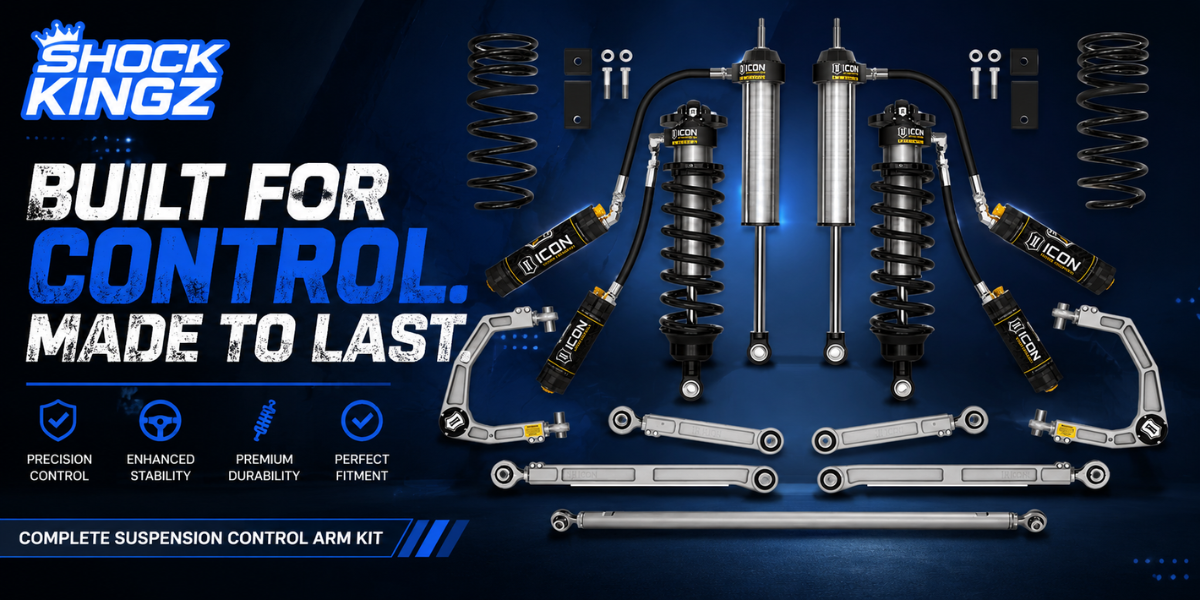
Control arms connect the wheel hub to the vehicle's chassis while allowing the wheel to move up and down over bumps, all while keeping it aligned at the correct angle for steering and handling. They're one of the core structural links in the suspension system, and their condition directly affects how precisely a vehicle steers, brakes, and tracks straight down the road.
For anyone new to suspension terminology, control arms are easy to overlook because they don't fail as dramatically or as often as shocks or struts. But because they're a structural, load-bearing connection rather than just a damping component, a worn or damaged control arm has outsized effects on alignment, tire wear, and handling precision compared to its relatively low profile in most suspension conversations.
How Control Arms Connect to the Chassis and Wheel Hub
Each control arm has two connection points: one end attaches to the vehicle's chassis or subframe through a bushing, and the other end attaches to the wheel hub assembly, typically through a ball joint. This arrangement lets the wheel move vertically in response to road bumps while the control arm constrains that movement to a controlled arc, keeping the wheel's alignment angle consistent rather than letting it flop freely.

Suspension control arms work as part of a broader system alongside shocks, struts, and springs, but they play a distinct role: while shocks and springs manage vertical motion and damping, control arms manage the geometry of that motion, determining exactly how the wheel moves relative to the chassis at every point in its travel.
Upper vs. Lower Control Arms: What Each One Does
On vehicles with a double wishbone or similar independent front suspension design, there are typically both upper control arms and lower control arms working together, each connected to the wheel hub via its own ball joint. The lower control arm generally handles the larger share of the load, since it sits closer to the road and bears more of the vehicle's weight transfer during braking and cornering. The upper control arm is usually smaller and plays a bigger role in fine-tuning camber angle, the tilt of the wheel relative to vertical.
Together, these two suspension arms form a linkage that controls the wheel's position through its full range of motion, not just at rest. As the suspension compresses and extends, the upper and lower control arms move through slightly different arcs, which is precisely tuned by the manufacturer to keep the tire's contact patch as consistent as possible throughout the suspension's travel.
Bushings and Ball Joints: The Pivot Points That Make It Work
Two types of pivot points make control arm movement possible, and each does a different job. Bushings, typically made of rubber or polyurethane, sit at the chassis-side connection and absorb the front-to-back and side-to-side forces generated by braking, acceleration, and road impacts, while still allowing the control arm to pivot up and down. Ball joints sit at the wheel-hub-side connection and allow rotation in multiple directions simultaneously, which is necessary since the wheel both moves vertically with the suspension and rotates side to side during steering.
Both components wear over time, since they're constantly absorbing motion and load. A bushing that's cracked or deteriorated allows excess play at the chassis connection, while a worn ball joint introduces play at the wheel end, and either one degrades the precision of the geometry the control arm is supposed to maintain. For a closer look at how control arms factor into off-road suspension kits, our companion guide covers their role alongside track bars and sway bar components.
How Worn Control Arms Affect Alignment and Handling
Because control arms directly set the wheel's geometry, wear or damage here shows up as alignment problems rather than the bouncing or fade associated with worn shocks. A bent control arm, a torn bushing, or a loose ball joint can each independently throw off camber or toe angle, causing uneven tire wear even if the tires themselves and the alignment settings were correct when last checked.
This is also why control arm issues often get misdiagnosed. A driver might notice the car pulling to one side, vibration at speed, or uneven tire wear and assume it's an alignment problem alone, when the actual cause is a worn bushing or ball joint that keeps pulling the alignment out of spec no matter how many times it's corrected. Addressing the suspension components themselves, rather than repeatedly re-aligning around them, is usually the actual fix.
Signs a Control Arm Needs Attention
A few practical signs point toward control arm wear specifically: clunking or knocking noises over bumps, often from a loose ball joint or worn bushing; a vehicle that pulls to one side or feels loose during cornering; uneven or rapid tire wear that returns after an alignment; and visible play when the wheel is grasped at the top and bottom and rocked, a common diagnostic check technicians use to isolate ball joint looseness. Any of these on their own is worth investigating, and more than one together is a stronger signal that a control arm component has failed.
Understanding what control arms actually do, connecting the chassis to the wheel hub while precisely controlling geometry through bushings and ball joints, makes it much easier for suspension beginners to recognize why a seemingly small worn component can have an outsized effect on how a vehicle drives.
Call to Action
Ready to explore options? Shockkingz carries control arms and other suspension components to help you find the right fit for your vehicle.
Frequently Asked Questions
Q1. What do control arms do?
Control arms connect the wheel hub to the vehicle's chassis while allowing the wheel to move up and down over bumps, keeping it aligned at the correct angle for steering and handling.
Q2. What's the difference between upper and lower control arms?
The lower control arm typically bears more of the vehicle's weight and load transfer during braking and cornering, while the upper control arm plays a bigger role in fine-tuning camber angle. Both work together to control wheel geometry.
Q3. How do control arm bushings and ball joints differ?
Bushings sit at the chassis-side connection and absorb front-to-back and side-to-side forces while allowing the arm to pivot. Ball joints sit at the wheel-hub-side connection and allow rotation in multiple directions for steering.
Q4. Can a bad control arm cause alignment problems?
Yes. A bent control arm, torn bushing, or worn ball joint can throw off camber or toe angle, causing uneven tire wear and alignment issues that return even after the vehicle is realigned.
Q5. What are the signs of a worn control arm?
Common signs include clunking noises over bumps, the vehicle pulling to one side, looseness during cornering, uneven tire wear that returns after an alignment, and visible play when the wheel is rocked by hand.



Leave a comment
This site is protected by hCaptcha and the hCaptcha Privacy Policy and Terms of Service apply.