
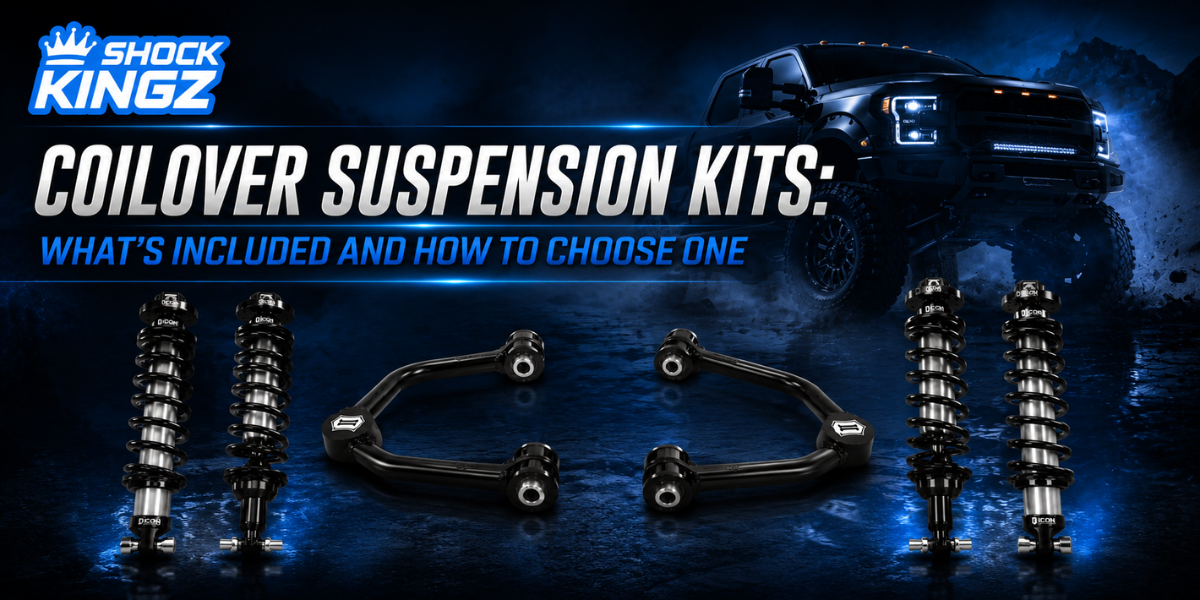
A typical coilover suspension kit includes four front or rear coilover units (or four total for a full-vehicle kit), matched springs already mounted on each unit, mounting hardware for the frame and axle connections, and an adjustment tool such as a spanner wrench. Higher-end kits often add extras like thrust bearings or spring washers to make future adjustments easier. Knowing this list before shopping makes it much easier to compare listings that look similar on the surface but include very different amounts of hardware.
For DIY installers, the gap between a complete kit and a partial one is one of the most common sources of frustration during installation, since discovering a missing bracket or bolt mid-project can stall the job for days while waiting on a replacement part. Understanding what should be in the box, and what to verify about fitment before ordering, avoids that problem entirely.
What's Included in a Coilover Suspension Kit?
A complete kit generally includes the following, though contents vary somewhat by manufacturer and application:
1. Coilover units: the assembled spring-and-damper units themselves, one per corner being upgraded, already matched for spring rate and valving.
2. Mounting hardware: bolts, brackets, and in some applications, upper or lower mounting plates needed to attach the coilover to the frame and axle or control arm.
3. Adjustment tools: most kits include a spanner wrench for ride height adjustment, since the locking collar and spring perch require it.
4. Spring washers or thrust bearings: found in higher-end kits, these components make future height and preload adjustments smoother and reduce binding at the perch.
5. Installation instructions: application-specific torque specs and mounting order, since improvising this step increases the risk of improper installation.
A kit missing any of the hardware items, particularly mounting brackets on applications that require them, isn't necessarily defective, but it does mean the listing wasn't a true complete kit, which is worth confirming before purchase rather than after the parts arrive.
Fitment and Compatibility: What to Confirm First
Coilovers are one of the least forgiving suspension components when it comes to fitment, since spring rate, mounting geometry, and adjustment range are all built around a specific vehicle application. A kit listed for the wrong trim, drivetrain configuration, or model year can arrive with mounting points that don't align or a spring rate that doesn't suit the vehicle's actual weight distribution.

Before ordering coilover suspension kits, confirm the listing specifies your exact year, make, model, trim, and drivetrain, not just a broad model range. Independent front suspension versus solid axle, and two-wheel drive versus four-wheel drive, frequently require different mounting hardware even on the same base model, so a listing that doesn't distinguish between these isn't reliable for exact fitment. For a closer look at why trucks use coilovers specifically at the front axle, our companion guide covers how suspension type affects fitment in more detail.
Adjustability Range: What Varies Between Kits
Not all adjustable coilovers offer the same range or type of adjustment, and this is where kits at different price points diverge most. Basic kits typically offer ride height adjustment only, through a threaded body and spring perch. Mid-range kits add single-dial damping adjustment, changing compression and rebound together. Higher-end suspension coilovers offer independent compression and rebound adjustment, sometimes with a wider click range for finer tuning.
The right adjustability range depends on intended use. A daily-driven vehicle rarely needs independent compression and rebound control, while a track-focused build benefits meaningfully from that precision. Paying for adjustment range you won't use is a common way DIY installers overspend on a first coilover purchase.
A Fitment-Checking Checklist Before You Buy
Before finalizing a purchase, verify these points against the listing and your vehicle:
Confirm the exact trim, drivetrain, and model year match, not just the general model name. Check whether mounting hardware is included or must be sourced separately. Verify the spring rate is appropriate for the vehicle's actual weight, especially if it regularly carries extra load. Confirm whether an alignment is required post-installation, which is standard for any meaningful ride height change. Check that the adjustment tool, typically a spanner wrench, is included rather than assumed.
Running through this checklist before ordering catches most of the fitment problems that otherwise surface only after the parts arrive and installation begins.
Installation Considerations for DIY Installers
Even a complete, correctly fitted kit still requires careful installation. Aftermarket coilovers typically bolt into the same mounting points as factory shocks and springs, but torque specs matter more than they might seem, since under-torqued mounting hardware can loosen over time and create noise or, in more serious cases, affect handling safety. Following the kit's specific torque sequence rather than assuming standard values applies is worth the extra few minutes it takes to check the documentation.
Plan for a post-installation alignment as a standard part of the project cost and timeline, not an optional extra, since ride height changes reliably affect suspension geometry. Understanding the full kit contents, confirming fitment carefully, and budgeting for the alignment afterward turns a coilover suspension kit purchase from a gamble into a straightforward, predictable upgrade.
Call to Action
Ready to compare kits for your vehicle? Shockkingz carries coilover suspension kits and adjustable coilovers to help you find the right fit and adjustment range.
Frequently Asked Questions
Q1. What's included in a coilover suspension kit?
A typical kit includes coilover units for each corner being upgraded, matched springs already mounted, mounting hardware, and an adjustment tool such as a spanner wrench. Higher-end kits may add thrust bearings or spring washers for easier future adjustments.
Q2. How do I know if a coilover kit will fit my vehicle?
Confirm the listing specifies your exact year, make, model, trim, and drivetrain. Independent front suspension versus solid axle, and two-wheel versus four-wheel drive, often require different mounting hardware even on the same base model.
Q3. Do all coilover kits include mounting hardware?
Not always. Some listings include only the coilover units themselves, while complete kits include brackets, bolts, and mounting plates. It's worth confirming this before ordering rather than assuming hardware is included.
Q4. Is more adjustability always better in a coilover kit?
Not necessarily. A daily-driven vehicle rarely needs independent compression and rebound adjustment, while a track-focused build benefits from that precision. Paying for adjustment range you won't use is a common way buyers overspend.
Q5. Do I need an alignment after installing coilovers?
Yes. Any meaningful ride height change affects suspension geometry, so a professional alignment is standard practice after installing a coilover suspension kit, not an optional step.





Leave a comment
This site is protected by hCaptcha and the hCaptcha Privacy Policy and Terms of Service apply.