
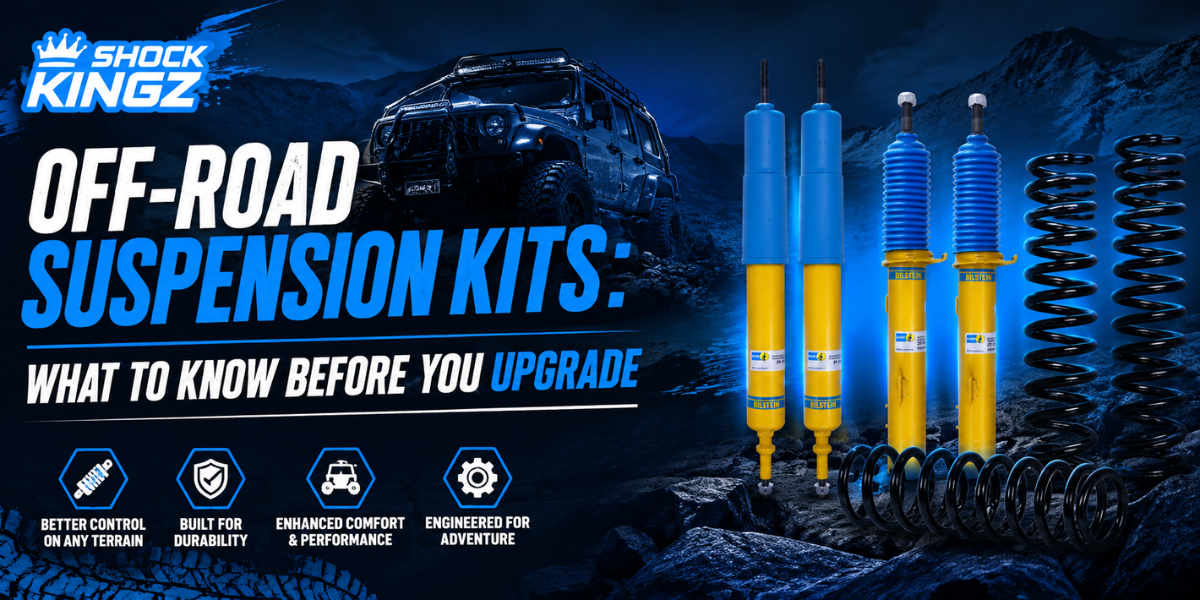
Off-road suspension kits typically include upgraded shocks, longer coil or leaf springs, and often control arms or track bars to correct geometry at the new ride height, all designed to increase wheel travel, articulation, and ground clearance for rougher terrain. Whether you actually need one depends on how and where you drive: occasional gravel roads rarely justify a full kit, but regular rock crawling, trail driving, or overlanding usually do.
That distinction matters before spending money on a kit, since off-road suspension kits range from a simple leveling adjustment to a full long-travel setup, and the right choice depends entirely on the terrain you're actually driving rather than the most aggressive-looking option on a parts site. Among the many aftermarket suspension kits on the market, the labels can blur together, but understanding what each one actually changes makes comparison shopping far easier.
What's Included in an Off-Road Suspension Kit?
A typical kit is built around a core set of components, each addressing a specific part of how the vehicle handles rough terrain:
1. Shocks: longer-travel, often gas-charged units that control the increased spring movement without fading under sustained off-road use.
2. Springs: longer coil or leaf springs that provide the primary ride height increase and support the vehicle at its new geometry.
3. Control arms: upper control arms correct suspension geometry on many independent front suspension vehicles and often increase available wheel travel.
4. Track bars and sway bar components: track bars keep the axle centered at the new ride height, while sway bar disconnects allow each wheel to move independently for better articulation on uneven terrain.
5. Bump stops: extended or upgraded bump stops absorb extreme impacts at full compression, protecting the rest of the suspension from damage.
Not every kit includes all of these parts. Basic suspension lift kits may only address ride height with new springs or spacers, while long-travel kits used for serious trail work typically include most or all of the components above, plus supporting parts like extended brake lines to accommodate the added suspension travel.
Do I Need an Off-Road Suspension Kit?
The honest answer depends on driving conditions rather than preference alone. A vehicle driven mostly on pavement with occasional gravel roads sees relatively little benefit from a dedicated kit, since stock suspension geometry and ground clearance are usually adequate for that use. Vehicles used regularly for rock crawling, technical trails, or sustained washboard and rutted terrain benefit meaningfully from increased wheel travel and articulation, since the stock setup wasn't engineered for that level of sustained stress.

A useful gut check: if you're regularly scraping the underbody on obstacles, running out of suspension travel before a wheel loses contact with uneven ground, or noticing shock fade on longer trail runs, those are concrete signs a kit addresses a real limitation rather than a cosmetic preference.
Wheel Travel, Articulation, and Ground Clearance Explained
These three terms get used loosely, but they describe distinct things. Wheel travel is the total distance a wheel can move up and down from full compression to full extension; more travel means the suspension can absorb larger bumps and dips before the chassis feels the impact. Articulation refers to how independently each wheel can move relative to the others, which matters most on uneven terrain where keeping all four tires in contact with the ground improves traction and control.
Ground clearance is simpler: it's the vertical space between the lowest point of the vehicle and the ground, and it directly affects approach, departure, and breakover angles, the angles at which the vehicle can climb onto, drive over, or descend from an obstacle without contacting the underbody. A kit that increases ride height without addressing articulation improves ground clearance but not necessarily how well the suspension handles uneven terrain, which is why serious off-road setups typically address all three together rather than height alone.
Matching a Kit to Terrain Type
Terrain type should drive the decision more than any other factor. Moderate gravel and forest roads generally call for a modest lift with upgraded shocks, enough to improve ground clearance without significantly altering handling characteristics on pavement. Rocky, technical trails benefit most from increased articulation, meaning control arms, track bars, and sway bar disconnects matter as much as ride height. Sustained high-speed desert or washboard terrain puts the emphasis back on shocks specifically, since heat management and consistent damping under repeated impact become the limiting factor over long runs. For a closer look at how terrain and duty cycle affect truck suspension parts, our truck suspension guide covers the same underlying principles.
Matching the kit to the terrain you actually drive, rather than the most capable-looking setup available, keeps the vehicle balanced for daily use while still addressing the specific demands of your typical trail conditions.
What Changes Beyond the Shocks and Springs
Raising a vehicle's ride height affects more than the suspension itself. Alignment typically needs adjustment after a lift, since geometry changes affect tire wear if left unaddressed. Brake lines often need to be extended to accommodate additional suspension droop, and in some cases, driveline angles change enough to require adjustment to avoid vibration at highway speeds. These secondary considerations are part of why a proper installation, not just bolting on parts, matters as much as the components themselves.
Suspension upgrade kits and truck suspension upgrades both cover a wide range of capability, from mild leveling to serious long-travel setups, and understanding what each component actually does, rather than assuming more parts automatically means more capability, is the difference between a setup that matches your terrain and one that simply raises the truck without solving the underlying problem.
Call to Action
Ready to compare options for your build? Shockkingz carries a range of off-road suspension kits built for terrain from moderate trails to serious rock crawling.
Frequently Asked Questions
Q1. What's included in an off-road suspension kit?
A typical kit includes longer-travel shocks, upgraded coil or leaf springs, and often control arms, track bars, or sway bar disconnects to correct geometry and improve articulation. Basic leveling kits may include only springs or spacers, while long-travel kits include most of these components together.
Q2. Do I need an off-road suspension kit?
It depends on driving conditions. Occasional gravel roads rarely justify a full kit, but regular rock crawling, technical trails, or sustained rough terrain usually benefit from the added wheel travel, articulation, and ground clearance a kit provides.
Q3. What's the difference between wheel travel and articulation?
Wheel travel is the total distance a wheel can move from full compression to full extension. Articulation refers to how independently each wheel can move relative to the others, which matters most for keeping all four tires in contact with uneven terrain.
Q4. Does a suspension lift always improve off-road capability?
Not automatically. A lift that increases ride height without addressing articulation improves ground clearance but not necessarily how well the suspension handles uneven terrain, which is why serious setups typically address height, travel, and articulation together.
Q5. Do I need an alignment after installing a suspension kit?
Yes. Raising ride height changes suspension geometry, so an alignment is typically needed afterward to prevent uneven tire wear. Depending on the kit, brake lines or driveline angles may also need adjustment.




Leave a comment
This site is protected by hCaptcha and the hCaptcha Privacy Policy and Terms of Service apply.