
Suspension geometry is the set of angles and measurements that define how a vehicle's wheels are positioned relative to the road and to each other, and it's the single biggest factor separating a car that handles predictably from one that doesn't. Every alignment number a shop hands back after service, camber, caster, and toe, describes some piece of this geometry, and small deviations in any of them show up directly as tire wear, handling quirks, or a car that pulls to one side.
What Is Suspension Geometry?
Suspension geometry refers to the angles at which the wheels sit relative to the chassis and the road surface, and how those angles change as the suspension moves through its range of travel. Every set of suspension components, control arms, struts, bushings, and ball joints, works together to define these angles, and the specific combination is engineered by the manufacturer to balance handling, comfort, and tire longevity for a given vehicle.
Because suspension geometry isn't a single fixed measurement but a relationship between multiple moving parts, it changes dynamically as a car goes through a corner, brakes hard, or crosses uneven pavement. A well-engineered geometry keeps the tire's contact patch as consistent as possible through that range of motion, while a worn or poorly matched setup lets the geometry drift outside its intended range, which is where alignment problems and uneven tire wear originate.
What Are Camber, Caster, and Toe?
Camber is the inward or outward tilt of a wheel when viewed from the front of the vehicle. Negative camber means the top of the tire leans inward toward the chassis, while positive camber means it leans outward. Camber affects how evenly a tire wears across its tread and how much contact patch is available during hard cornering; too much of either type of camber concentrates wear on one edge of the tire.
Caster is the forward or backward tilt of the steering axis when viewed from the side of the vehicle. A positive caster, where the top of the steering axis tilts toward the rear, generally improves straight-line stability and steering wheel self-centering, while insufficient caster can make a car feel twitchy or unstable at highway speed. Caster doesn't directly cause tire wear the way camber and toe do, but it strongly affects steering feel and stability.
Toe is the direction the front edges of the tires point relative to each other when viewed from above. Toe-in means the tires angle slightly toward each other at the front; toe-out means they angle away. Even small toe misalignments, often a fraction of a degree, can cause noticeably faster and more uneven tire wear than camber or caster issues, because toe error causes the tires to scrub sideways continuously while rolling forward.
How Suspension Geometry Affects Ride Quality and Tire Wear
Ride quality is shaped by more than spring rate and damping; it's also a direct function of how consistently the suspension geometry holds its intended angles across a range of road conditions. A geometry that shifts excessively under braking or cornering transmits that instability to the driver as harshness or unpredictability, even if the shocks and springs themselves are in good condition.
Tire wear patterns are one of the most reliable diagnostic signals of a suspension geometry problem. Feathering, a wear pattern where the tread has sharp edges on one side and smooth edges on the other, typically points to a toe issue. Wear concentrated on the inner or outer edge of the tread, with the rest of the tire wearing normally, usually points to a camber problem. Because these patterns are consistent and well-documented, a visual tire inspection is often the fastest first step in diagnosing a geometry issue before a full alignment check.
Suspension Tuning and Lift Performance
Suspension tuning is the process of adjusting geometry-related components to bring a vehicle's alignment within spec, or to intentionally shift it for a specific handling goal, such as more aggressive cornering camber on a track-focused build. This tuning becomes especially relevant after ride height changes, since raising or lowering a vehicle shifts the suspension's working angles away from where the factory geometry was designed to sit.
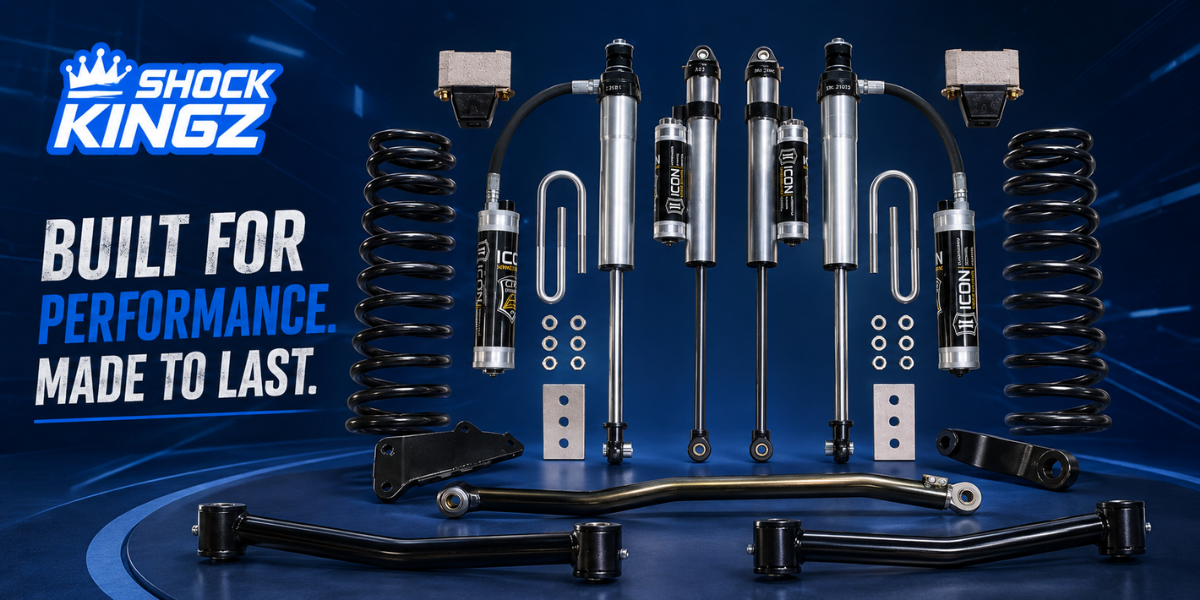
Lift performance is a good example of geometry in practice: a taller vehicle needs more usable wheel travel and a properly angled set of control arms and links to maintain both alignment and articulation across that extended range. Some vehicles benefit from adjustable components that widen the available correction range, extending caster and camber adjustment beyond what fixed factory hardware allows, which our companion piece on how adjustable control arms extend caster and camber correction range covers in more depth. Vehicles that see meaningful ride height adjustment often need this expanded range to keep alignment specs achievable at all.
Suspension geometry isn't an abstract engineering concept; it's the reason two vehicles with identical shocks and springs can feel completely different to drive, and the reason tire wear patterns tell such a consistent story about what's happening underneath a car. Understanding camber, caster, and toe individually, and how they interact as a system, gives an experienced enthusiast a real diagnostic advantage over waiting for a problem to become obvious.
Call to Action
Looking to dial in your setup? Shockkingz carries suspension geometry-focused parts and ride height adjustment components matched by application.
Frequently Asked Questions
Q1. What is suspension geometry?
Suspension geometry is the set of angles at which a vehicle's wheels sit relative to the chassis and road surface, and how those angles change as the suspension moves. It's defined by camber, caster, and toe together.
Q2. What is camber, caster, and toe?
Camber is the inward or outward tilt of a wheel viewed from the front. Caster is the forward or backward tilt of the steering axis viewed from the side. Toe is the direction the front edges of the tires point relative to each other viewed from above.
Q3. Which alignment issue causes the most tire wear?
Toe misalignment tends to cause the fastest and most noticeable tire wear, since even a small toe error makes the tires scrub sideways continuously while rolling forward.
Q4. How can I tell if my alignment is off just by looking at my tires?
Feathering, sharp edges on one side of the tread and smooth on the other, usually points to a toe issue, while wear concentrated on the inner or outer edge of the tread typically points to a camber problem.
Q5. Does lifting or lowering a vehicle affect suspension geometry?
Yes. Changing ride height shifts the suspension's working angles away from where the factory geometry was designed to sit, which is why alignment often needs to be corrected after a lift or lowering job.











Leave a comment
This site is protected by hCaptcha and the hCaptcha Privacy Policy and Terms of Service apply.