
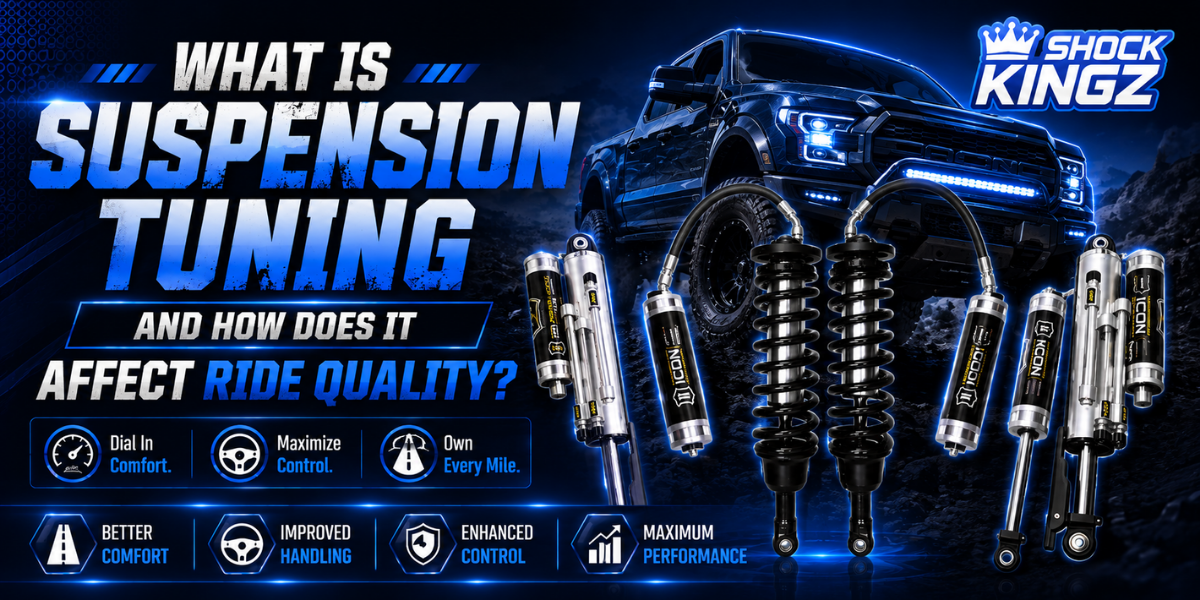
Suspension tuning is the process of adjusting a vehicle's damping, spring rate, and ride height to change how it rides and handles, and nearly every adjustment involves the same basic trade-off: more control and precision in exchange for a firmer, less forgiving ride. Understanding which lever produces which effect is what separates a deliberate setup change from guesswork.
What Is Suspension Tuning?
Suspension tuning refers to adjusting the mechanical settings of a vehicle's suspension, most commonly damping force, spring rate, and ride height, to shift the balance between comfort and handling precision. Unlike a full component swap, tuning often works within the range a given set of parts already allows, though more capable hardware, like adjustable coilovers, widens that range considerably. The core trade-off in suspension tuning is straightforward: stiffer settings improve handling precision and reduce body roll during cornering, while softer settings absorb more of the road's imperfections and improve comfort. Neither direction is objectively correct; the right setting depends entirely on how the vehicle is actually driven, and a setup tuned for maximum track performance will feel noticeably harsh during ordinary commuting.
The Adjustable Levers: Damping, Spring Rate, and Ride Height
Damping adjustment controls how quickly the suspension compresses and rebounds after hitting a bump. Increasing damping stiffness reduces body movement and improves control during hard cornering or braking, but it also transmits more road texture directly into the cabin, since the shock absorber resists movement more aggressively at every input. Many performance suspension systems include externally adjustable damping specifically so a driver can shift between a comfortable street setting and a firmer track setting without swapping parts.
Spring rate determines how much force is needed to compress the spring a given distance, measured in pounds per inch. A higher spring rate resists body roll and squat more effectively during aggressive driving, but it also means smaller bumps get transmitted more directly to the chassis, since the spring compresses less to absorb the same impact. Spring rate and damping are closely linked in practice: a spring that's too stiff for its damper, or a damper that's mismatched to spring rate, produces a harsh, unsettled ride even if either component would perform well when properly matched.
Ride height affects handling in a less obvious way. Lowering ride height drops the vehicle's center of gravity, which reduces body roll and improves cornering stability, but it also reduces available suspension travel, meaning the same size bump uses up more of the suspension's working range and is more likely to bottom out. This is one of several reasons ride height and damping settings are usually tuned together rather than independently.
Comfort vs. Performance: The Core Trade-Off
Handling balance is the practical outcome of how these levers are set relative to each other, and it's rarely a single "correct" setting so much as a position along a spectrum. A vehicle tuned toward comfort prioritizes absorbing road imperfections smoothly, accepting more body roll and less immediate steering response in exchange. A vehicle tuned toward performance accepts a firmer, busier ride quality in exchange for sharper turn-in, reduced body roll, and more predictable behavior at the limit.
Most drivers benefit from a setting somewhere in the middle rather than at either extreme, since a daily-driven car tuned entirely for track performance often feels unnecessarily harsh on regular roads, while a track-only car left at a comfort-oriented setting sacrifices real handling capability it doesn't need for everyday comfort.
How Suspension Geometry Interacts with Tuning
Suspension tuning and suspension geometry affect ride quality through different mechanisms, but they interact directly. Geometry, the angles set by camber, caster, and toe, determines how the tire contacts the road, while tuning determines how the suspension responds to motion. Changing ride height as part of a tuning adjustment shifts suspension geometry as a side effect, which is why a ride height change often calls for an alignment check afterward. Our companion guide on how camber, caster, and toe define suspension geometry covers this relationship in more depth for anyone tuning ride height specifically.
Suspension Upgrades vs. Tuning: What's the Difference
Suspension upgrades typically mean replacing components with different hardware, stiffer springs, upgraded dampers, or adjustable coilovers, that expand what's mechanically possible. Tuning, by contrast, is adjusting within the range a given set of components already allows. A vehicle with fixed, non-adjustable shocks has limited tuning range regardless of driver preference, which is why serious tuning flexibility usually requires upgraded, adjustable hardware rather than working within factory settings.
Understanding suspension tuning as a set of interconnected levers, damping, spring rate, and ride height, rather than a single dial, makes it easier to reason through why a specific change produces a specific outcome, and to set a vehicle up for the way it's actually going to be driven rather than chasing a generic "best" setting that doesn't account for real-world use.
Call to Action
Looking to dial in your ride? Shockkingz carries suspension tuning packages and performance suspension systems matched by driving style.
Frequently Asked Questions
Q1. What is suspension tuning?
Suspension tuning is adjusting a vehicle's damping, spring rate, and ride height to shift the balance between ride comfort and handling precision, generally within the range a given set of components allows.
Q2. Does stiffer suspension always mean better handling?
Stiffer settings generally reduce body roll and improve cornering precision, but they also transmit more road texture into the cabin, so stiffer isn't better for every driving situation, only for ones prioritizing handling over comfort.
Q3. What's the difference between damping and spring rate?
Spring rate determines how much force is needed to compress the spring, affecting body roll and squat, while damping controls how quickly the suspension compresses and rebounds after a bump. They're closely linked and usually tuned together.
Q4. Does lowering ride height improve handling?
Lowering ride height reduces the center of gravity and body roll, but it also reduces available suspension travel, making the vehicle more likely to bottom out over larger bumps.
Q5. What's the difference between suspension tuning and suspension upgrades?
Tuning adjusts settings within what existing components already allow, while upgrades replace components with different hardware that expands the available range, such as adjustable coilovers or stiffer springs.










Leave a comment
This site is protected by hCaptcha and the hCaptcha Privacy Policy and Terms of Service apply.