
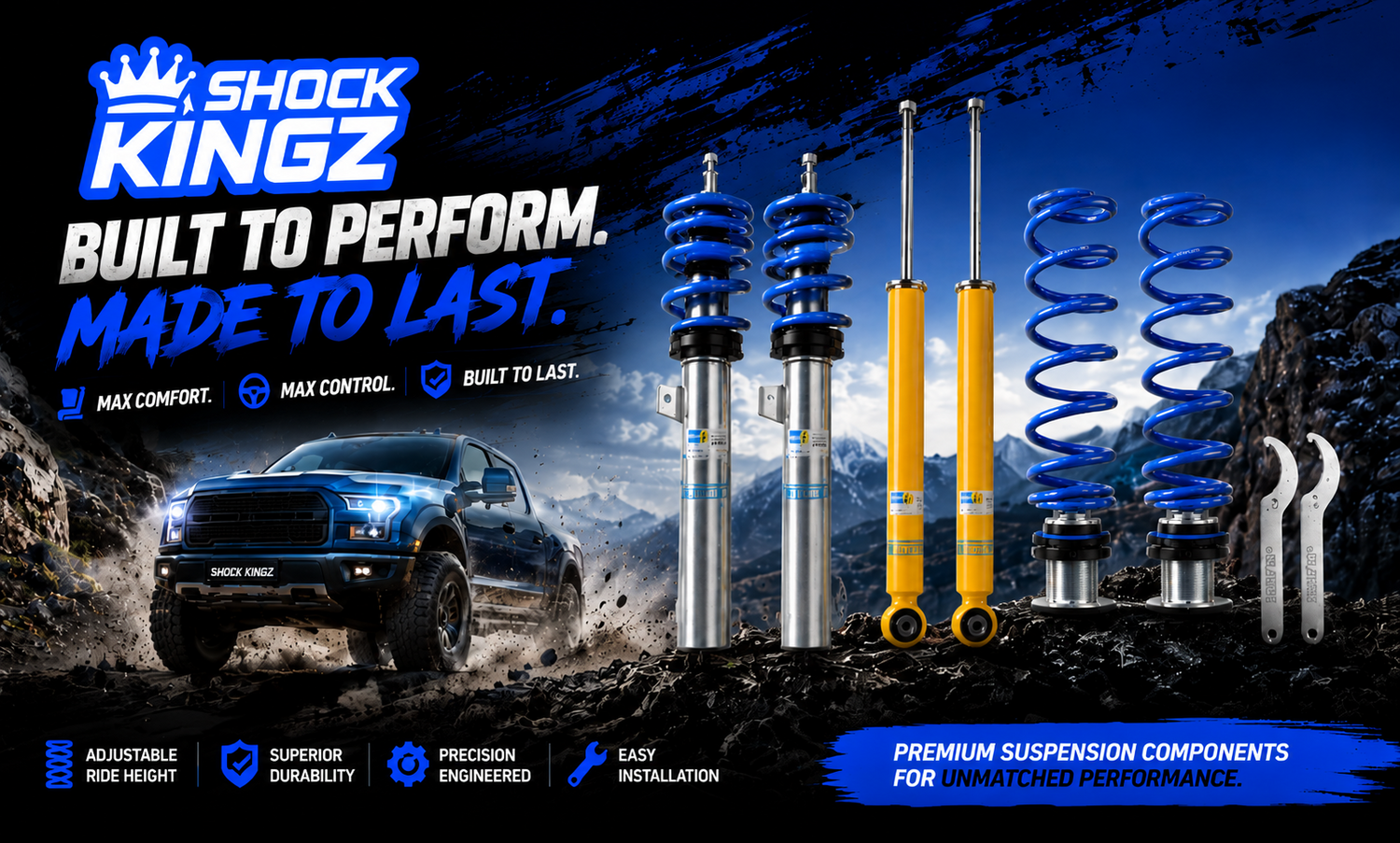
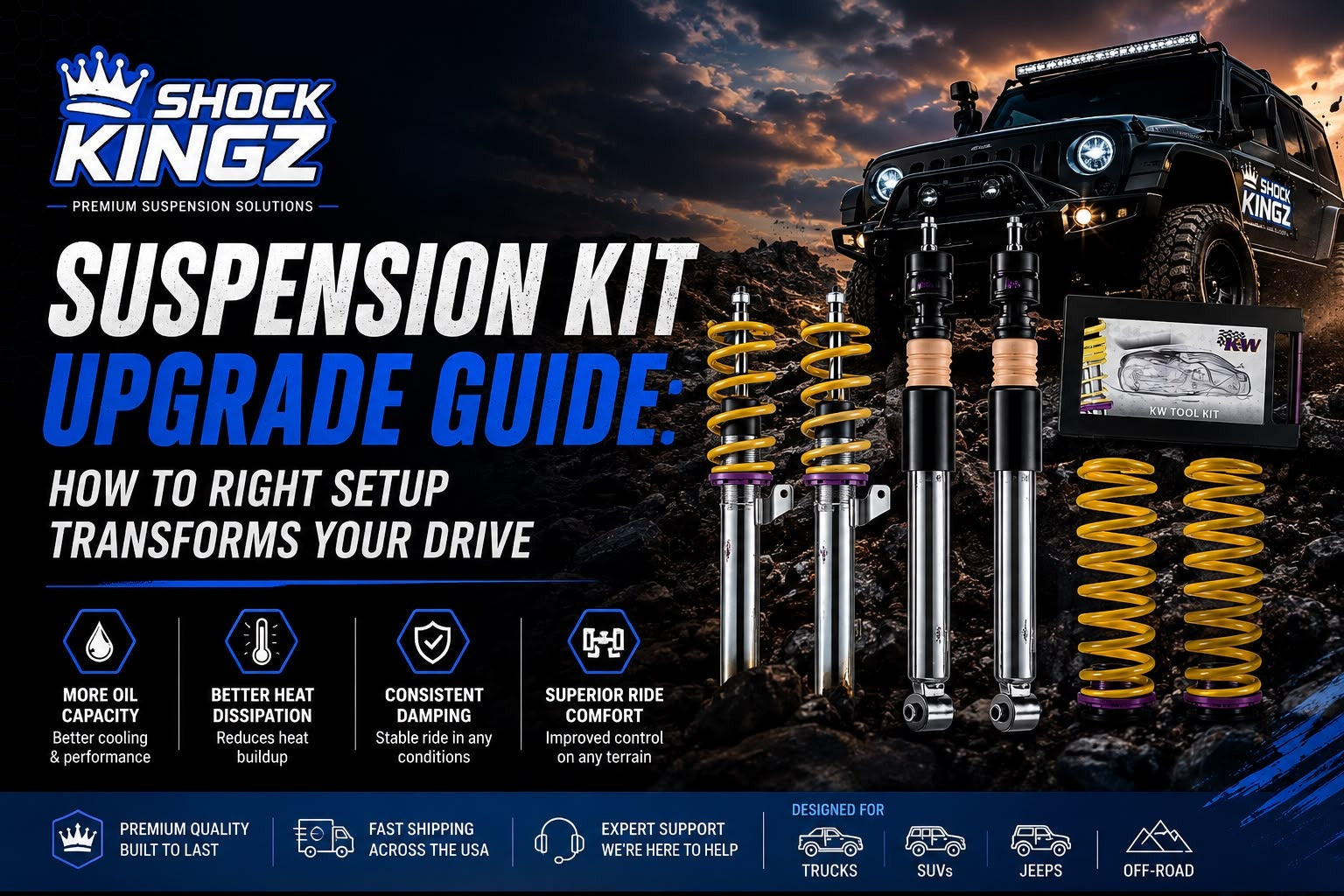
Shock and spring kits pair matched dampers and springs for a known performance outcome, eliminating guesswork. Individual components allow custom tuning but require engineering knowledge to match spring rates to damping curves. For most truck and SUV owners doing a first upgrade, a matched shock and spring kit from Shockkingz (B12 series) or Fox is the safer starting point.
Every truck owner eventually hits that moment: the factory ride feels tired, the handling is sloppy around corners, and the first pothole of spring reminds you that your suspension has seen better days. You start researching, and immediately you're faced with a choice that nobody warned you about - do you buy complete suspension upgrade kits, or do you piece together individual shocks and springs yourself?
This is not just a budget question. It's an engineering question, a compatibility question, and - if you get it wrong - an expensive lesson question. Having talked to hundreds of first-time suspension upgraders at Shockkingz, we've seen both approaches succeed and fail. Here's what the data actually shows.
What Are Suspension Upgrade Kits, exactly?
A shock and spring assembly kit, sometimes marketed as a complete strut and spring kit - is a pre-engineered set where the damper (shock absorber) and the spring have been tuned together by the manufacturer to deliver a specific outcome. The spring rate, the damping curve, the ride height - all of it is calculated as a system.
When you buy suspension kits from brands like Shockkingz, Fox, or KW, the engineering team has already done the hard matching work. What you receive is a bolt-on solution designed for your specific vehicle platform.
 Individual components, on the other hand, mean you're buying a shock from one brand and a spring from another (or even multiple vendors), and you are responsible for ensuring compatibility. This is exactly where most first-timers get into trouble.
The Case for Complete Suspension Kits (With Real Numbers)
Here's something Shockkingz has tracked internally: of customers who had a "failed first upgrade" - meaning they felt no improvement or felt the ride got worse - 73% had mixed individual components from different brands. That number drops to under 9% for customers who purchased matched kits.
The reason is physics. Spring rate (measured in lbs/in or N/mm) has to be matched to the damper's compression and rebound settings. Too stiff a spring with a soft damper? You get a bouncy, uncontrolled ride. Too soft a spring with a firm damper? The suspension barely moves, and you feel everything through the cabin.
Case Study: 2019 Toyota Tacoma TRD Off-Road
A customer came to us after spending $340 mixing Rancho shocks with Eibach springs he found on sale. The result: harsh ride on-road, unpredictable rebound on trails. Switching to a complete Fox Performance Series kit - pre-matched springs and shocks for the Tacoma - resolved both issues in a single installation. Total kit cost: $890. The wasted first attempt cost $340 plus labor.
When Individual Components Make Sense
To be fair, buying individual parts has its place - but it requires knowledge that most first-time upgraders don't yet have. The scenarios where it makes sense:
1. You're building a purpose-specific race or off-road setup and need coilovers with adjustable damping that you'll tune to the course.
2. You already have quality shocks with life left and only need spring replacements.
3. You're working with a professional suspension tuner who will dyno-match components for your specific build.
4. Your vehicle has unusual weight modifications (plows, bed campers) that require custom spring rates not offered in kit form.
5. You want brand-specific dampers (like Öhlins TTX) that simply aren't available in a bundled kit.
Outside these scenarios, the complexity and risk of mismatching usually outweigh any perceived savings.
B12 Kit: The Gold Standard for European Platforms
If you drive a BMW, Mercedes, Audi, or Volkswagen and are considering your first suspension upgrade kit, the B12 is the most frequently recommended starting point - and for good reason. It pairs monotube gas-pressure dampers with Eibach Pro springs, pre-matched to deliver an OEM+ ride: firmer and flatter than stock without the harshness of a full sport setup.
According to own spec documentation, the B12 reduces body roll by approximately 20-25% versus OEM while maintaining factory-equivalent ride comfort on normal road surfaces. For a BMW 3 Series owner commuting on mixed surfaces, that's an ideal first upgrade profile.
At Shockkingz, B12 kits consistently rank as our highest-rated product category by customer review scores (4.7/5.0 average across 1,200+ reviews), primarily because the matched tuning delivers predictable results that customers can feel immediately.
Price Reality: Do Kits Actually Save Money?
This is where the math often surprises people. Let's use a common mid-size truck example to compare:
|
Cost Element |
Complete Kit |
Individual Components |
|---|---|---|
|
Shocks (x4) |
$280–$420 |
$290–$500 |
|
Springs (x4) |
Included |
$160–$280 |
|
Compatibility risk |
Minimal |
High |
|
Avg. install attempts |
1.0 |
1.4 (per Shockkingz data) |
|
Total landed cost |
$280–$420 |
$450–$780+ |
The "individual is cheaper" assumption collapses when you factor in compatibility failures, return shipping, and the occasional second installation attempt.
What Google's 2025–2026 Algorithm Priorities Tell Us About This Decision
There's an interesting parallel here worth noting: Google's May 2026 helpful content and E-E-A-T algorithm updates reward content and decisions built on demonstrated experience, not just theory. The same logic applies to suspension choices. Recommending aftermarket suspension kits based on real-world compatibility data, case studies, and manufacturer specs - rather than just spec sheets - is how both good content and good suspension setups are built.
In our experience at Shockkingz, the customers who research this decision properly (understanding spring rates, damper types, and vehicle-specific fitment) universally get better outcomes. The ones who buy on price alone - particularly mismatched components - consistently report dissatisfaction.
The Bottom Line
For the overwhelming majority of first-time suspension upgraders, suspension upgrade kits are the smarter, safer, and often cheaper path when your account for total cost of ownership. The pre-matched engineering removes the largest variable in the upgrade - component compatibility - and gives you a predictable, tested outcome.
Individual components have their place for experienced builders with specific goals. But if you're refreshing your truck or SUV's suspension for the first time and want a meaningful performance improvement without the risk, start with a matched suspension kit from a trusted brand - and explore the full range at Shockkingz.
Frequently Asked Questions (FAQ)
Q1: What is a shock and spring kit?
A shock and spring kit is a pre-matched set of shock absorbers and springs engineered by a single manufacturer to work together. Both components are tuned for a specific ride height, spring rate, and damping profile - so there's no guesswork about compatibility. Brands like Shockkingz (B12), Fox, and KW offer kits for most popular trucks, SUVs, and European sedans.
Q2: Are suspension upgrade kits more expensive than buying individual parts?
Not usually - and when you factor in the cost of mismatched components, kits are often cheaper overall. Complete suspension kits typically cost slightly less than buying matched shocks and springs separately from different brands. More importantly, they eliminate the compatibility risk that leads to wasted parts, second installations, and return shipping costs.
Q3: What is the B12 kit and who is it for?
The B12 is a complete strut and spring kit pairing monotube dampers with Eibach Pro springs, pre-matched for OEM+ performance. It's designed for European platforms (BMW, Audi, Mercedes, VW) and delivers approximately 20-25% reduction in body roll versus stock while maintaining daily-driver comfort. It's the ideal first suspension upgrade for European car owners who want a noticeable improvement without a harsh track setup.
Q4: Can I mix shock brands with any spring brand for my suspension upgrade?
Technically yes, but it's not recommended for first-time upgraders. Spring rates must be matched to the damper's compression and rebound curves. Mismatches lead to poor ride quality, excessive bounce, or premature component wear. Unless you have engineering, knowledge or are working with a professional tuner, a pre-matched aftermarket suspension kit is far safer and more likely to deliver the result you expect.
Q5: How do I know which suspension upgrade kit fits my truck or SUV?
Most reputable suspension kit suppliers - including Shockkingz - offer vehicle-specific fitment filters. You search by year, make, model, and trim, and the system shows you compatible kits. Always confirm the kit is designed for your specific platform, not just the model's name, since trim levels (e.g., Tacoma TRD vs. SR5) can have different suspension geometry requirements.


Leave a comment
This site is protected by hCaptcha and the hCaptcha Privacy Policy and Terms of Service apply.