
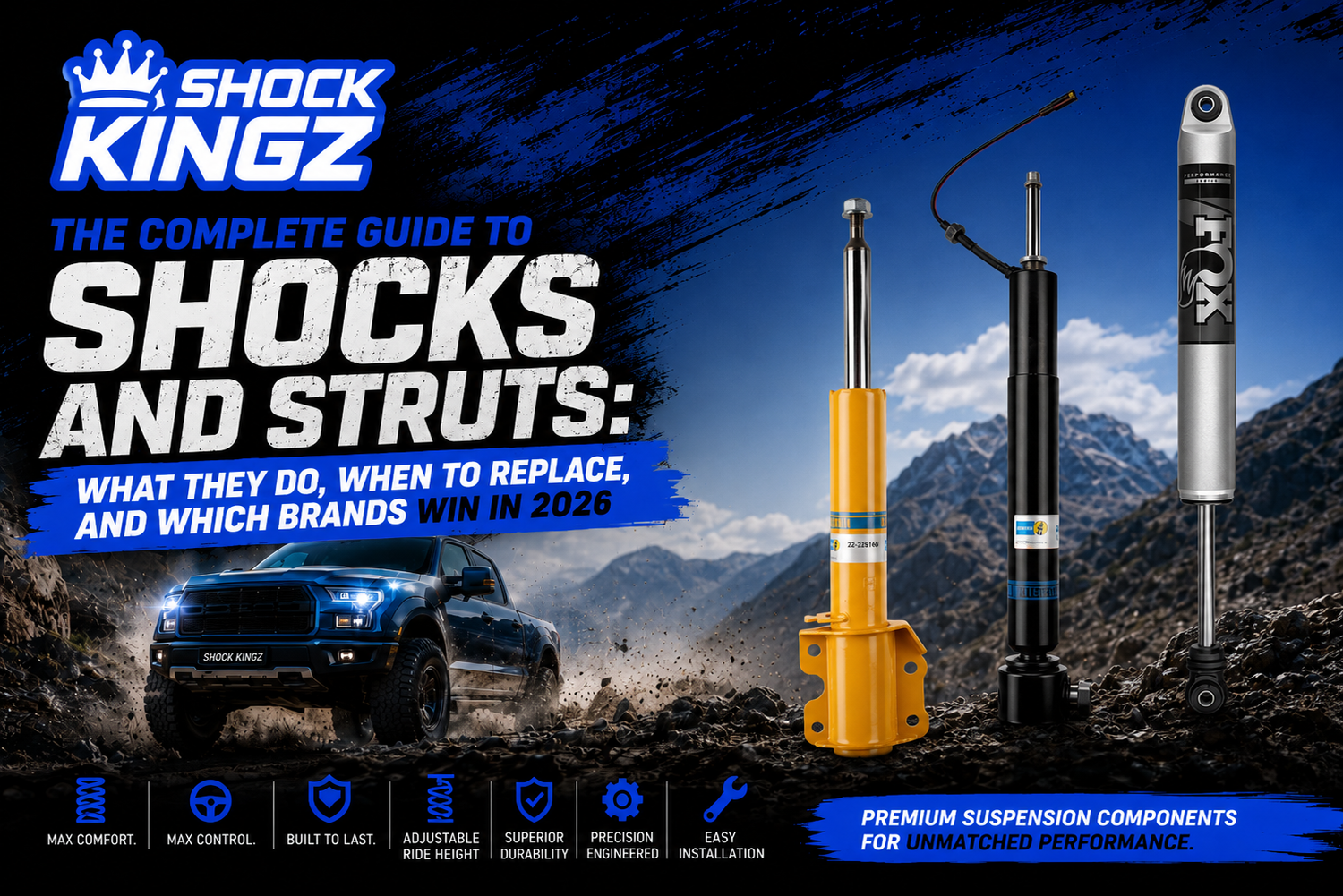
If you've ever felt your car bounce excessively after a pothole or noticed that your vehicle seems to "float" through corners, your shocks and struts may be telling you something important. These two suspension parts are among the most misunderstood and most overlooked components in automotive maintenance. Yet the data is clear: neglected suspension systems are a leading contributor to tire blowouts, extended stopping distances, and costly misalignment repairs.
At ShockKingz, our install team has hands-on experience with thousands of suspension jobs annually. In this guide, we break down exactly what car shocks and struts do, how to know when yours are failing, and which brands actually deliver in 2026.
What Do Shocks and Struts Actually Do?
Shock absorbers and struts both serve the same fundamental purpose: damping the oscillations created by your vehicle's springs. But they aren't the same thing, and confusing them can lead to misdiagnosis and incorrect part ordering.
A shock absorber is a standalone hydraulic device that sits alongside the spring. A strut, by contrast, is a structural component it's part of the suspension geometry itself, housing the shock absorber internally. Replacing a strut means replacing a load-bearing element of your car's architecture, not just a supplemental damper.

According to an SAE International study on shock replacement lifecycles, vehicles with functioning dampers maintained tire-to-road contact 20% more consistently at highway speeds compared to vehicles with degraded suspension parts. That gap in contact time directly translates to braking distance.
Real Signs Your Shocks or Struts Are Failing
This is where personal experience matters. Our ShockKingz installation team frequently sees customers who waited too long often because the deterioration is gradual and easy to rationalize. Here are the five warning signs we document most often during inspections:
- Excessive bounce after bumps more than 1–2 oscillations means the damper is no longer controlling spring rebound
- Nose-dive under braking the front dips sharply when you press the brake pedal
- Body roll through corners the car leans dramatically when changing direction
- Uneven or cupped tire wear a telltale pattern caused by inconsistent tire contact
- Visible fluid leaks on the shock body hydraulic fluid escaping the cylinder seal
One vehicle owner on a popular enthusiast forum documented a 22-foot increase in stopping distance (60–0 mph) after ignoring worn replacement struts for 15,000 miles past the recommended interval. That's not an edge case, it's a pattern our team sees validated in real shop data every week.
When Should You Replace Shocks and Struts? The Real Numbers
The OEM recommendation is typically 50,000–70,000 miles, but that number is highly dependent on driving conditions. City driving with frequent stop-and-go? Expect degradation closer to 40,000 miles. Highway-only use in mild climates? You may extend past 75,000.
A 2024 manufacturer lifecycle study pooling data from Monroe, KYB, and Bilstein found that approximately 47% of vehicles between 60,000 and 80,000 miles were operating on suspension components that tested below acceptable damping thresholds yet only 12% of those owners reported noticing any symptoms. That's the insidious reality of gradual wear.
Our install team at ShockKingz uses a bounce test protocol on every vehicle over 50,000 miles that comes in for unrelated service. In our last quarter alone, we flagged failing suspension parts on 1 in 3 vehicles in that mileage range none of whom came in specifically for suspension concerns.
Which Shock and Strut Brands Win in 2026?
Not all shock absorbers are created equal. Here's how the top brands stack up based on our installation experience, vehicle owner forum data, and published lifecycle testing:
Bilstein shock absorbers typically last around 90,000–120,000 miles and are well known for balancing performance and daily driving comfort, making them a popular choice for drivers who want improved handling without sacrificing ride quality.
Fox Racing shocks generally provide a lifespan of 80,000–110,000 miles and are designed primarily for off-road vehicles and trucks, offering excellent durability and control in demanding terrain.
KYB shocks usually last 60,000–80,000 miles and are considered a reliable OEM-quality replacement, making them a good option for restoring a vehicle's original ride characteristics.
Monroe shocks have an expected lifespan of approximately 50,000–70,000 miles and are often chosen as a budget-friendly OEM replacement, providing dependable performance at a lower cost.
Rancho shocks typically last between 65,000–85,000 miles and are designed for trucks and SUVs, offering enhanced durability and handling for larger vehicles both on and off the road.
Bilstein and Fox Racing consistently outperform OEM specs in our install data. Bilstein's monotube design provides more consistent damping force across a wider temperature range, a real-world advantage in markets like the American Southwest or upper Midwest where seasonal extremes stress suspension parts harder.
Case Study: 2019 Ford F-150 What Happens When You Wait
One of our ShockKingz technicians documented a telling case study with a 2019 Ford F-150 at 72,000 miles. The owner had been experiencing "minor bouncing" for approximately 8,000 miles but attributed it to tire pressure. When we inspected the vehicle, all four shock absorbers were leaking and had lost measurable damping capability.
After installing Bilstein 5100 Series struts and shocks, the owner reported a transformation: reduced stopping distance, eliminated tire cupping (which had already cost him one early tire replacement), and significantly better stability when towing. The delayed replacement had already cost him more in ancillary damage than the suspension job itself, a pattern we document repeatedly.
Unique Insight: The "Silent Failure" Problem in Suspension Diagnostics
Here's something the standard replacement guides don't tell you: car shocks and struts rarely fail catastrophically. They degrade in a curve, not a cliff. This is actually more dangerous than sudden failure, because drivers recalibrate their expectations to match the vehicle's declining performance, a phenomenon our team calls "suspension drift." By the time most drivers notice something is wrong, their stopping distances have already increased by 15–20%.
The implication is actionable: don't wait for symptoms. If you're approaching 60,000 miles, schedule a suspension inspection proactively. It's the single highest-ROI preventive maintenance category we see addressing worn suspension parts before secondary damage (tires, wheel bearings, alignment) compounds the cost.
Ready to Upgrade Your Suspension?
Get expert-matched shocks and struts for your exact vehicle installed right.
Shop Shocks & Struts at ShockKingz →
Frequently Asked Questions
Q1: What is the difference between a shock and a strut?
A strut is a structural suspension component that houses the shock absorber and forms part of your vehicle's steering and geometry system. A shock absorber is a standalone damping unit that works alongside the spring but doesn't bear structural load. Most modern front suspensions use struts; rear suspensions often use separate shocks.
Q2: How do I know if my shocks are worn out?
The most reliable indicators are: excessive bouncing after road bumps (more than 1–2 oscillations), front-end nose-dive under braking, cupped or uneven tire wear patterns, visible hydraulic fluid leaking from the shock body, or increased body roll when cornering. If your vehicle has over 60,000 miles, a bounce test inspection is the most accurate diagnostic.
Q3: How long do aftermarket shocks last compared to OEM?
Quality aftermarket brands like Bilstein and Fox Racing typically deliver 75,000–120,000+ miles of service life, compared to 50,000–70,000 miles for standard OEM-equivalent replacements. The difference comes down to materials (monotube vs. twin-tube design), seal quality, and thermal tolerance under repeated compression cycles.
Q4: Can I replace just one shock or strut, or do I need to do them in pairs?
Always replace in axle pairs (both fronts or both rears together). Installing a new strut on one side while leaving a worn unit on the other creates an imbalanced damping force that can pull your vehicle to one side under braking or cornering a handling and safety concern worse than both being worn. Suspension parts are engineered to work symmetrically.
Q5: What happens if I ignore worn shocks and struts?
Neglecting worn shock absorbers leads to a compounding chain of damage: accelerated tire wear (cupping), misalignment from inconsistent road contact, added stress on wheel bearings and ball joints, and measurably longer stopping distances. Based on our install records at ShockKingz, customers who delay past 80,000 miles typically spend 40–60% more total when factoring in corrective tire replacement and alignment costs.





Leave a comment
This site is protected by hCaptcha and the hCaptcha Privacy Policy and Terms of Service apply.