
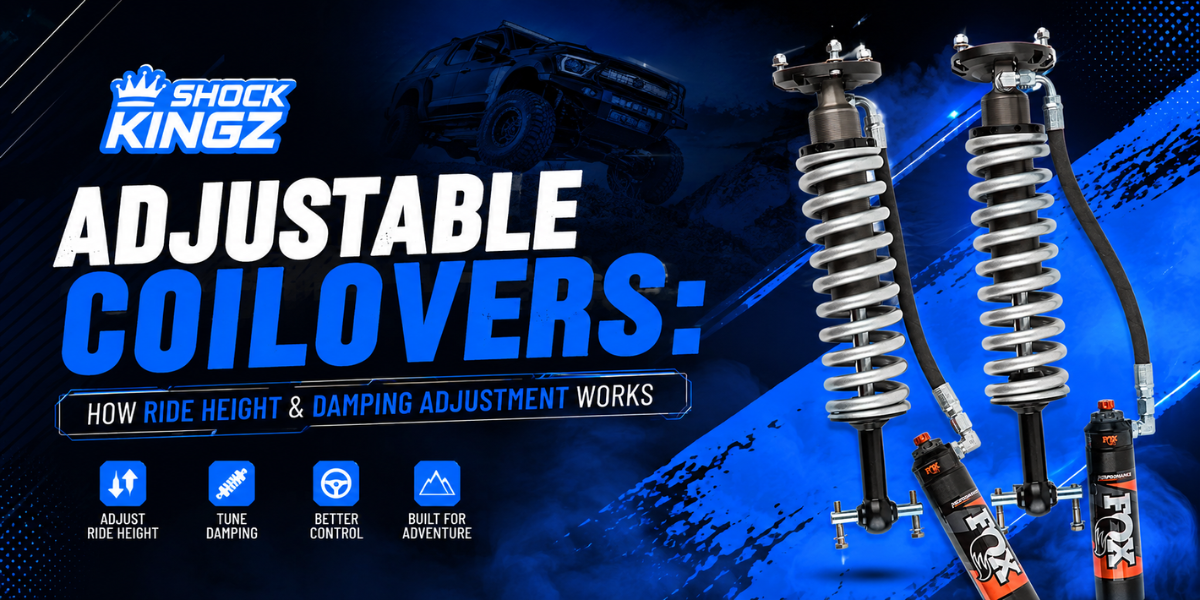
Adjustable coilovers let a driver change two separate things: ride height, by threading the spring perch or lower mount up or down the shock body, and damping, by turning a dial or knob that changes how much resistance the internal fluid provides during compression and rebound. These are two independent systems that happen to live in the same unit, and understanding them separately makes it much easier to know what you're actually changing when you make an adjustment.
For performance enthusiasts moving from stock or basic suspension into adjustable coilovers for the first time, conflating the two adjustments is one of the more common early mistakes. Turning the wrong ring or dial can change something you didn't intend to touch, so it's worth walking through each mechanism on its own before combining them.
How Ride Height Adjustment Works
Ride height adjustment on adjustable coilovers happens at the threaded body of the shock, where a spring perch or lower mount sits on machined threads. A locking collar directly below the perch holds it in position once height is set; loosening that collar with a spanner wrench allows the perch to be rotated, threading it up to raise the vehicle or down to lower it. Most kits move roughly one to one and a half millimeters of ride height per full rotation, though the exact figure varies by manufacturer and should be confirmed against the specific kit's documentation.
There are two general designs worth knowing. On coilover suspension kits with an adjustable lower mount, height is set independently of the spring, meaning the adjustment doesn't affect preload or reduce available suspension travel. On fully threaded designs, height is set by moving the spring perch itself, which does change spring preload as a side effect, since moving the perch also changes how much the spring is compressed at rest.
How Damping Adjustment Works
Damping adjustment is a separate system entirely, controlling how quickly the internal shock fluid moves through valving during compression and rebound rather than how high the vehicle sits. On many coilovers, a single dial adjusts compression and rebound together for simplicity; more advanced setups offer independent dials for each, letting a driver fine-tune how the suspension responds to bumps versus how quickly it settles afterward.

Turning the damping dial counterclockwise typically softens the setting, allowing fluid to move more freely and producing a more compliant ride, while turning it clockwise stiffens the damping, restricting fluid flow and producing tighter, more controlled body movement at the cost of some comfort. Neither direction is inherently correct; the right setting depends on whether the priority is daily comfort or maximum control during aggressive driving.
The Tools Involved: Spanner Wrenches and Adjustment Points
A spanner wrench, sometimes sold as a lock-ring or C-spanner wrench, is the standard tool for ride height adjustment, since the locking collar and spring perch both have machined notches designed for it. Most performance suspension systems ship with a spanner wrench included, and using two wrenches simultaneously, one on the perch and one on the locking collar, makes it easier to hold position while tightening the collar back down after adjustment.
Damping adjustment typically doesn't require a separate tool, since the dial or knob is designed for hand adjustment and often includes an audible or tactile click at each setting, making it possible to count clicks and return to a known baseline. Keeping track of the click count from a neutral setting is a practical habit, since it makes any future adjustment or troubleshooting far easier to reverse. For a closer look at the core components that make up a coilover unit, our companion guide breaks down the threaded body, spring perch, and damper in more detail.
What Changing Each Setting Actually Does to Handling
Ride height adjustment primarily affects the vehicle's center of gravity and, indirectly, suspension geometry, since lowering or raising the car changes control arm angles and can affect camber and toe. This is why any meaningful ride height adjustment, generally more than a small amount, calls for a professional alignment afterward to prevent uneven tire wear and maintain predictable handling.
Damping adjustment affects how the suspension responds to inputs rather than static geometry. Stiffer damping reduces body roll and improves responsiveness during hard cornering or track use, but transmits more road imperfection into the cabin. Softer damping smooths out daily driving but can feel less controlled during aggressive maneuvers. Because these two adjustments affect different things, ride height for stance and geometry, damping for how the suspension behaves dynamically, they should be thought of and adjusted as separate decisions rather than a single combined setting.
Keeping Adjustments Balanced Side to Side
Whichever adjustment you're making, matching settings on both sides of the vehicle matters more than most people expect. Uneven ride height side to side changes handling balance in a way that's often subtle until it shows up as a pull to one side or uneven tire wear, and mismatched damping settings between the left and right sides can make the car feel inconsistent through corners in opposite directions. Measuring ride height at a consistent reference point and counting damping clicks from the same baseline on both sides keeps the adjustment process accurate and repeatable.
Understanding these two systems separately, ride height through the perch and locking collar, damping through the internal valving and dial, gives performance enthusiasts a clearer foundation for tuning adjustable coilovers to match a specific vehicle, driving style, or event rather than adjusting by feel alone.
Call to Action
Ready to explore options? Shockkingz carries adjustable coilovers and performance suspension systems to help you find the right fit for your setup.
Frequently Asked Questions
Q1. How does ride height adjustment work on adjustable coilovers?
Ride height is adjusted by loosening the locking collar with a spanner wrench and rotating the spring perch or lower mount up or down the threaded shock body. Most kits move roughly one to one and a half millimeters per full rotation.
Q2. How does damping adjustment work on adjustable coilovers?
Damping is adjusted using a dial or knob that changes how much resistance the internal shock fluid provides during compression and rebound. Turning it one direction softens the ride, while the other direction stiffens it for more control.
Q3. Do I need special tools to adjust coilovers?
Ride height adjustment typically requires a spanner wrench to loosen and retighten the locking collar. Damping adjustment is usually made by hand using a dial or knob and doesn't require a separate tool.
Q4. Does adjusting ride height affect alignment?
Yes. Changing ride height alters suspension geometry, including camber and toe, so a professional alignment is generally recommended after any meaningful height adjustment to prevent uneven tire wear.
Q5. Why is it important to match adjustments on both sides of the car?
Uneven ride height or damping settings between the left and right sides can create a handling imbalance, such as pulling to one side or inconsistent cornering behavior, so both sides should be measured and adjusted from the same baseline.









Leave a comment
This site is protected by hCaptcha and the hCaptcha Privacy Policy and Terms of Service apply.