
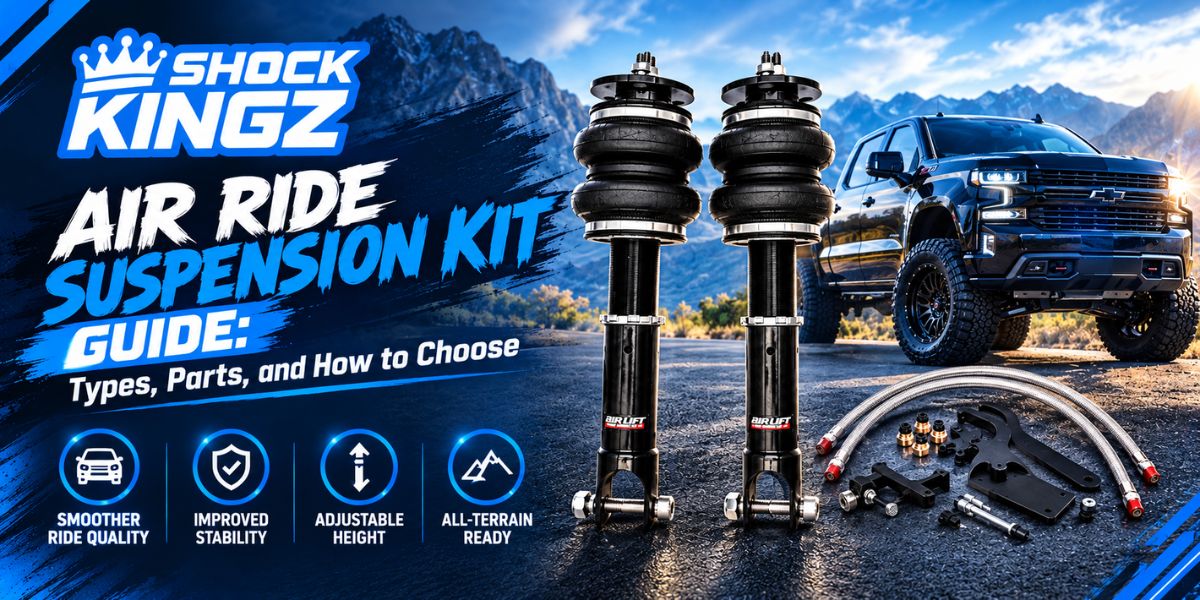
Few suspension complaints are as frustrating as a truck that sags the moment a trailer is hitched, or a lowered car that scrapes every driveway apron. Both problems share a root cause: a fixed ride height that cannot adapt to changing conditions. An air ride suspension kit solves that by using adjustable air pressure, rather than steel alone, to carry weight and set the stance of the vehicle.
The phrase covers a lot of ground, though. Some kits simply add an air spring to the factory suspension, while others replace the springs entirely with a full air system. This guide explains how each type works, which parts to expect, what adjustable ride height can realistically do, and how shoppers at ShockKingz can narrow the choices before buying.
What an Air Ride Suspension Kit Actually Does
A conventional coil or leaf spring has one rate. It is chosen to handle an average load, which is why an empty pickup can ride stiffly while the same truck with a loaded bed squats at the rear. Air behaves differently. Because the pressure inside an air spring can be raised or lowered, the supporting force changes with it. More pressure supports more weight, and less pressure softens the ride.
That adjustability is the core benefit. A driver can add pressure before towing, drop it for an unloaded commute, and, in some full systems, change vehicle height for clearance or appearance. Air does not add payload capacity, however. Gross vehicle weight ratings, hitch ratings, and axle limits still apply, and a kit only helps the suspension manage the load within those limits.
Two Very Different Types of Air Kits
Most confusion about air suspension comes from lumping two product categories together. They solve different problems, use different parts, and suit different buyers.
Air Helper Spring Kits
Helper kits keep the factory springs and add an air spring to support them. Brands such as Air Lift and Firestone are well known in this style, and the LoadLifter 5000 air spring kit is an example of the category. Helper kits are popular on trucks, vans, and SUVs that tow, haul, or carry heavy gear. The stock suspension still does the baseline work, so the vehicle generally keeps its original springs as a foundation. Always confirm that detail in the instructions for the exact kit.
Full Air Suspension Systems
Full systems replace the coil or strut spring with an air spring, usually paired with an air-compatible shock or strut. These are common on lowered cars, show builds, and some luxury vehicles. They offer a much wider height range, but they depend completely on the compressor, valves, and lines. A major air leak can leave the vehicle sitting on its bump stops, so installation quality matters far more here.
The table below summarizes how the two approaches differ.
| Feature | Air Helper Spring Kit | Full Air Suspension System |
|---|---|---|
| Main goal | Support loads and level the stance | Wide ride height range and stance control |
| Factory springs | Usually kept in place | Usually replaced by air springs |
| Common use | Towing, hauling, carrying gear | Lowered cars, show builds, luxury vehicles |
| Height range | Limited to load leveling | Much wider adjustment |
| Complexity | Lower | Higher |
| If air is lost | Factory springs still support the vehicle | Vehicle may sit on its bump stops |
Parts Inside a Typical Air Ride Suspension Kit
Kit contents vary by brand and vehicle, but most systems share the same building blocks.
Air Springs and Sleeves
The air spring is a flexible rubber and metal assembly that holds pressurized air. Its sleeve flexes as the suspension moves, and after many years the rubber can crack or leak. Owners who need a repair rather than a complete kit can look at a replacement air spring sleeve, though the sleeve type must match the original part.
Compressor, Tank, and Lines
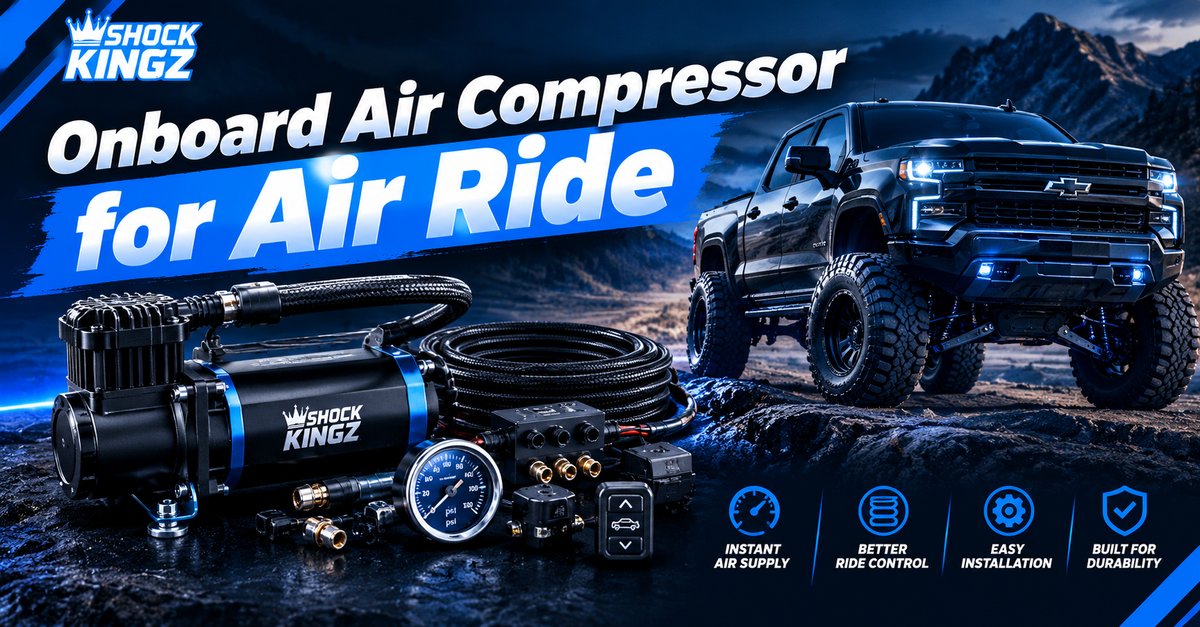
Systems that adjust on demand use an onboard compressor, often with a reservoir. The air tank components collection covers hardware that supports this kind of setup. Simpler helper kits skip the compressor and use a fill valve instead, topped up with a handheld inflator or shop air. Air lines should always be routed away from exhaust heat, sharp edges, and moving parts.
Air Suspension Valve and Controller
Valves decide where the air goes. In a basic kit, a single inflation valve sits near the bumper or in the wheel well. In more advanced systems, an air suspension valve routes air to each corner while a controller tells it what to do. ShockKingz lists a valves collection for this type of hardware. Wireless options such as the Air Lift wireless air control system let drivers adjust pressure from a phone app instead of a wired panel. A simple pressure gauge is still useful for confirming what the system is actually holding.

Adjustable Ride Height: What Air Can and Cannot Do
Adjustable ride height is the feature most shoppers want, yet expectations should match the kit. A helper kit mainly restores or levels the stance under load. It is not designed to raise a truck several inches. A full air system can change height more dramatically, but tire clearance, driveline angles, axle limits, and local regulations still apply.
For a deeper look at how height is set on mechanical hardware, the ShockKingz guide to ride height adjustment walks through the general process. The article on whether ride height adjustable shocks level a truck helps clarify how shock adjusters compare with air. In short, air lets pressure do the work, while mechanical adjusters rely on preload and spring seat changes.
One caution applies to every kit. Never chase height by running extreme pressure. Each kit lists a minimum and maximum pressure, and staying inside that range protects the springs, sleeves, and bump stops. Checking pressure when the tires are cold and the vehicle is parked on level ground also gives a more consistent reading from week to week.
How to Choose the Right Air Ride Suspension Kit
Start With the Job
Towing, hauling, camping gear, a sagging rear end, and show-style stance are all different goals. Towing and hauling point toward helper kits. A lowered, daily-driven car points toward a full air system. A vehicle with a worn or broken spring may need new springs before any air kit can do its job.
Confirm Exact Fitment
Check the exact Year, Make, Model, Trim or submodel, and drive type, along with cab style, bed length, and whether the vehicle has factory air or electronic suspension. Trims that share a name can use different spring or shock designs, so a kit that fits one version may not fit another. A fitment check before purchase prevents returns and wasted weekends.
Plan the Control Setup
Decide whether a manual fill valve, a wired dual-gauge panel, or an app-based controller suits the driver. Daily towing is easier with a compressor, while occasional haulers may be happy with a valve and an inflator. All-in-one packages, such as the Firestone wireless all-in-one kit listed for the Ram 3500 4WD, bundle components for a specific application, so read the listing closely.
Installation and Maintenance Notes
Many helper kits are marketed as bolt-on, but a safe installation still requires jack stands, correct torque values, and careful line routing. A full system is more involved. Professional installation is a sensible choice when wiring, tank mounting, or strut replacement is unfamiliar.
Ownership is straightforward. Check pressure periodically, inspect lines and fittings for rubbing, and look for leaks with soapy water if the vehicle sags overnight. Most manufacturers also specify a minimum pressure, so follow the kit instructions rather than letting the springs fully deflate.
Air springs also work best alongside healthy dampers. Springs support weight, while shocks control motion, so a worn shock paired with a new air spring will still bounce. The ShockKingz article on suspension tuning and ride quality explains how the two work together. Some off-road builders also use air-adjustable units such as a King air shock, which uses air pressure inside the shock body.
Common Mistakes to Avoid
- Shopping by brand name instead of exact fitment, which is the most common cause of returns.
- Treating an air kit as a lift kit. For true lift, the guide to suspension lift kits covers the options.
- Ignoring worn shocks, bushings, and mounts that will undermine the new air springs.
Final Thoughts on Choosing an Air Ride Suspension Kit
The right air ride suspension kit depends less on the brand and more on the job. Helper kits suit drivers who tow and haul and want a level, controlled stance. Full systems suit builders who want a wide height range and accept the added complexity. Brands like ShockKingz offer options for different suspension needs, but exact fitment, sensible pressure limits, and healthy shocks decide whether the kit feels like an upgrade.
Shoppers who verify the vehicle details first and match the control setup to real daily use usually end up with a system that works quietly in the background, which is exactly how good suspension should behave.
Find the Right Air Suspension Setup
Browse ShockKingz suspension parts, compare brands, and confirm fitment for your exact vehicle before you order.
Shop Suspension
Frequently Asked Questions
Practical answers about air ride suspension kits, ride height, compressors, fitment, and maintenance.









Leave a comment
This site is protected by hCaptcha and the hCaptcha Privacy Policy and Terms of Service apply.