
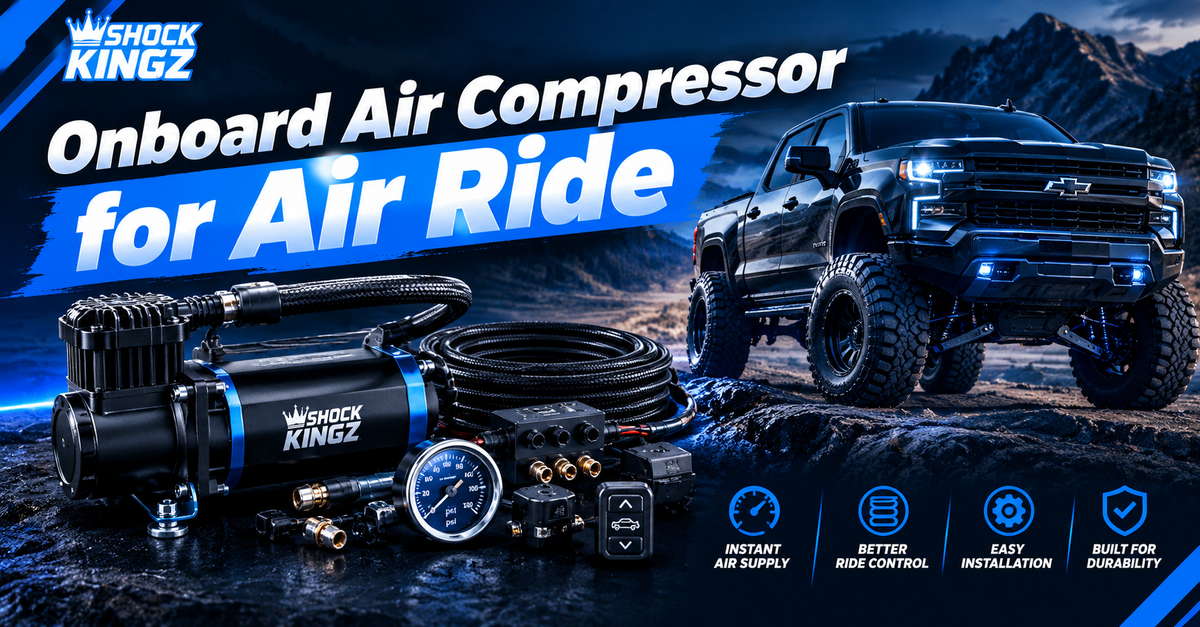
Air ride suspension gives a vehicle something a conventional spring setup cannot: adjustable air pressure and ride height. But that flexibility depends on a properly matched air-management system. At the center of that system is the onboard air compressor, which replenishes compressed air after adjustments and keeps the air tank ready for the next demand.
For a street car that only changes height occasionally, compressor requirements can be modest. A vehicle that repeatedly adjusts ride height, supports an air suspension setup, or uses compressed air frequently needs a system designed around higher demand.
The key is not simply buying the biggest compressor available. Compressor sizing, tank volume, operating pressure, duty cycle, electrical requirements, and intended use all need to work together.
What Does an Onboard Air Compressor Do?
An onboard air compressor converts electrical power into compressed air and sends that air into the system's storage tank. From there, valves and air lines distribute pressure to the appropriate air springs or other pneumatic components. The compressor itself does not normally make every ride-height adjustment directly. Instead, it keeps the tank supplied so the system has a reserve of compressed air available when adjustment is needed.
That distinction matters because tank capacity and compressor output solve different problems. A larger tank can provide a greater reserve for quick adjustments, while a higher-output compressor can replenish that reserve faster. A well-designed system balances both rather than relying entirely on one component.
Air Lift products available through ShockKingz include air spring systems designed for load support and ride control, making it important to consider the complete air-management setup rather than looking at the compressor in isolation.
How to Size an Onboard Air Compressor
There is no universal compressor size that works for every air ride installation. The correct choice depends on how the vehicle will use its air suspension.
Several factors deserve attention before selecting a compressor.
1. Air Tank Capacity
The tank acts as the system's compressed-air reserve. When the suspension needs a quick adjustment, stored air can be released without waiting for the compressor to generate pressure at that exact moment.
A larger tank can therefore be useful for systems that make frequent or larger adjustments.
The compressor then has the job of replenishing that tank after use.
This creates an important relationship:
Tank capacity affects how much air is available immediately, while compressor output affects how quickly that supply is restored.
Choosing a compressor without considering tank size can result in a system that looks powerful on paper but performs poorly in real-world use.
2. Required Fill Speed
Fill speed matters most when the vehicle frequently changes ride height.
A system used primarily for occasional adjustments does not necessarily need the same compressor output as a vehicle that regularly moves between multiple ride-height settings.
The desired response should therefore be considered before selecting equipment. Faster adjustment demands generally require greater air delivery and a system capable of handling that workload repeatedly.
3. Operating Pressure
Air suspension components operate within pressure ranges specified by their manufacturers. Compressor selection should account for the pressure required by the specific air-management system rather than relying on a generic maximum-pressure number.
The compressor needs to reach the required operating pressure while working within its intended duty cycle.
It is also important not to treat a compressor's maximum pressure as its normal operating pressure. Maximum pressure represents a capability; real-world performance depends on air delivery, system volume, temperature, and operating conditions.
4. Vehicle Use
The vehicle's purpose can dramatically change compressor requirements.
A daily-driven car with occasional ride-height adjustment has different needs from a show vehicle that repeatedly cycles its suspension throughout an event. A truck using air springs primarily for load support has another set of requirements.
ShockKingz currently carries Air Lift air-spring products for a range of vehicles, including universal and vehicle-specific applications. The available products demonstrate why exact vehicle fitment and intended use should be considered before purchasing.
Understanding Compressor Duty Cycle
Duty cycle is one of the most important specifications when choosing an onboard air compressor.
In simple terms, duty cycle describes how long a compressor can operate within a specified period before it needs to cool down. A compressor with a higher duty-cycle rating is generally better suited to applications that demand longer or more frequent operation.
This does not mean a higher duty cycle automatically makes one compressor better for every vehicle.
A compressor should be matched to the actual workload.
For example, a system that makes occasional ride-height corrections may not need the same continuous operating capability as a system that repeatedly fills the tank throughout the day.
Why Heat Matters
Compressing air generates heat. Repeated compressor operation can therefore increase temperature, especially when the compressor is working hard or operating in a poorly ventilated location.
Excessive heat can shorten component life and reduce consistent performance.
That is why duty cycle should be considered alongside compressor output. A compressor capable of producing the required pressure but unable to tolerate the application's operating pattern may not be the right choice.
The mounting location also matters. Adequate airflow and protection from excessive heat, moisture, dirt, and road debris can help the compressor operate more reliably.
Compressor Output vs. Duty Cycle
These specifications are related, but they are not interchangeable. Compressor output describes how much air the compressor can deliver under specified conditions. Duty cycle describes how long it can operate under its rated conditions before cooling is required.
A high-output compressor with an inadequate duty cycle may fill a tank quickly but struggle when operated repeatedly. A compressor with a suitable duty cycle but insufficient output may operate reliably yet take too long to replenish the tank. The goal is balance. For most air ride installations, the right compressor is the one that can supply the required pressure and air volume while comfortably handling the expected operating pattern.
Why the Air Tank Still Matters
It can be tempting to focus entirely on compressor specifications, but the tank plays a major role in system behavior.
A tank stores compressed air so the suspension can respond without waiting for the compressor every time a valve opens. That stored air can make repeated adjustments feel quicker and can reduce the need for the compressor to run during every individual adjustment.
However, a tank does not eliminate the need for a properly sized compressor. Once stored air is consumed, the compressor must replenish it. This is where compressor and tank sizing need to be considered together. Increasing tank volume without considering compressor recovery time can simply create a larger reserve that takes longer to refill.
How an Air Valve Controller Fits Into the System
An air valve controller manages where compressed air goes within an air suspension system. Depending on the system design, valves can control inflation and deflation of individual air springs or groups of air springs. The controller and valves therefore influence how precisely the vehicle can adjust its air pressure and ride height.
The compressor supplies the air, the tank stores it, and the valve system directs it. Thinking about the system in these separate functions makes troubleshooting and component selection easier.
If the compressor runs constantly, for example, the problem may not necessarily be compressor output. Air leaks, an undersized tank, excessive adjustment frequency, or an improperly matched system can also increase compressor workload.
Ride Height Adjustment and Compressor Demand
Ride height adjustment is one of the main reasons air suspension differs from a fixed spring setup. Lowering or raising the vehicle requires air to move into or out of the air springs. The amount of air required depends on the suspension components, pressure requirements, vehicle weight, and amount of height change.
Frequent large adjustments naturally place more demand on the air-management system than occasional minor corrections. This is why intended use should be established before selecting the compressor.
A system designed for occasional leveling does not necessarily need the same configuration as a performance-oriented air ride installation where ride height changes are a regular part of operation.
For vehicles where adjustable suspension behavior is the goal, ShockKingz also offers an extensive selection of coilover systems, including Air Lift Performance applications. Coilovers and air suspension solve ride-height goals differently, so the correct system depends on the vehicle and desired driving characteristics.
Electrical Requirements and Installation
An air compressor is an electrically powered component, so the vehicle's electrical system and installation need appropriate attention.
The wiring should follow the compressor manufacturer's requirements, including appropriate fuse protection, wire sizing, connections, and grounding. The compressor should also be mounted securely. A poor mounting location can expose it to unnecessary vibration, water, dirt, or heat. Air lines should be routed carefully to avoid sharp edges, moving suspension components, exhaust heat, and areas where abrasion could occur.
The air-management system should also be installed according to the manufacturer's instructions. Because suspension and air pressure systems can affect vehicle behavior, professional installation can be a sensible option when the installer is unfamiliar with pneumatic systems or vehicle suspension.
Common Onboard Compressor Mistakes
Several mistakes can undermine an otherwise good air ride setup.
- Choosing by maximum pressure alone: Maximum pressure does not tell the whole story. Air delivery, tank size, duty cycle, and operating conditions also matter.
- Ignoring duty cycle: Frequent compressor operation generates heat. A compressor should match the expected workload.
- Using the wrong tank size: An excessively small tank can require frequent compressor cycling, while an oversized tank may take longer to refill.
- Poor mounting: Heat, moisture, vibration, and debris can affect compressor reliability.
- Ignoring leaks: A small leak can cause the compressor to run repeatedly as the system loses stored air.
- Skipping fitment checks: Air suspension components are not universally interchangeable. Vehicle year, make, model, trim, drivetrain, and existing suspension configuration should be checked before purchasing.
ShockKingz uses vehicle-specific fitment information on its product listings, and buyers should verify exact application details before ordering.
Choosing the Right Setup for the Vehicle
The best approach is to start with the vehicle's actual requirements rather than selecting a compressor first.
Consider:
- How often the suspension will be adjusted
- How quickly adjustments need to happen
- Required operating pressure
- Air tank capacity
- Expected compressor run time
- Available mounting space
- Electrical requirements
- Environmental exposure
Existing air suspension components. A compressor should then be selected as part of the complete system. For vehicles using air springs primarily for load support, the goal may be maintaining level ride height under changing loads. For an air ride performance setup, frequent height adjustment and response may be more important.
ShockKingz's current catalog includes Air Lift air spring kits, compressors, controllers, and other suspension-related products, making the complete system worth evaluating before selecting individual components.
When to Consider an Air Ride Upgrade
Air suspension can be useful when adjustable ride height or variable load support is a priority. Air Lift 1000 products available through ShockKingz, for example, are designed to provide additional support within compatible coil-spring applications. Their product information emphasizes adjustable air pressure for changing load conditions.
The important point is that an air ride system should be selected around the vehicle's actual requirements. A properly matched compressor, tank, valves, air lines, and air springs work as a system. Changing one component without considering the rest can create an imbalance that limits the performance of the entire installation.
Conclusion
Choosing an onboard air compressor for air ride is less about finding the largest compressor and more about matching the complete system to the vehicle's requirements. Tank capacity determines how much compressed air is available for immediate use. Compressor output determines how quickly that supply can be restored. Duty cycle determines how well the compressor can handle repeated operation, while the valve system controls where that compressed air goes.
Before purchasing, the vehicle's intended use, operating pressure, adjustment frequency, tank size, electrical requirements, and exact component compatibility should all be considered. For suspension components and air-spring applications, ShockKingz offers products from established suspension brands, including Air Lift, alongside shocks, struts, coilovers, and other suspension components.
Frequently Asked Questions
What does an onboard air compressor do for air ride?
An onboard air compressor supplies compressed air to your air ride system, helping refill the air tank and maintain the pressure needed for ride-height adjustment and suspension control.
How should an air ride compressor be sized?
Compressor sizing depends on your vehicle, air tank capacity, operating pressure, desired fill speed, and how frequently you adjust ride height.
Why is compressor duty cycle important?
Duty cycle indicates how long a compressor can operate before it needs cooling time. A higher-duty-cycle compressor is better suited to systems that require frequent adjustments or repeated tank refills.
Does an air ride system need an air tank?
An air tank provides a reserve of compressed air and allows the system to make faster suspension adjustments.
What matters during compressor installation?
Proper electrical wiring, adequate ventilation, secure mounting, clean air intake routing, and correct plumbing are important for reliable compressor performance.
OWN THE STANCE. CONTROL THE RIDE.
Upgrade your build with performance-driven air ride components.
Shop Air Ride Parts →OWN THE STANCE. CONTROL THE RIDE.
Upgrade your build with performance-driven air ride components.
Shop Air Ride Parts





Leave a comment
This site is protected by hCaptcha and the hCaptcha Privacy Policy and Terms of Service apply.