
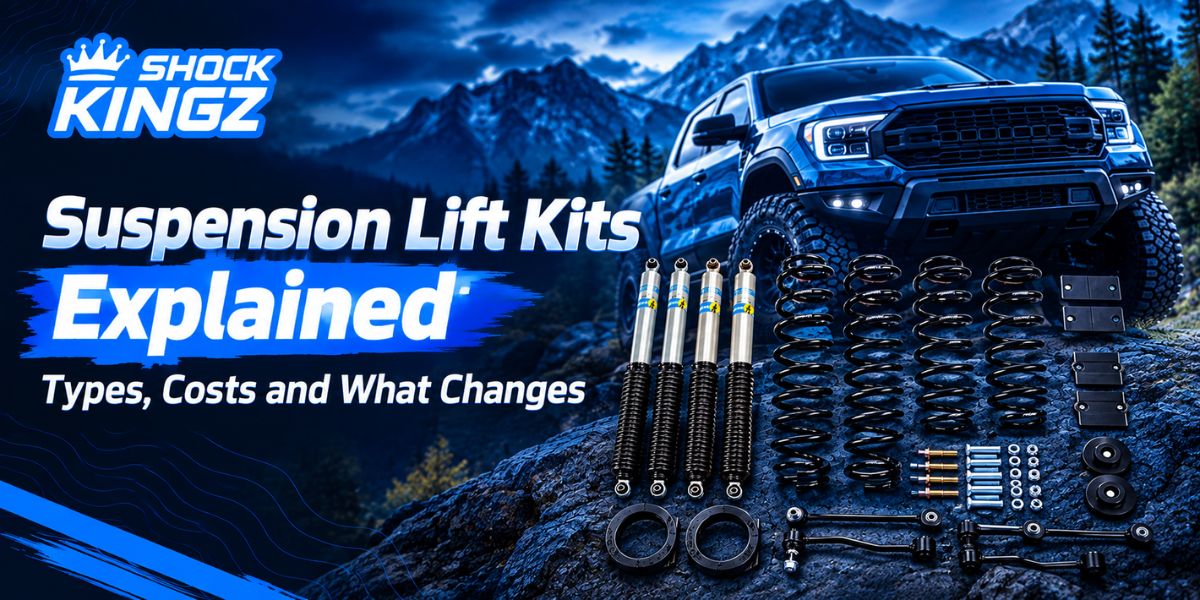
A suspension lift kit raises a vehicle by replacing or extending its springs, shocks, and sometimes its control arms. Simple spacer and leveling setups can cost a few hundred dollars. Complete systems commonly start near $1,700 and pass $10,000 for large-lift, vehicle-specific builds, before installation, alignment, and tires. The right kit depends on how much clearance you need and how much factory handling you want to keep.
This guide covers how kit types differ, what they cost, and what changes once your vehicle sits higher.
What Does a Suspension Lift Kit Include?
Contents vary widely, so two kits with the same advertised lift can differ in price and behavior. A kit may be a pair of spacers, or a full set of springs, shocks, control arms, brackets, and hardware. Read the parts list carefully. Stage names such as "Stage 1" or "Stage 2" are set by each brand, so they are not a standard you can compare across manufacturers.
What Are the Main Types of Suspension Lift Kits?
For the classic body lift, leveling, and full-lift breakdown, see our earlier guide to types of suspension lift kits. Here, the focus is how each approach gains its height, because that shapes ride quality and cost.
Spacers and lift blocks
Spacers sit above a coil spring or strut, or between the axle and a leaf spring, and push the vehicle upward. They are inexpensive and simple, and they keep your factory shocks. The trade-off: they add height without adding suspension travel, so shocks may run closer to the end of their stroke.
Height-adjustable shocks and lift springs
Some replacement shocks have an adjustable spring seat that sets front height while keeping factory springs. Published lift ranges for these designs commonly run from zero to roughly 2.5 inches, depending on the vehicle. Our article on ride height adjustable shocks explains when they level a truck and when they will not. Lift springs can serve a similar purpose at the rear.
Complete suspension kits
Complete suspension kits bundle matched springs or coilovers with shocks valved for the new height, and some add brackets or control arms. One example is a 3-inch system for 2007–2018 Jeep Wrangler JK, whose listing describes dual-rate springs and vehicle-specific shocks with clearance for 33-inch tires. Check each listing for exactly what ships in the box.

Large-lift systems with upgraded arms
Lifts of roughly 4 to 6 inches change suspension geometry enough that redesigned upper control arms often become part of the package. These systems cost the most and take the most installation work.
| Approach | Typical Use | What It Changes | Limitation |
|---|---|---|---|
| Spacers / Lift Blocks | Small height gain | Ride height | No added suspension travel |
| Adjustable Shocks / Lift Springs | Leveling, modest lift | Height and damping | Limited lift range |
| Complete Kits | Roughly 2–4.5 in. | Height, travel, damping | Higher cost and more labor |
| Large-Lift With Arms | Roughly 4–6 in. | Geometry and clearance | Highest cost and additional parts |
How Much Does a Suspension Lift Kit Cost?
Price follows scope. In current retail listings reviewed for this guide, parts-only prices fall roughly into these bands:
| Kit level | Typical parts price |
|---|---|
| Lift blocks or lift springs | About $150–$300 |
| Partial or front-end kits | About $1,000–$1,250 |
| Complete kits (2–4.5 in.) | About $1,700–$5,000 |
| Large-lift, vehicle-specific systems | About $8,600–$12,300 |
Prices shift by vehicle, brand, and promotion, so treat these as orientation, not quotes. Budget separately for:
Installation labor, which varies by shop and vehicle
- A post-install alignment
- Larger tires and wheels, if they motivate the project
- Supporting parts such as extended brake lines, track bars, or driveshaft changes
- Speedometer recalibration
Want to see what is available for your vehicle? Browse the lift kits collection and use the year, make, and model selector to narrow the list.
What Changes When You Lift a Vehicle?
Height is only part of the story. Expect these effects:
- Center of gravity. A taller vehicle rolls more in corners and responds differently in quick direction changes. For performance driving, choose the smallest lift that meets your tire and clearance goals.
- Alignment geometry. Camber, caster, and toe shift, and control arm angles change. An alignment belongs in the plan, and larger lifts may need adjustable arms.
- Driveline angles. Driveshaft and axle angles change on 4WD and rear-drive vehicles. Unaddressed, that can cause vibration and wear.
- Brake lines and linkages. Brake lines, sway bar links, and track bars may need extending or relocating.
- Tires and calibration. Larger tires affect speedometer accuracy, gearing, braking distance, and fuel economy. Vehicles with driver-assistance cameras or sensors may need recalibration, so check the manufacturer's guidance.
- Ride quality. It can improve or get harsher, depending on spring rates and shock valving.
- Legal limits. Maximum height and bumper rules vary by state or region.
How Do You Choose an Aftermarket Suspension Kit?
Start with the goal rather than the inch count. Our suspension kit buying guide covers fitment, included parts, and matching a kit to daily driving, towing, or trail use. Use this checklist before you order:
- Confirm year, make, model, submodel, and drive type
- Define your pavement-to-trail split and target tire size
- Pick the smallest lift that meets your clearance needs
- Compare included parts, not stage labels
- Confirm shocks are valved for the lift height
- Budget for alignment, installation, and supporting parts
Weighing complete suspension kits against separate parts? A matched set reduces guesswork on shock length and spring rate, while separate parts allow more customization. Browse suspension packages to see how matched sets are listed.
Common Suspension Lift Kit Mistakes
- Buying by lift height alone. Component quality, fitment, and included parts matter just as much.
- Mixing parts not designed together. Mismatched shocks and springs can ride poorly or run out of travel.
- Skipping the alignment. Wrong angles wear tires quickly.
- Assuming one kit fits every trim. Engine, trim, and drivetrain can change what fits.
Lifting a larger vehicle? Compare control arm options and confirm each listing's fitment before you decide.
Conclusion
Choosing the right suspension lift kit comes down to your vehicle, driving style, budget, and clearance needs. While a modest lift can improve ground clearance and provide room for larger tires, a complete system can offer a more balanced approach to ride quality, suspension travel, and handling when properly matched to your vehicle. Before buying, confirm fitment, compare included components, and account for installation and alignment costs. ShockKingz makes it easier to explore suspension upgrades for your build. Browse our lift kits collection to find options that fit your vehicle and driving goals.
Frequently Asked Questions
Practical answers about suspension lift kits, ride quality, installation, fitment, and maintenance.
Will a suspension lift kit make my ride rougher?
Not necessarily. Ride quality depends on spring rates, shock valving, and lift height. Some kits are tuned for comfort and others for off-road control. Read the listing, and ask the manufacturer or retailer about intended use before buying.
Can I install a suspension lift kit myself?
Smaller bolt-on kits may be manageable with proper tools, safe lifting equipment, and a service manual. Compressing springs and larger lifts raise the difficulty and the risk. If you are unsure, professional installation and alignment are the safer route.
Do I need new shocks with a lift kit?
Usually you need shocks suited to the new height. Factory shocks may be too short, limiting how far the suspension can extend. Complete kits normally include matched shocks, but confirm that in the parts list.
Can a lift kit affect my vehicle warranty?
It can, depending on the vehicle maker's and the part maker's terms. Policies differ. Ask your dealer and the kit manufacturer before installing, and get their answers in writing.
How do I know which tire size a lift kit supports?
Manufacturers often state a maximum tire size in the listing, but real clearance depends on wheel offset and fender trim. Treat the figure as a starting point, then confirm wheel and tire dimensions with the manufacturer.
How often should lifted suspension be inspected?
Many installers recommend re-checking hardware torque after an initial break-in period, then inspecting bushings, ball joints, and shocks at regular service intervals. Follow the instructions included with your kit.
Ready to Take Your Build Further?
Get the ground clearance, tire fitment, and trail-ready capability your vehicle needs. Explore suspension lift kits at Shockkingz and find the right setup for your next adventure.
Shop Lift Kits →




Leave a comment
This site is protected by hCaptcha and the hCaptcha Privacy Policy and Terms of Service apply.