
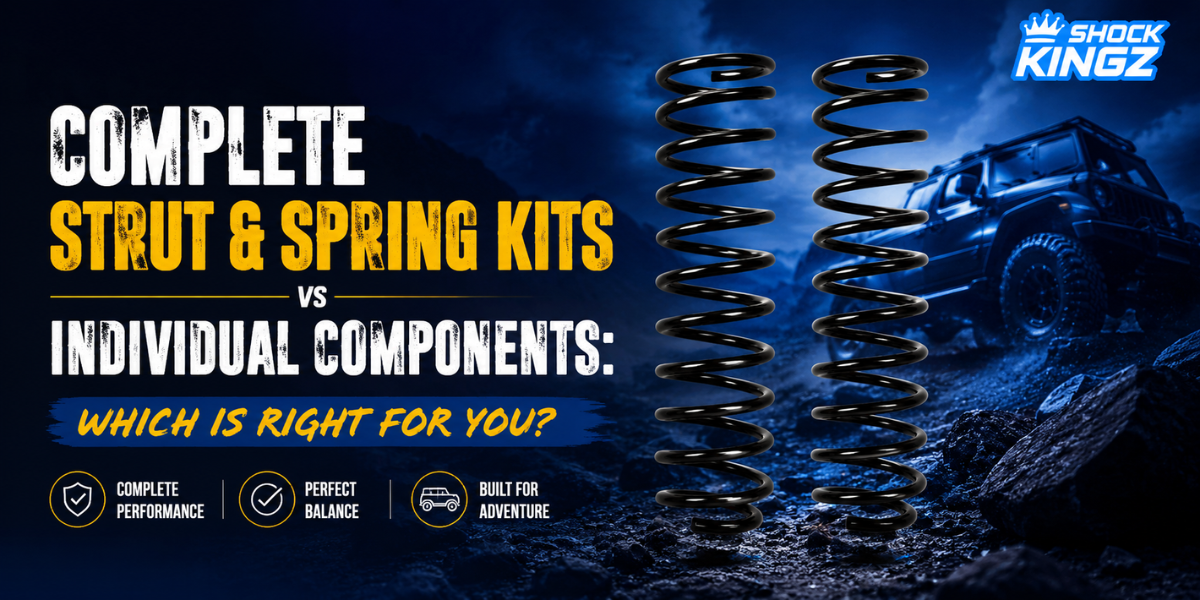
A complete strut and spring kit costs more upfront but saves significant labor time and removes the risk of mismatching components, while sourcing individual parts costs less in materials but requires more time, a spring compressor, and careful attention to matching spring rate and strut valving correctly. For most DIY installers without a spring compressor already on hand, the complete kit is the more practical choice; for experienced installers with the right tools who are optimizing for the lowest possible parts cost, individual components can still make sense.
That tradeoff is really the whole decision in miniature, but the details behind cost, labor, part-matching risk, and warranty coverage are worth understanding before choosing either path, since the "right" answer depends heavily on your specific situation rather than one option being universally better.
Cost vs. Time: Where the Money Actually Goes
A complete strut and spring kit typically costs more in parts than buying a bare strut alone, often by a meaningful margin, because the manufacturer has already matched and assembled the strut, spring, and mount as a unit. Sourcing individual parts, a strut, a separately purchased coil spring, and a mount, usually costs less in materials but doesn't include that assembly labor, which the installer has to perform instead.
The time difference is significant. Installing a complete assembly typically cuts total job time roughly in half compared to assembling individual components, since there's no spring compression step. For a DIY installer without a spring compressor, that tool alone adds cost and a learning curve on top of the individual-parts price, which narrows the apparent savings considerably once you account for it.
Labor Complexity and the Part-Matching Risk
Working with individual parts means the installer takes on the job the manufacturer normally does: verifying that the coil spring's rate matches the strut's valving, correctly seating the spring during compression, and torquing the upper mount under spring load. Any mismatch between spring rate and strut valving can produce a ride that feels wrong even though every individual part is functioning correctly, and that kind of subtle mismatch is difficult to diagnose after the fact.

A shock and spring assembly kit or quick strut assembly removes that risk because the manufacturer has already validated the spring rate against the strut valving for the specific application. This matters more than it might seem: a mismatched spring and strut combination doesn't usually announce itself as an obvious failure, it just produces suboptimal handling that's easy to attribute to something else entirely.
Warranty Coverage: What Changes
Warranty terms differ in a way that's easy to overlook when comparing prices. A complete kit typically carries a single warranty covering the strut, spring, and mount as a matched assembly, since the manufacturer is vouching for the whole unit working together. When you source individual parts, each component may carry its own separate warranty from its own manufacturer, and if a problem develops, it can be harder to determine whether the strut, the spring, or the installation itself is responsible.
This matters practically if something goes wrong. Diagnosing a warranty claim on a single matched assembly is generally simpler than sorting out which of three separately sourced parts caused an issue, and some sellers will point to installation or part mismatch as reasons to deny a claim on individually sourced components.
Side-by-Side Comparison
Here's how the two approaches stack up across the factors that matter most for a DIY install:
|
Factor |
Complete Strut and Spring Kit |
Individual Components |
|---|---|---|
|
Parts cost |
Higher upfront cost |
Lower upfront cost |
|
Installation time |
Roughly half the time of individual parts |
Longer, includes spring compression |
|
Tools required |
No spring compressor needed |
Spring compressor required |
|
Part-matching risk |
Low pre-matched by manufacturer |
Higher must verify spec match yourself |
|
Warranty |
Single warranty on the matched assembly |
Separate warranty per component |
Neither column is universally "better." A complete kit trades money for time, safety, and certainty. Individual parts trade time and some risk for a lower upfront cost, which can be the right call for an experienced installer who already owns the tools and is comfortable verifying spec compatibility.
Which Option Fits Your Project
If you're doing a strut replacement for the first time, don't already own a spring compressor, or simply want the lowest-risk path to a correctly matched setup, a complete strut and spring kit or coil spring and shock replacement kit is generally the more sensible choice despite the higher sticker price. If you've done spring compression safely before, already have the tools, and are specifically trying to minimize cost on a project where you're confident in matching specs correctly, individual components can save money without meaningfully increasing risk.
Both paths fall under the broader category of aftermarket suspension systems, and neither is a wrong choice on its own; they simply optimize for different priorities. Understanding what you're actually trading, money for time and certainty, or savings for added complexity, is what makes the decision straightforward rather than guesswork.
Call to Action
Ready to compare options for your vehicle? Shockkingz carries a range of shock and spring assembly kit options as well as individual components to fit your project and budget.
Frequently Asked Questions
Q1. Should I buy a complete strut and spring kit or individual parts?
A complete kit costs more but saves roughly half the installation time and removes the need for a spring compressor, making it the more practical choice for most DIY installers. Individual parts cost less but require more time, tools, and careful spec matching.
Q2. Is it risky to mix a coil spring and strut from different sources?
It can be. If the spring rate doesn't match the strut's valving, the ride can feel wrong even though each part functions correctly on its own, and that kind of mismatch is difficult to diagnose after installation.
Q3. Do I need a spring compressor if I buy individual parts?
Yes, in most cases. Sourcing an individual strut and spring requires compressing the spring safely during installation, which adds tool cost and a learning curve compared to a pre-assembled kit.
Q4. Does a complete strut kit have better warranty coverage?
Often, yes. A complete kit typically carries a single warranty covering the strut, spring, and mount as a matched assembly, while individually sourced parts may each carry separate warranties, which can complicate a claim if something goes wrong.
Q5. Is it ever worth buying individual suspension components instead of a kit?
Yes, for experienced installers who already own a spring compressor and are confident matching spring rate to strut valving. In that case, individual parts can lower the total cost without meaningfully increasing risk.




Leave a comment
This site is protected by hCaptcha and the hCaptcha Privacy Policy and Terms of Service apply.