
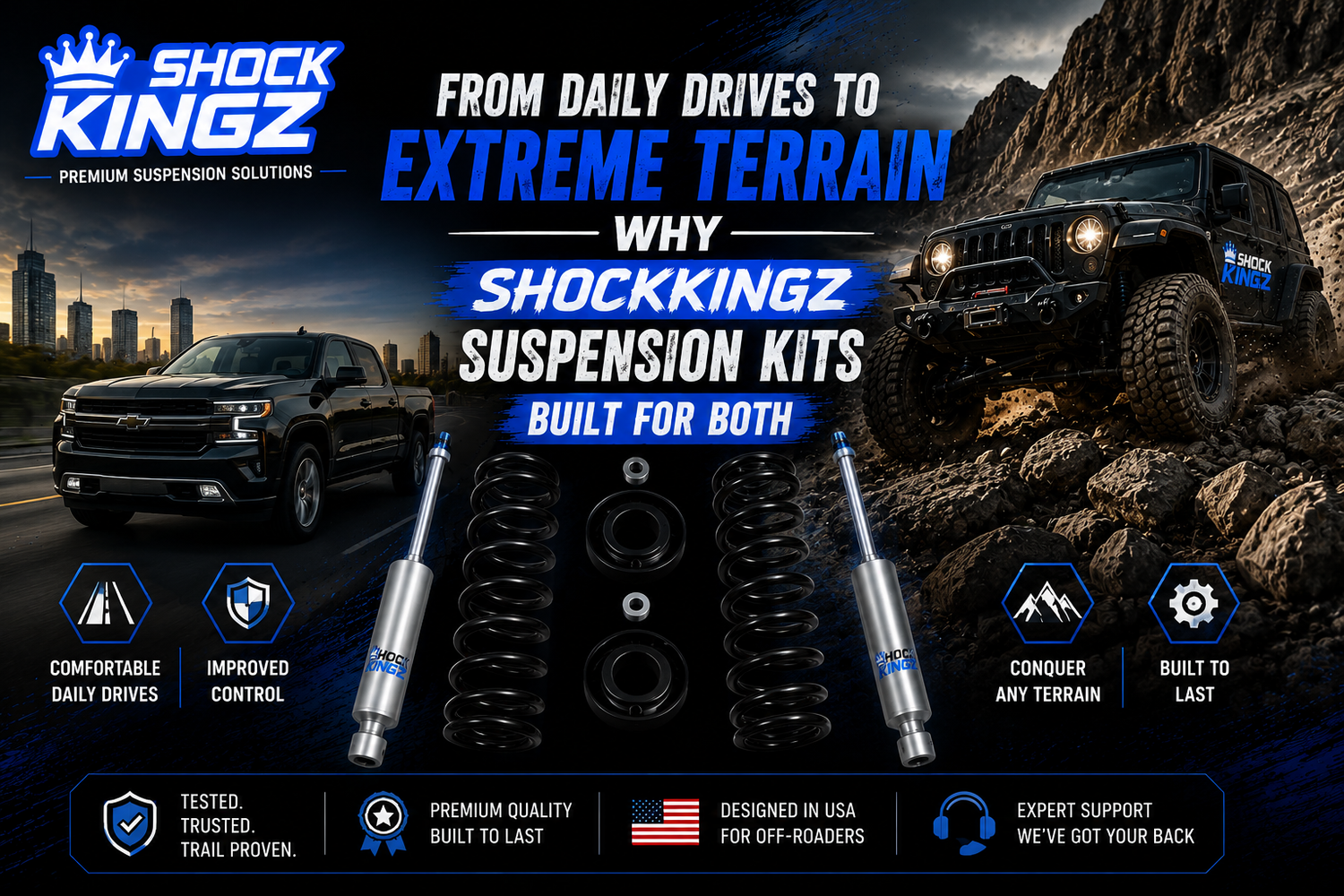
Most suspension upgrades are built for one thing. Either they're soft enough for comfort on smooth roads but fall apart on a rough trail, or they're tuned so stiff that your daily commute feels like a punishment. The sweet spot - a setup that handles both without compromising either - is harder to find than most people expect.
That's exactly what a matched suspension kit is designed to solve. Not just better shocks, not just stiffer springs - a complete system where every component is calibrated to work together across the full range of what you actually put your vehicle through. It's the approach ShockKingz has built its entire catalog around - matched kits by vehicle, by use case, by the way you actually drive.

Why "One Size Fits All" Suspension Usually Fits Nobody
Stock suspension is engineered around one scenario: average roads, average loads, average driving. The moment your usage shifts - heavier cargo, a weekend trail, faster cornering - the limits show up fast. The truck squats under load. The SUV leans in corners it used to handle clean. The car bottoms out on a rut that wasn't there last week.
An aftermarket suspension kit doesn't just replace worn parts - it replaces the assumptions built into the factory setup. Springs matched to your actual weight and use. Shocks tuned for the damping your driving demands. Everything working together from the start instead of being retrofitted one piece at a time.
What Changes Between Daily and Extreme Use - and How a Kit Handles Both
The difference between a comfortable daily commute and a hard off-road trail comes down to two things: input speed and load variation.
City roads and highways deliver slow, predictable inputs - mild bumps, gradual load shifts. Off-road terrain does the opposite: rapid, unpredictable impacts, uneven weight distribution, heat from sustained shock compression. A kit built for versatility has to manage both.
Here's how the main suspension types compare across use cases:
| Use Case | What the Suspension Faces | Kit Priority | Shop at ShockKingz |
|---|---|---|---|
| Daily commuting | Potholes, speed bumps, highway miles | Comfort, noise reduction, longevity | Shock & Spring Kits |
| Towing & hauling | Heavy rear loads, brake dive, sway | Load stability, level ride, control | Shock & Spring Kits |
| Weekend trails | Rocks, ruts, uneven weight transfer | Travel, heat tolerance, articulation | Shock & Spring Kits |
| Extreme terrain | Sustained abuse, heat buildup, impacts | Reservoir shocks, maximum travel | Shock & Spring Kits |
The Daily Driving Difference
Most people notice the daily driving improvement before anything else, because it's the one they feel every single day. A properly matched spring rate means the car stops bobbing over speed bumps. Upgraded damping absorbs the sharp edge of a pothole instead of transferring it straight to the seat. Noise from worn bushings and loose mounts disappears.
None of this requires a stiff race-tuned setup. The best street kits are specifically valved to be soft enough for comfort on regular roads while holding enough damping authority to stay composed when conditions change suddenly - a car that cuts in front of you, a patch of rough road that appears without warning.
What Extreme Terrain Actually Demands
Rough terrain is harder on suspension than most people realize - not because individual impacts are so violent, but because they never stop. One boulder, one rut, one washboard section is manageable. Three hours of it back-to-back is what separates a quality kit from one that fades and wanders by the end of the day.
The core challenge is heat. Every compression stroke generates heat inside the shock fluid, and once that fluid gets too hot, damping goes soft and unpredictable. Kits designed for serious off-road use address this with larger shock bodies, more fluid capacity, and in some cases external reservoir canisters that pull heat away from the main shock body entirely.
The result is a setup that performs on hour three of a hard trail the same way it did on hour one - which is exactly what you need when you're miles from the nearest pavement and control matters most.
How to Read Your Current Suspension
Before upgrading, it helps to know what you're working with. A few quick checks:
- Bounce test - push down on each corner and release. More than two rebounds means the shock is done
- Visual check - any oil film or visible weeping on the shock body means it's leaking
- Load test - sit a heavy load in the truck bed and watch if the rear sags noticeably more than an inch or two
- Highway feel - if the vehicle drifts or requires constant minor steering corrections, damping has likely faded
Two or more of these pointing toward worn suspension is a clear signal. Not sure whether to go kit or individual parts? Our Shock & Spring Kit comparison guide breaks down exactly why a matched kit wins every time.
Installation: One Thing Most People Skip
Kits go in cleaner and perform better when they're installed together rather than mixing old and new components. New shocks against old, compressed springs means the damping is fighting a spring rate it wasn't designed for. New springs on old, tired shocks means the springs are doing all the work while the shocks contribute almost nothing.
Professional alignment after install isn't optional - it's what converts a mechanical improvement into an actual driving improvement. Skip the alignment and half the benefit stays on the shop floor.
Frequently Asked Questions
1. Can one suspension kit really handle both daily driving and off-road use?
Yes - the key is correct spring rate and damping valving for your vehicle's weight and typical load. A properly matched kit handles daily comfort and moderate trail use without needing separate setups for each.
2. Will upgrading my suspension make my daily ride harsher?
Not if the kit is matched correctly. A street-oriented kit is valved for comfort on regular roads. You'll actually notice an improvement in smoothness compared to worn factory shocks - the harshness most people attribute to "performance" kits comes from wrong spring rates, not from upgrading itself.
3. What's the difference between a shock and spring kit vs just replacing shocks?
Shocks and springs are calibrated together - the damping rate is designed around a specific spring rate. Replacing only shocks means the new damping fights the spring it wasn't designed for, which creates either a bouncy or an overly stiff ride. A matched kit avoids that mismatch.
4. How do I know if my current suspension is worn out?
Do the bounce test - push down each corner and count rebounds. More than two means it's gone. Other signs: oil on the shock body, rear squat under load, wandering at highway speed, and uneven tire wear across the tread.
5. How do I find the right kit for my vehicle?
Use the year, make, and model selector on ShockKingz - every kit in the catalog is matched to specific vehicle fitments. Filter by use case (street, off-road, towing) and you'll see exactly what's built for your rig.
ShockKingz - "Your Road Doesn't Define Your Suspension. Your Kit Does."
Matched kits for daily drivers, overland rigs, and everything in between - all by vehicle fitment.
Find My Suspension Collection: https://shockkingz.com/collections/
Browse by vehicle → filter by use case → get the right kit the first time.




Leave a comment
This site is protected by hCaptcha and the hCaptcha Privacy Policy and Terms of Service apply.