
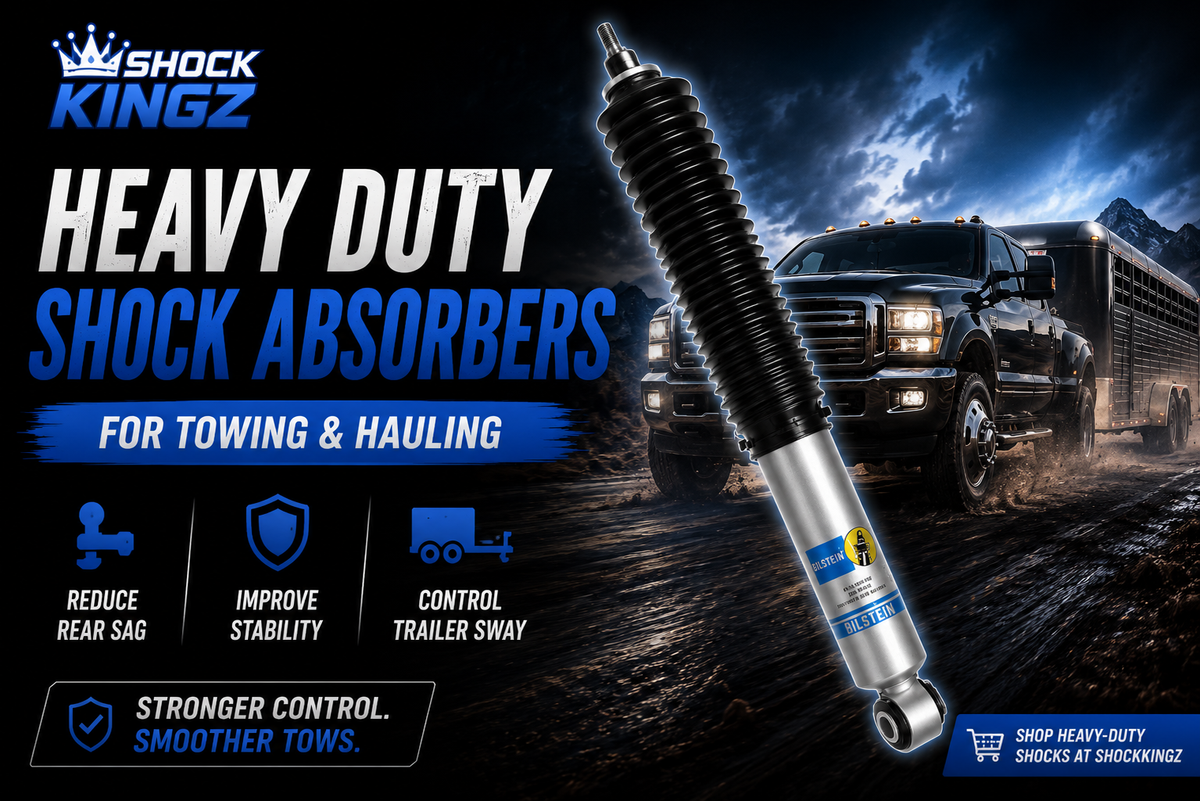
Anyone who has towed a loaded trailer down a long mountain grade knows the feeling: the truck starts to porpoise over expansion joints, the side mirrors show the trailer swaying a beat behind the cab, and the whole rig feels loose at highway speed. That sensation rarely comes from the hitch. More often it comes from the suspension, and specifically from shocks that were never engineered for the loads truck owners actually put on them.
Heavy duty shock absorbers reduce rear sag, body roll, and trailer sway by adding more compression damping at higher suspension loads. Factory shocks are valved for a truck's empty curb weight, not its maximum GVW, so upgrading to load-rated performance shocks delivers an immediate, measurable difference for anyone who tows or hauls on a regular basis.
Why Factory Shocks Fall Short Under Load
Every truck ships with a shock valving compromise. Engineers tune the factory dampers to feel comfortable when the bed is empty and the cab holds two people, because that is how most trucks spend most of their miles. The moment a work truck operator loads a flatbed with equipment, or an F-250 owner hooks up a 9,000-pound fifth wheel, the suspension is working at a compression range the factory shock was never optimized for.
The result is predictable: excessive rear squat, a harsh, under-damped ride over bumps, and a truck that wallows through corrections instead of settling quickly. A RAM 2500 owner hauling a horse trailer described it well in a service consultation: the truck felt fine unloaded, but the instant the trailer went on, every lane change turned into a two-second recovery. That delayed recovery is a damping problem, not a spring problem, and it's exactly what heavy duty shock absorbers are built to correct.
What Heavy Duty Shock Absorbers Actually Change
Upgraded shocks change two things: the amount of compression damping available at higher loads, and how quickly the suspension settles after a disturbance. Monotube designs with larger-diameter pistons move more oil per stroke, which lets them generate meaningful damping force even when the rear suspension is compressed several inches deeper than stock. That translates into less rear sag under tongue weight, reduced body roll in corners, and faster settling after bumps, all of which directly reduce the oscillation that turns into trailer sway.

These are truck suspension parts that work with the existing spring rate rather than replacing it, which is why owners researching a heavy duty shocks collection usually start there before touching springs or airbags. It's a lower-cost, direct-fit change that addresses the damping side of the equation specifically.
Remote Reservoir Shocks and Heat Management on Long Grades
Damping fluid heats up under sustained work, and heat is the enemy of consistent shock performance. A standard twin-tube shock has a fixed, relatively small oil volume, so on a long mountain descent with a loaded trailer pushing the suspension hard, that oil can heat up enough to lose viscosity and fade, similar to how brakes fade on a long grade. Remote reservoir shocks solve this by adding external oil volume and surface area, which keeps the fluid cooler and the damping force consistent mile after mile.
This matters most for owners running near their truck's max GVW on a regular basis, commercial operators, ranch trucks, and anyone doing repeated grade descents with a loaded gooseneck. Customer tow rig reviews collected across Shockkingz's install network consistently flag long-grade stability as the difference owners notice first after switching to a higher oil volume shock.
Trailer Sway: What Suspension Can and Can't Fix
It's worth being precise about what suspension upgrades do and don't solve. Trailer sway originates at the hitch and trailer, driven by crosswinds, passing trucks, and uneven load distribution. Firmer compression damping doesn't eliminate the initial sway input, but it does reduce how much the truck's body oscillates in response, which is what turns a small sway event into an amplified, hard-to-control one. That's why upgraded shocks are described as reducing sway rather than preventing it.
NHTSA data on tow-related crashes consistently lists loss of vehicle control, including trailer sway, among the contributing factors in towing incidents, which is a reminder that suspension upgrades are one part of a larger system. For a deeper walkthrough of hitch setup, see this guide to choosing a weight-distribution hitch with sway control. Correct tongue weight and appropriately rated tires matter just as much as the shocks themselves.
Matching Suspension Upgrades to How You Actually Tow
Not every truck needs the same truck suspension upgrades. The right upgrade path depends on how the truck is actually used. An owner who tows a light utility trailer a few weekends a year has different needs than someone running a truck camper or a gooseneck stock trailer every week. For occasional towing, a direct-fit heavy duty shock absorber is often enough to fix sag and sway complaints. For trucks that regularly swing between empty and fully loaded, adjustable shocks that let the driver stiffen the rear for towing days and soften it for daily driving offer the most practical middle ground.
Full-time work trucks and trucks that consistently run near max GVW are the clearest candidates for combining suspension upgrades: heavy duty shocks paired with load-rated springs or air helper springs. That combination addresses both the spring rate and the damping side of the equation, which is really the full picture of what a tow-focused suspension setup needs to do well.
Getting this right starts with knowing your truck's actual GVW and typical tow weight, then matching the shock's load rating and damping curve to that number rather than guessing. A shock that's correctly matched to how the truck is actually loaded will outperform a more expensive shock that isn't, every time.
Frequently Asked Questions
Q1. What shocks are best for heavy towing?
For regular towing, heavy duty shock absorbers with reinforced valving provide noticeably better load control than factory shocks. For trucks operating near maximum GVW or towing on long mountain grades, remote reservoir shocks with higher oil volume manage heat buildup more effectively and maintain consistent damping over longer descents.
Q2. Will upgraded shocks reduce trailer sway?
Yes. Firmer compression damping reduces the body oscillation that amplifies trailer sway, particularly at highway speeds. Suspension upgrades work best alongside a properly rated weight-distribution hitch with integrated sway control, since sway originates at the hitch and trailer rather than the truck's suspension alone.
Q3. Do I need special shocks for a truck camper?
Truck campers add significant, sustained rear load, which is different from occasional trailer towing. Adjustable heavy duty shock absorbers let owners stiffen the rear suspension for loaded camper trips and soften it for unloaded daily driving, giving a more balanced ride in both conditions.
Q4. How do I know if my truck's suspension is undersized for towing?
Common signs include excessive rear sag with the trailer hitched, a harsh or bouncy ride over bumps while loaded, and slow recovery after lane changes or wind gusts. If these symptoms appear consistently at or near your truck's rated towing capacity, the factory shocks are likely under-damped for that load.
Q5. What's the difference between heavy duty shocks and air helper springs?
Heavy duty shocks primarily improve damping and control, meaning how quickly the suspension settles, while air helper springs primarily add load-carrying capacity to reduce sag. Many tow-focused setups combine both, since they address different parts of the same problem.




Leave a comment
This site is protected by hCaptcha and the hCaptcha Privacy Policy and Terms of Service apply.