
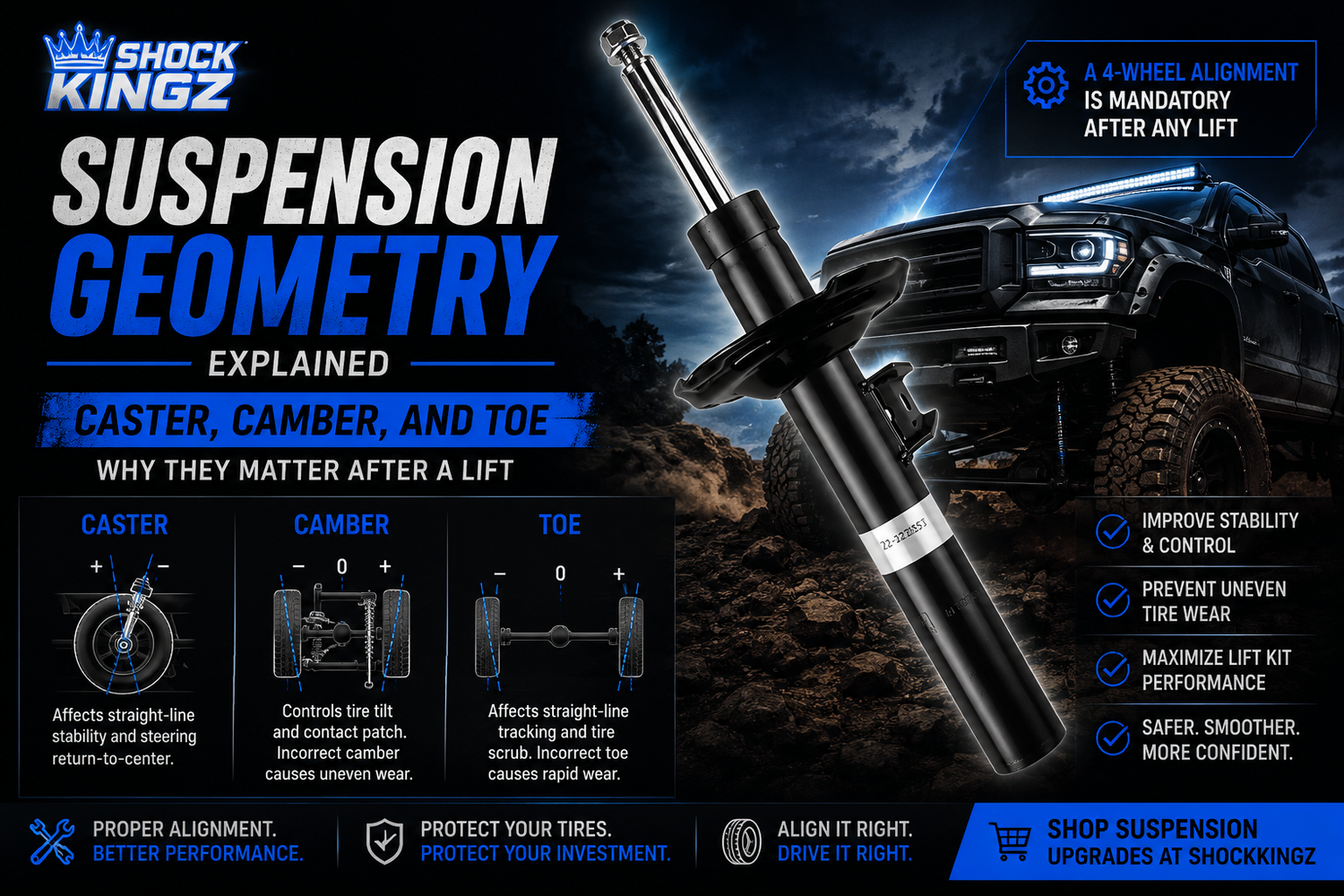
Most people who lift a truck or SUV understand that the ride height changes. Far fewer understand that suspension geometry changes with it, specifically caster, camber, and toe, the three alignment angles that determine how a vehicle tracks, steers, and wears its tires. Skip an alignment after a lift and you're likely to notice a truck that pulls to one side, feels vague on-center, or eats through a set of tires in under 20,000 miles instead of the 50,000+ miles most tires are rated for.
Quick answer: caster, camber, and toe are the three primary suspension alignment angles that control tire wear, straight-line stability, and steering feel. When you lift a vehicle, all three change caster affects return-to-center and stability, camber affects tire contact, and toe affects straight-line rolling resistance. A 4-wheel alignment is mandatory after any suspension lift, no exceptions.
Caster: The Angle Behind Straight-Line Stability
Caster is the fore-aft tilt of the steering axis when viewed from the side of the vehicle. Picture a shopping cart's front wheel caster it's what makes the wheel trail behind its pivot point and self-center as you push the cart forward. Positive caster does the same thing for a truck's steering: it improves straight-line stability and how readily the wheel returns to center after a turn. Lifting a solid-axle truck typically pushes caster in the negative direction because the control arm angles change, which is why aftermarket upper control arms (UCAs) exist specifically to restore proper caster geometry after a lift. A shop technician with over a decade of lift installs put it simply: "Caster is the number one complaint I hear as 'my truck feels loose on the highway,' and it's almost always a caster problem, not a shock problem."
Camber: Why Your Tires Wear Unevenly
Camber describes the inward or outward tilt of the tire when viewed from the front of the vehicle. Negative camber tilts the top of the tire inward; positive camber tilts it outward. Even small camber errors concentrate wear on one edge of the tread a tire that should last 50,000 miles can be worn to the wear bars on one side in half that distance if camber is off by even a degree or two. Lift kits change the camber angle because they alter the geometry of the control arms and, on independent front suspension trucks, the CV axle angle as well. This is one of several reasons suspension tuning after a lift isn't optional cosmetics it's what keeps tire wear even across the tread.

Toe: The Angle That Affects Rolling Resistance and Fuel Economy
Toe is the inward or outward angle of the tires when viewed from above think of how your own feet point in or out when you stand. Toe-in means the fronts of the tires point slightly toward each other; toe-out means they point away. Incorrect toe creates a scrubbing effect as the tires roll, which shows up as feathered tire wear and, in more extreme cases, measurably reduced fuel economy from the added rolling resistance. Toe is also the angle most sensitive to ride height changes, since it's set relative to the vehicle's static position.
Why a Lift Changes All Three at Once
A lift kit doesn't move one suspension point in isolation; it changes the entire geometry of the control arms, track bars, and steering linkage relative to the frame. That's why caster, camber, and toe all shift together rather than one at a time. SAE alignment specifications define acceptable ranges for each angle by vehicle platform, and lift kit manufacturers typically publish their own adjusted specs to account for the new ride height. A 2-inch lift might only need toe and camber adjustment, while a 4-6 inch lift often requires new control arms just to bring the caster back within range, since stock arms may not have enough adjustment travel to compensate.
Signs of a Geometry Problem and When to Re-Check Alignment
A handful of symptoms point directly to a geometry problem after a lift: the truck pulling to one side under normal braking, uneven wear across the tread rather than at the edges or center only, and a steering wheel that doesn't return to center on its own after a turn. None of these are subtle once you know to look for them, and none of them resolve on their own; they get worse with mileage until an alignment addresses the underlying angles. The same rule applies any time you change ride height adjustment settings on an adjustable coilover or leveling system: plan to re-check alignment. Small tweaks of half an inch or less sometimes stay within spec, but anything larger typically shifts caster, camber, or toe enough to warrant a fresh check. Budgeting $100 to $200 for a standard 4-wheel alignment after any suspension upgrades is inexpensive insurance against $400 or more in premature tire replacement, and it's the single most cost-effective step in a lift build that DIYers skip most often.
Suspension geometry isn't an abstract spec sheet number, it's the difference between a lift that drives as good as it looks and one that pulls, wanders, and chews through tires. Caster, camber, and toe all move together when you change ride height, so treat a post-lift alignment as part of the install, not an optional add-on for later.
CTA
Shop Suspension Upgrades at Shockkingz.
FAQ
Q1. What is caster angle in suspension?
The fore/aft tilt of the steering axis. Positive caster improves straight-line stability and steering return-to-center feel. Lifts typically reduce caster, which is why upper control arms are often needed to restore it.
Q2. What does camber do in suspension?
Camber is the inward or outward tilt of the tire when viewed from the front. Incorrect camber causes one-sided tire wear, and lift kits commonly change camber settings.
Q3. How much does a wheel alignment cost after a lift?
Typically $100 to $200 for a standard 4-wheel alignment is inexpensive compared to the $400 or more in premature tire wear that uncorrected geometry can cause.
Q4. What is toe and why does it matter?
Toe is the inward or outward angle of the tires when viewed from above. Incorrect toe causes feathered tire wear and added rolling resistance, which can also reduce fuel economy.
Q5. Do all lift heights require new control arms for proper alignment?
Not always. Smaller lifts often stay within the adjustment range of stock control arms, while larger lifts (typically 4 inches or more) may need aftermarket control arms to bring caster back into spec.





Leave a comment
This site is protected by hCaptcha and the hCaptcha Privacy Policy and Terms of Service apply.