
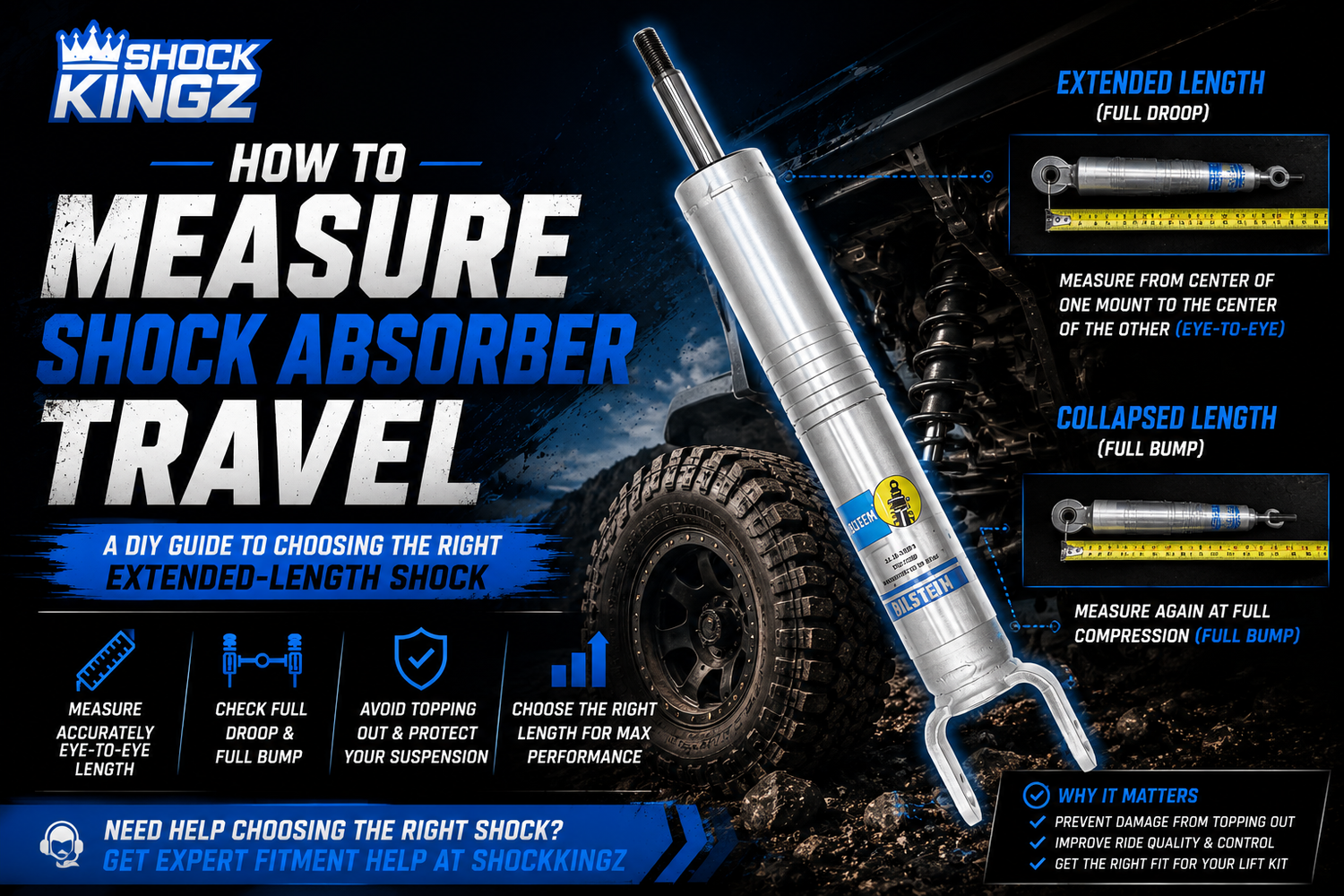
One of the most common mistakes in DIY suspension upgrades is picking a replacement shock by lift height alone instead of by actual travel measurements. A 3-inch lift doesn't automatically mean you need a "3-inch shock" ; it means you need a shock whose collapsed and extended lengths match the new range of motion your axle will travel through. Get that number wrong and the shock either tops out at full droop or bottoms out under compression, both of which damage the shock and, in worse cases, the mount itself.
Choose the right extended-travel shock for a lifted vehicle, measure the collapsed and extended length of your current shock absorbers with the suspension at full droop and full bump. The replacement shock needs at least the same extendSed length and the same or shorter collapsed length. Most lift kit manufacturers publish exact shock length requirements for their kits, which is the fastest way to cross-check your own measurements before ordering.
Why Shock Length Matters for Lifted Suspensions
A shock isn't just a damper it's also a mechanical stop that limits how far the suspension can travel in both directions. When you lift a truck or SUV, the axle gains extra downward travel at full droop. If the new shock's extended length is too short for that added range, the shock itself becomes the limiting factor and gets forced past its own internal stop, known as topping out. Industry data from suspension manufacturers puts topped-out shocks among the top three most common warranty claims on newly lifted trucks, right behind incorrect torque on control arm bolts and misaligned upper mounts.

Tools You'll Need to Measure Shock Travel
You don't need a shop full of equipment for this. Basic suspension tools cover it: a tape measure or set of calipers, a floor jack, jack stands, and a notepad or phone to log numbers as you go. If you're planning to measure a shock that's still mounted, add a breaker bar and socket set to your shock absorber tools kit so you can drop the lower mount and let the suspension hang at full droop safely. Skipping the jack stands here isn't worth the risk a suspension at full droop with no support can drop suddenly once the last bolt comes out.
How to Measure Collapsed and Extended Length
With the shock off the vehicle, measure eye-to-eye: center of the upper mounting hole to center of the lower mounting hole, fully compressed first, then fully extended. Write down both numbers. This eye-to-eye measurement is the industry-standard reference every shock manufacturer uses on spec sheets, so it's what you'll be matching against when you shop for a replacement. A technician who specializes in lift kit installs shared that the single biggest source of return requests he sees is customers ordering by advertised "travel" figures instead of actual eye-to-eye numbers, since travel alone doesn't tell you whether the shock physically fits the mounting geometry.
Matching Shock Length to Your Lift Kit
Once you have your current shock's collapsed and extended measurements, compare them against your lift kit's published specs. Reputable lift kit manufacturers list a required shock length range for each kit height, and most name-brand extended shocks are built to match those exact ranges. If your kit doesn't list shock specs, add your lift height to your stock extended length as a rough starting estimate, then verify against the shock manufacturer's own eye-to-eye chart before buying rough math gets you in the ballpark, but the chart is what confirms fitment. This is also where a proper suspension installation plan pays off: measuring before you buy saves a return shipment and a wasted weekend.
Common Mistakes When Selecting Extended-Length Shocks
The recurring errors are predictable once you've seen a few: assuming lift height equals shock length, measuring with the suspension unloaded instead of at true full droop and full bump, and skipping a test fit before final torque. A full shock rebuild swapping internals into an existing shock body rather than buying new only makes sense if the existing body's eye-to-eye length already matches your new travel requirements; rebuilding a shock that's simply too short doesn't solve a geometry problem. Double-checking your numbers against the lift kit spec sheet before you order is the single habit that prevents most of these mistakes.
Getting shock length right is arguably the most overlooked part of a lift install, mostly because it's easy to assume the kit manufacturer already handled it. Sometimes they have but generic aftermarket shocks and mixed-brand builds still require you to measure and verify, especially when a kit was designed around one shock brand and you're substituting another. Take ten minutes to measure eye-to-eye, cross-reference the spec sheet, and confirm clearance through a full range of motion before final torque. That small amount of upfront checking is what separates a smooth, quiet ride from a topped-out clunk and premature wear down the road.
FAQ
Q1. How do I measure my current shock absorber?
Extend and measure from the center of one mounting hole to the center of the other. This eye-to-eye measurement is the standard reference used by all shock manufacturers.
Q2. What happens if shocks are too short for a lift?
Shocks top out at full droop, damaging the shock body and causing a harsh clunking sensation. In severe cases this can also cause structural frame damage.
Q3. Where can I find the shock length specs for my lift kit?
Your lift kit manufacturer provides spec sheets. Shock manufacturer fitment databases and tech support lines can also verify correct length by make, model, and lift combination.
Q4. Do I need to measure at full droop and full bump, or just one position?
Both. Measuring only one position won't tell you whether the shock will bottom out under compression or top out at full extension, so both ends of the travel range matter.
Q5. Can I use a shock's advertised travel figure instead of measuring eye-to-eye?
Not reliably. Advertised travel numbers don't account for mounting geometry, so two shocks with the same travel figure can have different eye-to-eye lengths and won't necessarily fit the same application.








Leave a comment
This site is protected by hCaptcha and the hCaptcha Privacy Policy and Terms of Service apply.