
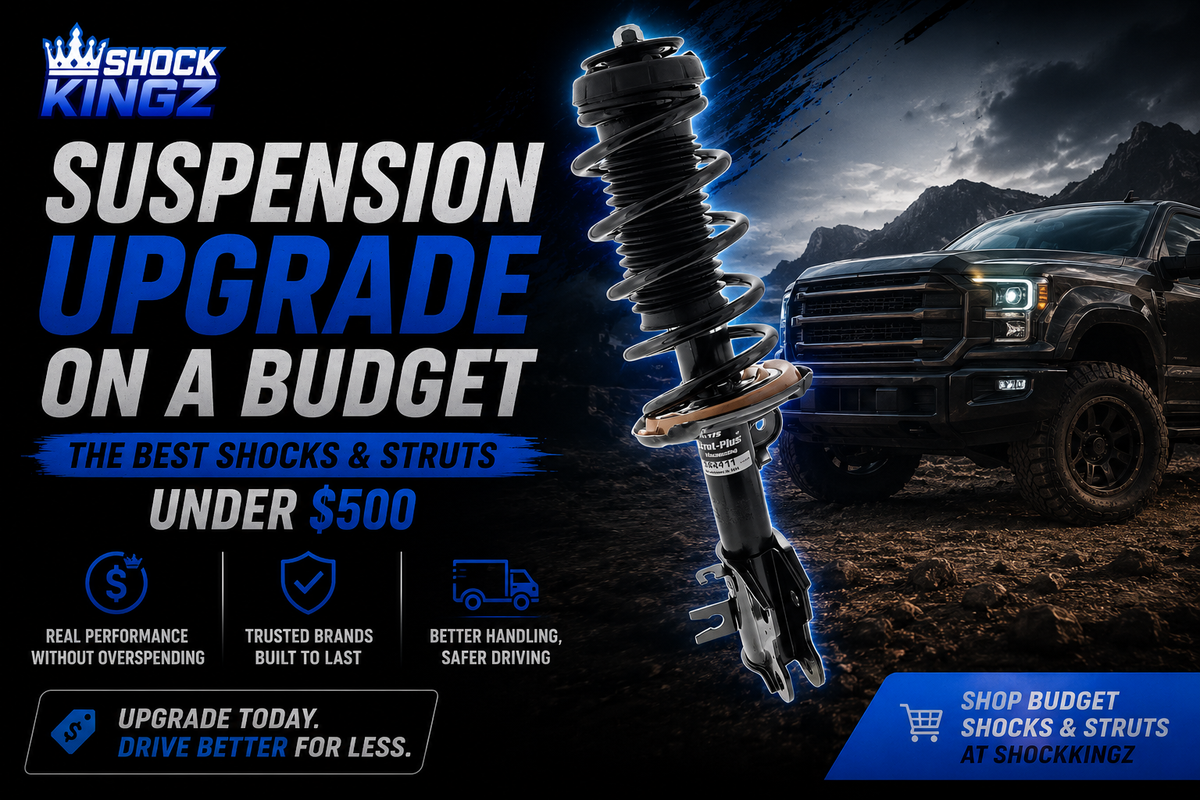
A worn set of shocks doesn't usually announce itself with a warning light. It shows up as a slightly longer stopping distance, a nose-dive under braking, or a truck that wallows over highway expansion joints. Most owners live with it for months before realizing the ride they've gotten used to isn't how the vehicle is supposed to feel. The good news is that fixing it doesn't require a four-figure build budget.
The best vehicle suspension upgrades under $500 for trucks and SUVs deliver real damping improvements without breaking the build budget. KYB Gas-a-Just provides OEM+ performance at roughly $150 to $250 for a full set. Shockkingz B4 replacement shocks run $250 to $400 and offer strong longevity at near-OEM pricing. Rancho RS5000X covers light off-road needs at a mid-budget price point, typically landing in a similar range for a full set.
Why OEM Shocks Wear Out Faster Than Most Owners Expect
Factory shocks are built to a cost target, not a longevity target. Most manufacturers spec dampers that perform acceptably through the warranty period and a bit beyond, which in practice means noticeable degradation starting around 50,000 to 70,000 miles. Seals harden, gas pressure drops, and the damping curve flattens out gradually enough that drivers adjust without noticing. A Tacoma owner who brought a truck in with 85,000 miles for an unrelated tire issue is a common case: the shocks tested well within a "normal for mileage" range, but the owner described the ride as noticeably tighter and more controlled after replacement, simply because the baseline had drifted so slowly.
That gradual decline is exactly why budget-tier vehicle suspension upgrades feel so dramatic to first-time buyers. You're not comparing a $200 shock to a $600 shock in isolation; you're comparing fresh damping fluid and seals to hardware that's been slowly fading for years.
What You Actually Get for Under $500
A $500 budget realistically covers a full set of four direct-fit shocks or struts on most half-ton trucks and midsize SUVs, sometimes with room left for basic installation hardware, which is exactly the kind of budget-friendly truck suspension upgrades most first-time buyers are looking for. What it typically does not cover is a full coilover system, adjustable damping, or a lift kit paired with matched springs. Buyers shopping this range are looking for aftermarket suspension parts that restore or modestly improve on factory ride quality and control, not an off-road-focused rebuild.

Setting expectations correctly matters here. Suspension upgrade kits at this price point are about damping quality, not ride height or dramatic handling transformation. That's a reasonable trade for the price, but it's worth knowing going in so the result matches what was promised.
KYB, Shockkingz B4, and Rancho: How the Budget Options Compare
These three names come up constantly in budget suspension kits comparisons, and each serves a slightly different priority. KYB Gas-a-Just shocks are engineered close to OEM valving, which makes them a safe, predictable choice for daily drivers who want the truck to feel like new rather than different. Shockkingz B4 shocks sit a step above on build quality and typically hold their damping characteristics longer, which is why they command a higher price within the same budget bracket. Rancho RS5000X shocks are valved slightly firmer and are aimed at owners who occasionally leave pavement, whether that's a gravel driveway, a job site, or light trail use.
None of these are "better" in an absolute sense. The right pick depends on how the vehicle is actually driven, which is a more useful framework than chasing a single top-rated product. For a closer look at heavier-duty needs, see this guide to shock absorber upgrades for regular towing and hauling, which covers a step up from the budget tier.
Struts vs. Shocks: Which Upgrade Makes Sense for Your Vehicle
Not every vehicle uses the same suspension architecture, and that changes both the cost and the scope of the job. Trucks and body-on-frame SUVs typically use shocks paired with separate springs, so a shock-only swap is straightforward and keeps costs on the lower end of the $500 range. Many crossover SUVs and unibody vehicles use strut assemblies instead, which combine the damper, spring, and mount into one unit. Strut replacement generally costs more per corner and often calls for a front-end alignment afterward, so budget-conscious buyers on strut-based vehicles should plan for that added step rather than being surprised by it at checkout.
Owners comparing options across a full shocks and struts collection will notice pricing spreads more by vehicle platform and part complexity than by brand alone.
Getting the Most Value From a Budget Suspension Upgrade
A few practical habits separate a good budget upgrade from a wasted one. Replace shocks or struts in pairs, front or rear together, rather than one at a time, since mismatched damping side to side creates uneven handling. Check bushings and mounts while the suspension is apart, since a new shock paired with a worn mount won't deliver the improvement it should. Budget for an alignment if struts are involved, and confirm the part is a direct fit for the exact trim and drivetrain configuration before ordering, since ride height and towing packages can change the correct part number. Customer budget build reviews collected by Shockkingz consistently point to these same three habits as the difference between a satisfying budget upgrade and a disappointing one.
For most daily-driven trucks and SUVs, a well-matched set of shocks in this price range restores the confidence-inspiring ride the vehicle had when it was new, which is a meaningful upgrade even without touching ride height or spring rate. The value isn't in chasing a premium badge; it's in matching fresh, correctly rated damping to how the vehicle is actually used every day.
Frequently Asked Questions
Q1. What are the best shocks under $300 for a Ford F-150?
KYB Gas-a-Just and Shockkingz B4 shocks are both commonly available under $300 for a full set and represent a meaningful upgrade over worn OEM shocks.
Q2. Is it worth upgrading shocks on a daily driver with 80,000 miles?
Yes. OEM shocks typically begin degrading around 50,000 to 70,000 miles, and even a budget-tier upgrade can noticeably restore handling and braking confidence.
Q3. Can I get quality OEM-replacement shocks for under $500?
Yes. OEM-replacement shock sets, such as the Shockkingz B4 line, commonly fall in the $250 to $450 range for many trucks and SUVs.
Q4. What's the difference between shocks and struts, and does it affect the budget?
Shocks are a standalone damping component, while struts combine a spring, mount, and damper into one structural unit. Strut replacement typically costs more per corner and often requires a follow-up alignment.
Q5. Do budget suspension upgrades require an alignment afterward?
In most cases involving strut replacement, yes. An alignment keeps tire wear even and steering centered after the suspension geometry has been disturbed.




Leave a comment
This site is protected by hCaptcha and the hCaptcha Privacy Policy and Terms of Service apply.