
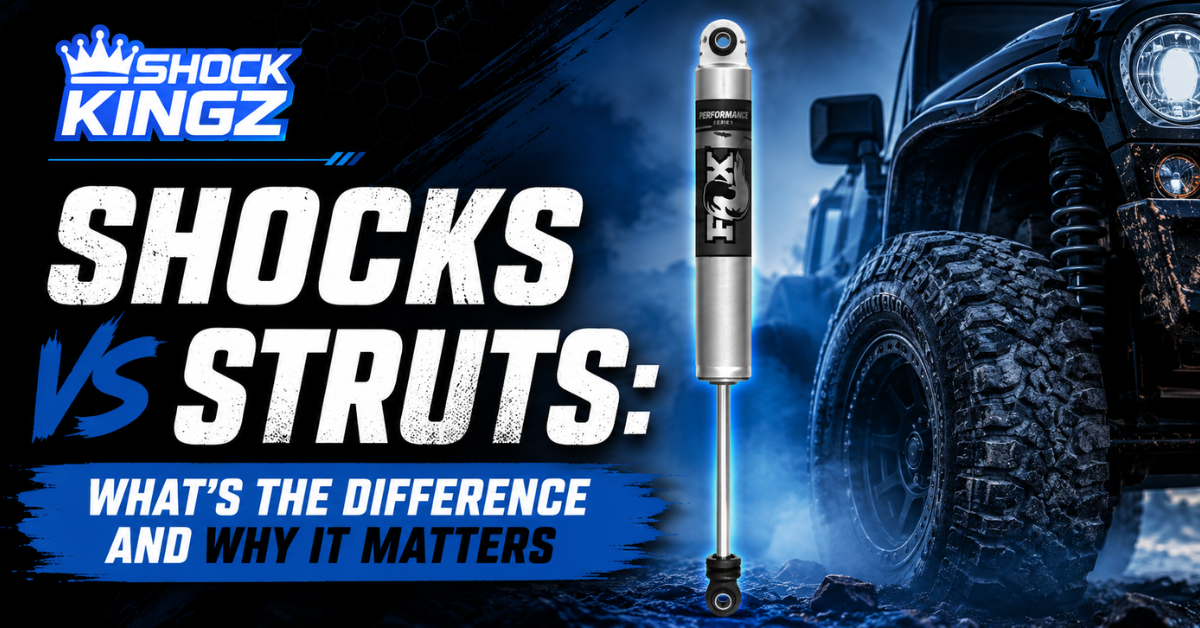
Most drivers use "shocks" and "struts" interchangeably until a mechanic points at their car and says only one of the two actually applies. That mix-up is understandable, since both parts sit in roughly the same location and both affect ride quality. As two of the most misunderstood vehicle suspension parts, they are not interchangeable, and knowing which one your vehicle uses changes what a proper repair actually looks like.
Shocks and struts both control how a vehicle's suspension moves, but they are structurally different. A shock absorber is a standalone damping unit that controls spring and suspension movement without bearing the vehicle's weight. A strut combines a shock absorber with a coil spring and a mounting point into a single structural unit that supports part of the vehicle's weight and suspension geometry. Most modern cars and crossovers use struts up front; many trucks and SUVs use separate shocks at all four corners. Both are core components of a vehicle's suspension systems, and both wear out over time, but the design difference changes how each one should be diagnosed and replaced.
What Are Shocks?
A shock absorber, often just called a shock, is a hydraulic or gas-charged damping device that slows down and controls the motion of the spring and suspension after the vehicle hits a bump. It doesn't hold the vehicle up. That job belongs to the spring, which the shock works alongside without bearing any of the vehicle's static weight. Shocks are common on trucks, body-on-frame SUVs, and older or heavier vehicles because this design separates the load-bearing and damping jobs into two components, which is generally easier and cheaper to service piece by piece.
Without a functioning shock, a spring will keep bouncing after a bump for several cycles instead of settling quickly, which is why worn shocks show up as a floaty, wallowing ride and longer stopping distances at speed.
What Are Struts?
A strut is a structural suspension component that integrates a shock absorber inside a coil spring assembly, along with a mounting point that connects to the vehicle's body. Unlike a shock, a strut does bear part of the vehicle's weight and plays a direct role in wheel alignment geometry, specifically camber angle. This is why replacing a strut, unlike replacing a shock, typically requires a wheel alignment afterward.

The most common strut design is the MacPherson strut, used on the vast majority of front-wheel-drive cars, many crossovers, and a growing number of compact SUVs. It's popular because it packages the damping, spring, and structural mounting into one compact assembly, which saves space in the engine bay and simplifies manufacturing. If a vehicle's front suspension looks like a single cylinder running from the wheel hub up into the body, with a spring wrapped around it, that's almost always a strut.
Key Differences Between Shocks and Struts
The core distinction comes down to structural role versus ride control. Standalone shock absorbers provide ride control only, damping motion without supporting the vehicle. Struts provide both ride control and structural support, since they carry part of the vehicle's weight and hold the wheel in proper alignment. That structural role is also why strut replacement is a heavier job: it typically involves compressing and transferring the coil spring to a new strut body, and it directly affects alignment, while a shock swap is usually a more contained, bolt-on replacement.
Shocks vs. Struts at a Glance
|
Factor |
Shocks |
Struts |
|---|---|---|
|
Function |
Damps suspension motion |
Damps motion and supports vehicle weight |
|
Structural role |
None; works alongside a separate spring |
Integrated with coil spring and body mount |
|
Alignment impact |
Minimal |
Directly affects camber; alignment usually required after replacement |
|
Typical vehicles |
Trucks, body-on-frame SUVs, rear suspension of many cars |
Front suspension of most cars, crossovers, compact SUVs |
How to Tell Which One Your Vehicle Uses
When comparing car shocks and struts on your own vehicle, the fastest way to check is to look at the front suspension through the wheel well or from underneath. If you see a shock absorber running through the center of a coil spring with a mounting plate at the top connecting to the body, that's a strut. If the spring and the damper are two separate components mounted at different points, that's a shock-and-spring setup. Many vehicles mix designs, running struts in front and shocks in the rear, so it's worth checking each end separately rather than assuming the whole vehicle uses one type. For a look at how these parts factor into cost-conscious repairs, see this guide to budgeting for a suspension upgrade under $500.
A vehicle's owner's manual or a parts lookup by VIN will also confirm this instantly, which is the more reliable method if there's any doubt after a visual check. Browsing a vehicle suspension parts collection by vehicle make and model is another way to confirm which part type applies before starting any repair research.
In short: shocks and struts both belong to a vehicle's broader suspension system and both damp motion, but a shock is a standalone damping component while a strut is a load-bearing structural assembly that combines a shock, a spring, and a mount. Most trucks and body-on-frame SUVs use shocks; most cars and crossovers use struts up front. Knowing which one is on your vehicle is the first step before any repair conversation, since the parts, labor, and follow-up work involved are meaningfully different between the two. Educational resources like Shockkingz can be a useful starting point for looking up which part type applies to a specific vehicle.
Frequently Asked Questions
Q1. What is the difference between shocks and struts?
A shock absorber only damps suspension motion and doesn't support the vehicle's weight, while a strut combines a shock, a coil spring, and a body mount into one structural unit that both damps motion and bears part of the vehicle's weight.
Q2. Can a car have both shocks and struts?
Yes. Many vehicles use struts in the front suspension and separate shocks in the rear, which is why it's important to check each end of the vehicle individually rather than assuming a single design throughout.
Q3. Does replacing struts require a wheel alignment?
Usually, yes. Because struts affect camber angle and overall suspension geometry, an alignment is typically recommended after strut replacement, whereas a standalone shock replacement usually doesn't require one.
Q4. How do I know if my car has shocks or struts?
Look at the front suspension: if a damper runs through the center of a coil spring with a mounting plate at the top, that's a strut. If the spring and damper are separate components mounted at different points, that's a shock-and-spring setup.
Q5. What is a MacPherson strut?
A MacPherson strut is the most common strut design, combining the shock absorber, coil spring, and steering knuckle mount into a single compact assembly. It's widely used in front-wheel-drive cars, crossovers, and many compact SUVs.








Leave a comment
This site is protected by hCaptcha and the hCaptcha Privacy Policy and Terms of Service apply.