
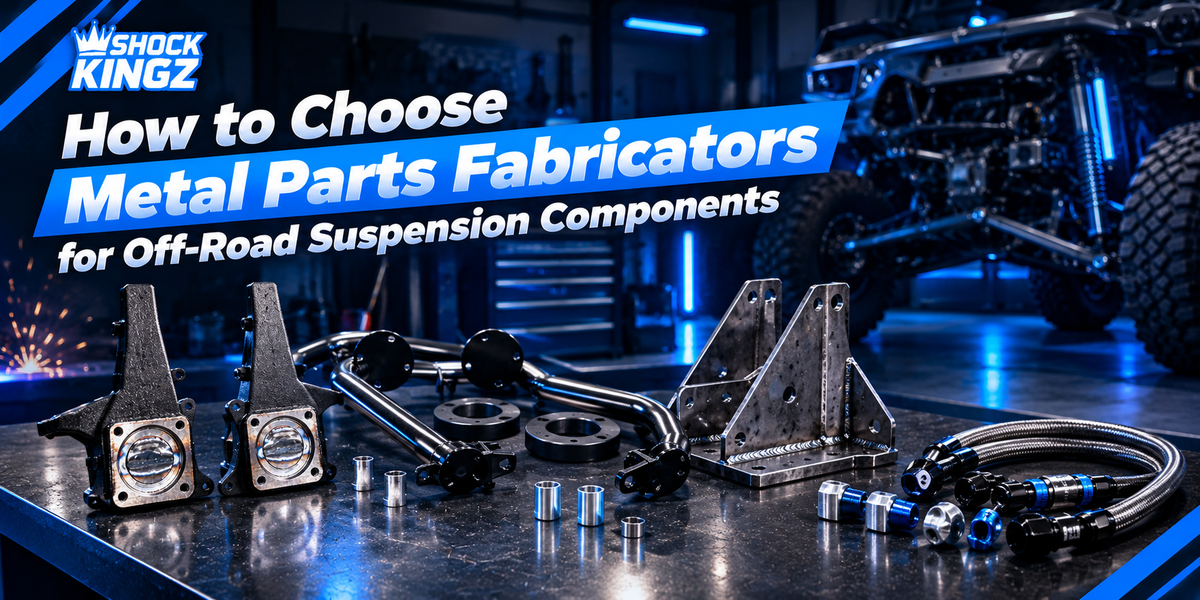
Choosing the right metal parts fabricators for suspension components requires more than finding a shop that can cut and weld metal. A reliable fabricator should understand your vehicle, suspension geometry, material selection, fitment requirements, welding practices, and intended off-road use. Before approving a custom bracket, mount, link, or other component, evaluate the fabricator's experience, design process, dimensional accuracy, material knowledge, and inspection methods.
For off-road enthusiasts, the objective is not simply to build the strongest-looking part. The component needs to be appropriate for its application and work correctly with the rest of the suspension system.
What Should You Look for in Metal Parts Fabricators?
The best metal parts fabricators should be able to explain why a particular material, thickness, joint design, and manufacturing method is appropriate for your project.
Before starting a custom suspension project, ask:
- What material will be used, and why?
- How will the component be designed and measured?
- What fabrication and welding processes will be used?
- How will fitment and dimensions be verified?
- Has the fabricator worked on similar off-road applications?
- What limitations or installation requirements apply to the finished component?
A fabricator who can clearly answer these questions is easier to evaluate than one that relies only on descriptions such as "heavy duty" or "race quality."
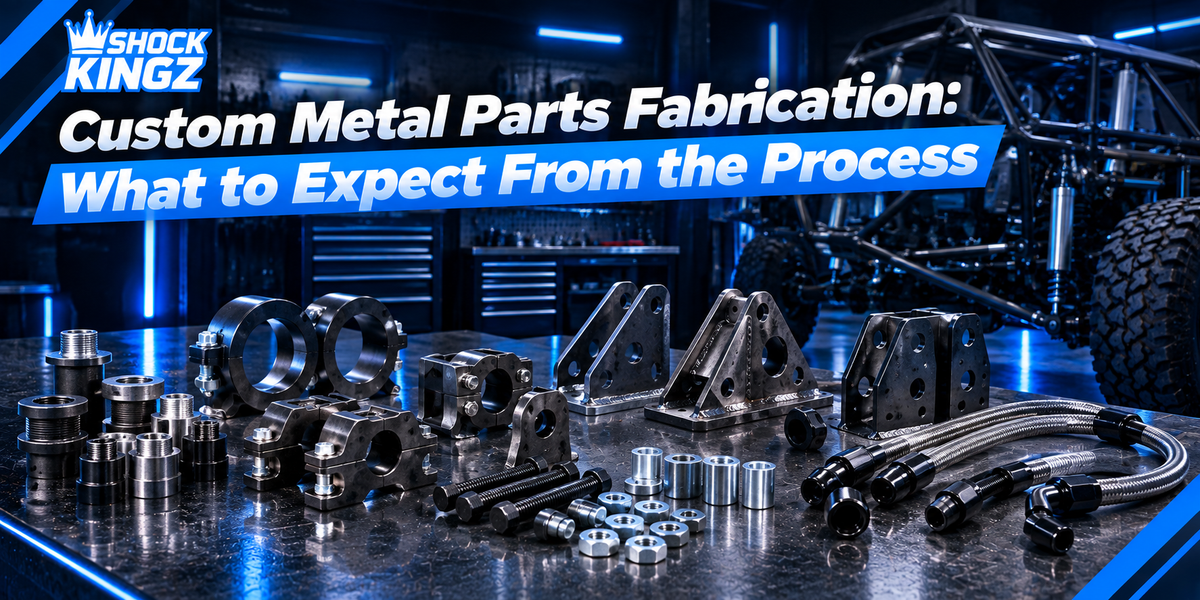
Shockkingz offers a range of fabrication components that can be incorporated into custom automotive projects, including brackets, mounts, tubing-related hardware, rod ends, spacers, and other supporting components.
Does Material Choice Matter in Metal Parts Fabrication?
Yes. Material selection should be based on the application rather than simply choosing the material that sounds strongest.
Common materials used in automotive metal parts fabrication include mild steel, DOM tubing, 4130 chromoly, and aluminum. Each has different characteristics that can make it appropriate for particular applications.
The important point is that stronger does not automatically mean better. A fabricator should select material according to the component's design, expected loads, weight requirements, manufacturing method, and intended use.
For example, 4130 chromoly can be useful in applications where strength-to-weight characteristics are important, but it also requires appropriate welding practices. Material selection and welding procedures should therefore be considered together.
How Important Are Welding Quality and Joint Design?
For welded suspension components, the weld should be considered as part of the complete joint rather than judged only by how attractive the bead looks.
Ask the fabricator how the parts will be fitted, positioned, welded, and checked. Proper fit-up and controlled welding practices can be important when producing suspension-related components.

This matters particularly with custom metal parts fabrication, because a custom component may not follow the same standardized manufacturing process as a mass-produced part.
A useful conversation should cover:
- Base material and grade
- Tube or plate thickness
- Joint configuration
- Welding process
- Filler material where applicable
- Heat-control requirements
- Fixturing during welding
- Dimensional inspection after fabrication
A clean-looking weld alone does not prove that a component has the correct dimensions, material, joint preparation, or suitability for a particular application.
Instead, evaluate the entire fabrication process.
Does the Fabricator Understand Suspension Geometry?
This is one of the most important questions for off-road suspension work.
Suspension components do not operate independently. Changing the location of a mounting point, pivot, link, or shock can affect how connected components move through suspension travel.
For example, changing a control-arm mounting location can influence alignment relationships, while changing a shock mounting position can affect available travel, clearance, and the shock's operating position.
Before approving a fabricated component, make sure the fabricator understands the existing suspension layout and what the modification is intended to accomplish.
If you are unfamiliar with these relationships, our guide to suspension geometry provides useful background on how suspension components and alignment angles work together.
Planning a custom suspension project? Browse the off-road fabrication parts available from Shockkingz and review the dimensions, materials, and intended applications before finalizing your design.
Should Metal Parts Fabricators Use CAD or Fixtures?
CAD is not required for every fabrication project, but it can be valuable when dimensions, clearances, or repeatability are important.
For a custom suspension component, ask whether the fabricator can work from:
- Vehicle measurements
- Existing components
- Engineering drawings
- CAD files
- Templates
- Digital scans
- Accurate dimensioned sketches
What Fitment Information Should You Give the Fabricator?
Providing accurate information at the beginning can prevent unnecessary modifications later.
For an off-road suspension project, provide as much of the following information as possible:
- Vehicle year, make, and model
- Two-wheel or four-wheel drive
- Current ride height
- Suspension type
- Existing lift or suspension modifications
- Tire and wheel size
- Shock or coilover model
- Intended suspension travel
- Intended terrain
- Typical vehicle load
- Existing mounting dimensions
- Clearance restrictions
- Photos of the installation area
Vehicle information alone may not be enough for a heavily modified off-road build.
Two vehicles with the same year, make, and model can have substantially different suspension configurations after modifications. Accurate measurements and photographs can therefore be just as important as basic vehicle identification.
When purchasing fabrication components, always check the individual product dimensions and intended application rather than assuming that every component is interchangeable.
What Fabrication Components Can Be Useful for a Suspension Build?
Not every project requires completely custom fabrication.
Sometimes the better approach is to combine commercially available Fabrication Components with custom work where necessary. This can reduce the amount of one-off manufacturing required while giving the builder access to standardized components.
For example, Shockkingz carries components such as the 5/8-inch RHT 4130 stepped-thread bung, which is designed for applications including custom tie rods, control arms, and links.
Another example is the 4130 billet tube clamp, which can be incorporated into suitable tubular fabrication projects.
These examples highlight an important buying principle: verify the dimensions, thread specifications, material, and intended application of each component before incorporating it into a suspension assembly.
A commercially available fabrication component can be useful, but compatibility should always be confirmed for the specific build.
What Are Common Mistakes When Choosing a Fabricator?
Several mistakes can make a custom suspension project more expensive or complicated than necessary.
Choosing by price alone
The lowest quote may not include the same level of design work, material specification, inspection, or finishing as another quote.
Compare what each fabricator is actually providing rather than comparing the final price alone.
Assuming thicker metal is always better
Adding material can increase weight without automatically producing a better component. Material selection, geometry, joint design, and the expected loads all matter.
Ignoring suspension geometry
A bracket can physically fit while still placing a component in an unsuitable position.
Consider how the modification affects the connected suspension components throughout their operating range.
Providing incomplete measurements
Missing dimensions can lead to repeated fabrication, modifications, or installation problems.
Take accurate measurements before sending the project to the fabricator.
Treating all 4130 fabrication the same
4130 is not simply a "stronger steel" option that can be treated identically to every other material. Welding and fabrication practices need to be appropriate for the material and application.
Forgetting serviceability
Think beyond installation.
Consider whether you will still have access to bolts, joints, bushings, grease fittings, shocks, and other components that may eventually require inspection or maintenance.
When Should You Choose a Fabricated Part Instead of an Off-the-Shelf Component?
Custom fabrication makes the most sense when a suitable catalog component does not meet the vehicle's requirements, when packaging is unusual, or when a project requires a specific mounting arrangement or geometry.
For a straightforward replacement, an application-specific component may be the simpler solution.
For a heavily modified off-road vehicle, custom brackets, mounts, links, or supporting hardware may be necessary.
The decision should be based on the actual requirements of the vehicle rather than choosing custom parts simply because they appear more specialized.
If you are still learning how the individual components work together, our complete beginner's guide to suspension systems provides additional background on shocks, springs, control arms, sway bars, and other suspension components.
Need Help Identifying the Right Fabrication Component?
Share your vehicle details and the component you're trying to build or replace with the Shockkingz team. Confirm dimensions and application requirements before ordering to help avoid an unsuitable match.
Contact Shockkingz →Frequently Asked Questions
Practical answers about suspension fabrication, material selection, CNC manufacturing, fitment, and custom components.









Leave a comment
This site is protected by hCaptcha and the hCaptcha Privacy Policy and Terms of Service apply.