
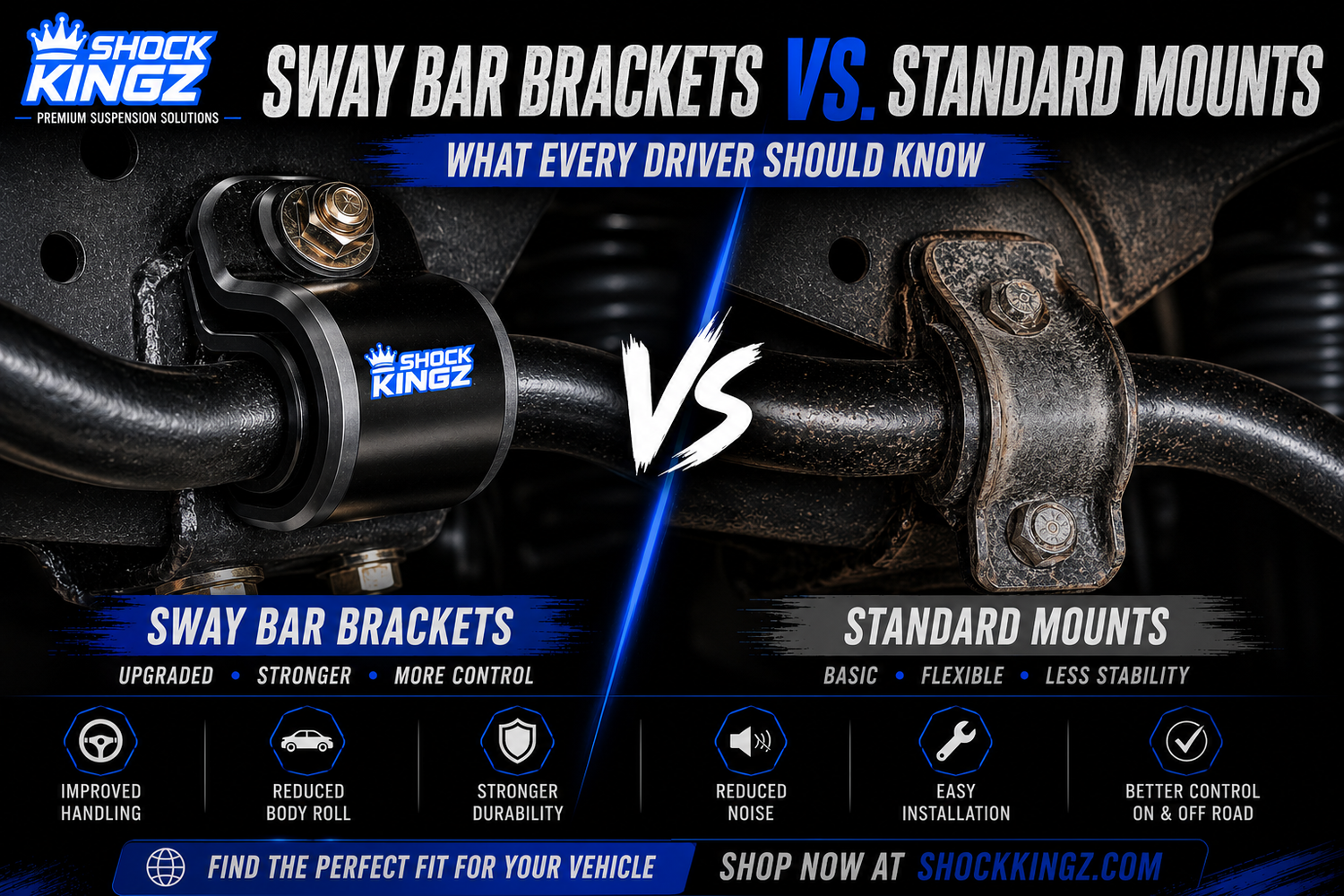
What Are Sway Bar Brackets?
If you have ever taken a sharp corner and felt your vehicle lean heavily to one side, your sway bar and its mounting brackets are the components working to fight that movement.
Sway bar brackets are the hardware that clamps the sway bar - also called an anti-roll bar -directly to your vehicle's chassis, holding it in place as it twists and transfers force across the suspension.
Without properly functioning sway bar brackets, even a high-quality sway bar cannot do its job effectively. A loose or worn bracket allows the sway bar to shift under load, which translates into sloppy cornering, inconsistent handling, and accelerated wear on surrounding suspension parts.
Sway bar brackets are especially critical for:
- Performance vehicles that corner at speed
- Trucks and SUVs carrying heavy loads or towing
- Off-road builds that take on uneven terrain repeatedly
- Any vehicle where the factory mounts have worn out or cracked
Key functions sway bar brackets perform:
- Secure the sway bar firmly to the vehicle frame or subframe
- Distribute cornering forces evenly across the suspension system
- Minimize body roll when changing direction or cornering
- Maintain wheel alignment consistency during suspension travel
Just like worn shocks and struts, worn sway bar brackets quietly degrade handling without an obvious single failure point - making regular inspection important.
What Are Standard Mounts?
Standard mounts, also called factory or OEM mounts, are the original brackets that come installed on your vehicle from the manufacturer. They are designed to meet the baseline requirements of the vehicle's intended use - which for most passenger cars and trucks means comfortable, predictable everyday driving at moderate speeds.
OEM mounts get the job done for most drivers in normal conditions. However, they are built to a cost and weight target, which means they are often made from stamped steel with rubber bushings that degrade over time. Once those bushings compress or the steel fatigues, the mount loses its rigidity and body roll increases noticeably.
Signs your standard mounts may need replacement:
- Clunking or knocking sounds from under the vehicle during cornering
- Increased body lean that was not there before
- Visible cracking or deformation in the rubber bushings
- Loose sway bar movement when inspected by hand
Key Differences: Sway Bar Brackets vs. Standard Mounts

|
Feature |
Standard OEM Mounts |
Aftermarket Sway Bar Brackets |
|
Material |
Stamped steel |
Reinforced steel or high-grade alloy |
|
Durability |
Moderate, degrades over time |
High, built for long-term use |
|
Performance |
Basic body roll control |
Enhanced cornering stability |
|
Adjustability |
None |
Available on many models |
|
Weight |
Heavier due to stamped steel |
Often lighter with stronger alloys |
|
Best for |
Stock daily driving |
Performance, off-road, heavy-duty use |
|
Lifespan |
50,000 to 80,000 miles typical |
100,000+ miles with proper maintenance |
Benefits of Upgrading to Sway Bar Brackets
Improved Handling and Cornering Stability
The most immediate benefit drivers notice after upgrading sway bar brackets is how much flatter the vehicle corners. A rigid, well-secured sway bar transfers load across the axle more effectively, keeping both tires planted through turns. Whether you are merging at highway speeds or navigating a winding back road, the difference is noticeable from the first drive.
Increased Durability Under Load
Factory mounts are not designed for sustained heavy use. If you tow frequently, carry loads in your truck bed, or push your vehicle hard on weekends, the OEM mounts wear faster than the rest of the suspension. Aftermarket sway bar brackets made from reinforced steel or high-grade alloy handle that stress without deforming or cracking.
Smoother Overall Ride
A properly secured sway bar does not just reduce lean - it also reduces the lateral movement that causes that unsettled, floating feeling on uneven surfaces. When the sway bar stays planted in its mounts, weight transfers more predictably and the ride feels composed rather than unpredictable.
Adjustability for Your Driving Style
Many performance sway bar brackets include multiple mounting positions or adjustable end links, letting you tune how aggressively the sway bar resists roll. Stiffer settings suit track and performance use, while softer settings work better for trucks that need suspension compliance off-road.
How to Choose the Right Sway Bar Brackets
Match to Your Vehicle Type and Use Case A bracket built for a performance car has different requirements than one built for a lifted truck. Consider your primary use - daily driving, towing, off-road, or track - and choose a bracket rated for those demands.
Prioritize Material Quality Reinforced steel brackets are better suited for high-load applications like trucks and tow vehicles. High-grade alloy brackets offer a strong strength-to-weight ratio and resist corrosion well - ideal for off-road or high-humidity environments. Avoid low-grade cast brackets that look similar but crack under sustained stress.
Verify Fitment Before Ordering Sway bar diameter and chassis mounting points vary between vehicle makes, models, and years. A bracket that does not match your sway bar diameter will not clamp correctly. Use the vehicle selector on the ShockKingz website to filter by your exact year, make, and model before purchasing.
Consider the Full Suspension Picture Sway bar brackets work as part of a complete suspension system. If your control arms or shock absorbers are also worn, upgrading the brackets alone will not restore full handling performance.
Read our Suspension Kit Upgrade Guide to understand what else may need attention before or alongside this upgrade.
Installation Guide
Most experienced DIYers can complete a sway bar bracket swap in one to two hours. Professional installation is recommended if you are not comfortable working under a raised vehicle.
Tools Required:
- Wrench set
- Socket set with extensions
- Torque wrench
- Jack stands and floor jack
- Thread-locking compound
- Lubricant for bushings
- Step-by-Step Installation:
- Lift and secure the vehicle using jack stands at all four corners. Never work under a vehicle supported only by a floor jack.
- Locate the existing sway bar mounts along the frame or subframe - typically two brackets on each side of the sway bar.
- Remove the old hardware by unbolting the existing brackets. Note the orientation of the bushings before removing them.
- Install new bushings if included with your bracket kit. Apply a thin coat of lubricant to reduce noise and extend bushing life.
- Position the new brackets over the sway bar and align with the mounting holes on the chassis.
- Hand-thread all bolts first before torquing anything down - this ensures the bracket seats evenly.
- Torque to manufacturer specifications using a torque wrench. Do not guess over-tightening can crack the bracket or strip threads.
- Lower the vehicle and test drive through a few slow corners first. Listen for any creaking or knocking before returning to normal driving.
Common Issues and Troubleshooting
Creaking or Knocking Sounds After Installation - This is almost always a bushing issue. Apply fresh lubricant to the sway bar where it contacts the bushing, and confirm all bolts are torqued correctly. A dry bushing against metal will creak on every body movement.
Uneven Handling Side to Side - Check that both brackets are torqued to the same specification and seated at the same angle. A misaligned bracket on one side creates an asymmetric sway bar tension that pulls the vehicle in corners.
Brackets Loosening Over Time - Use thread-locking compound on all bracket bolts during installation. Re-torque after the first 200 to 300 miles, as new hardware naturally settles slightly under load.
Bracket Cracking or Deforming - This indicates the bracket was either under-rated for your vehicle's weight and use case, or it was over-tightened during installation. Replace with a bracket rated for your specific application and torque to spec.
Shop Suspension Components at ShockKingz
At ShockKingz, we carry the suspension components you need to keep your vehicle stable, safe, and composed - whether you are replacing worn factory hardware or building out a performance or off-road setup.
Browse our full Suspension Packages for complete system upgrades, or shop individual components below:
- Shocks and Struts - OEM and performance replacements for all vehicle types
- Shock and Spring Kits - Matched kits for trucks, SUVs, and off-road rigs
- Coilovers - Height-adjustable performance setups for sport builds
FAQs
1. How do I know if my sway bar brackets need replacing?
The clearest signs are clunking or knocking sounds during cornering, visible cracking in the rubber bushings, or a noticeable increase in body lean that was not there before. If the sway bar moves when you push it by hand with the vehicle raised, the brackets have lost their grip.
2. Can I replace just the brackets without replacing the sway bar itself?
Yes. If the sway bar is in good condition but the brackets or bushings are worn, replacing the hardware alone restores proper function. However, if the sway bar itself is bent or cracked, both the bar and brackets should be replaced together.
3. Do I need an alignment after replacing sway bar brackets?
Standard bracket replacement does not change alignment angles. However, if you are also replacing control arms, end links, or other steering and suspension components at the same time, an alignment check is always recommended.
4. What is the difference between sway bar brackets and sway bar end links?
Brackets are the mounts that clamp the sway bar to the chassis. End links are the connecting rods that attach the ends of the sway bar to the control arms or struts. Both need to be in good condition for the sway bar to work correctly. Worn end links cause similar symptoms to worn brackets - clunking and increased body roll.
5. Are aftermarket sway bar brackets worth the upgrade over OEM?
For daily drivers in stock condition, quality OEM-spec replacements are perfectly adequate. For trucks that tow or haul regularly, performance-oriented vehicles, or off-road builds, aftermarket sway bar brackets made from reinforced steel or high-grade alloy deliver noticeably better rigidity and longevity.
6. How often should sway bar components be inspected?
Inspect sway bar brackets, bushings, and end links at every tire rotation or roughly every 10,000 to 15,000 miles. Vehicles used off-road or in harsh climates should be inspected more frequently due to increased wear and corrosion exposure.
ShockKingz stocks shocks, struts, coilovers, control arms, and complete suspension packages for every driving style. Find your fit at shockkingz.com.





Leave a comment
This site is protected by hCaptcha and the hCaptcha Privacy Policy and Terms of Service apply.