
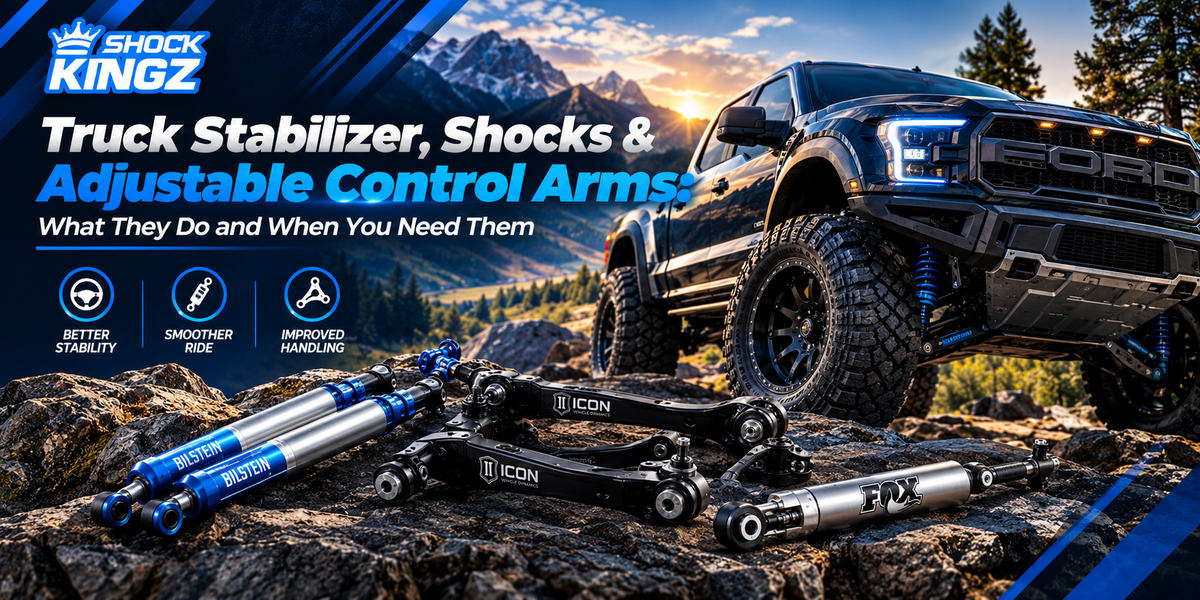
A truck stabilizer(steering stabilizer) calms steering shake and wander. Shocks control how your suspension moves over bumps. Adjustable control arms restore proper alignment geometry, which matters most after a lift. They solve different problems, so match the part to the symptom, then confirm fitment for your exact truck.
Lifted a truck, added bigger tires, or started towing more? Your front end works harder, and the parts that keep it composed matter more. This guide covers what each component does, the signs you need it, and how to choose without overspending.
What Does a Truck Stabilizer Do?
A truck stabilizer, also called a steering stabilizer or steering damper, works like a shock absorber for your steering. It sits between the steering linkage and the frame or axle and resists unwanted side-to-side movement.
It tends to make the most difference on trucks running larger or heavier tires than stock, on rough roads where the steering wheel shimmies, and on lifted trucks that see regular off-road use. Think of it as a comfort and control upgrade. It is not a fix for worn tie rods, ball joints, or bushings, and it can hide those problems, so inspect the front end first.
Fitment is vehicle-specific. For example, Eibach lists its Pro-Steering Stabilizer for 2017–2026 Ford F-250 and F-350 Super Duty 4WD trucks with the 6.7L Power Stroke. Browse steering stabilizer shocks by vehicle to confirm yours.
What Do Truck Shocks Do?
Springs hold your truck up. Truck shocks control how fast the suspension moves, so the truck doesn't keep bouncing after a bump.
You'll usually notice when they wear out. The ride turns floaty, the nose dives under braking, or the truck feels unsettled with a load. Shocks are also worth revisiting after a lift, because lifted trucks need dampers sized for the added height and travel. The same applies if you tow or haul and want steadier control.
Shocks are only one part of the picture. If you're changing ride height, review the springs and control geometry at the same time.
What Do Adjustable Control Arms Do?
Control arms link your wheels to the frame and guide wheel movement as the suspension travels. After a lift, factory upper arms can sit at a steeper angle than designed. That pushes ball joints toward the edge of their range and makes alignment harder.
Adjustable control arms give the installer more range, especially for caster, so the truck tracks straight and the steering returns to center. Our guide to upper vs. lower control arms for lifted trucks explains which arm your build needs.
They are most useful on larger lifts, especially when the alignment shop can't reach spec, when the truck wanders at highway speed, or when you see uneven tire wear or worn upper ball joints. Small lifts don't always need them, and some lift kits include arms while others don't, so read the parts list before you buy.

Do You Need All Three?
Not always. A lightly modified daily driver may only need fresh shocks. A truck with a big lift, larger tires, and off-road use often benefits from all three, chosen to work together.
For a bigger overhaul, a matched suspension package can simplify the decision by pairing components for your vehicle. To see how lifting changes on-road feel, read how lift performance impacts handling and ride comfort.
Common Mistakes to Avoid
The most common mistake is using a stabilizer to mask worn parts, when the cause should be fixed first. Buyers also pick shocks by brand alone instead of matching them to their lift height and use. Skipping the alignment is another frequent error, since new arms or a new ride height both call for one.
Which One Do You Need? Match the Symptom
Use these common symptoms as a starting point when identifying which suspension component may need inspection.
| If You Notice | Start by Checking | Why |
|---|---|---|
| Steering wheel shake over bumps | Steering stabilizer | Dampens steering movement |
| Bouncy, floaty, or nose-diving ride | Shocks | Control suspension travel |
| Alignment can't be set after a lift | Adjustable control arms | Restore adjustment range |
| Wandering at highway speed | Alignment and caster, then control arms | Lifts can reduce caster |
| Clunk from the front end | Ball joints, bushings, mounts | Worn parts should be checked first |
Two more are worth watching for. Many people assume a lift kit includes control arms, and many kits don't. Others overlook fitment details, even though trim, engine, and drivetrain can change which part applies.
Before You Buy
Start by confirming your year, make, model, and drive type, and note your lift height and tire size. Inspect the steering and suspension for worn parts, and decide whether your truck is mainly a daily driver, a tow rig, or an off-roader. Finally, plan for an alignment after installation so your tires and steering get the full benefit of the upgrade.
Frequently Asked Questions
1. Is a steering stabilizer the same as a shock?
They work on the same principle but do different jobs. A steering stabilizer dampens steering movement, while shocks control suspension travel. You can need one, both, or neither, depending on your truck and symptoms.
2. Will a steering stabilizer fix death wobble?
Not on its own. A stabilizer can reduce steering shake, but violent wobble usually points to worn or loose front-end parts. Have the steering and suspension inspected before relying on a stabilizer.
3. Do I need adjustable control arms with a 2-inch lift?
Not necessarily. Many trucks can stay with stock arms on smaller lifts if alignment stays in spec. Taller lifts more often need corrected geometry, so check your lift kit's instructions.
4. Are shocks for lifted trucks different from stock shocks?
Often, yes. Lifted trucks typically need shocks with the right length and travel for the new height. Always check the listing for your vehicle and lift range.
5. Do new control arms require an alignment?
Yes. Replacing control arms or changing ride height affects alignment angles, so plan for an alignment afterward to protect tires and steering.






Leave a comment
This site is protected by hCaptcha and the hCaptcha Privacy Policy and Terms of Service apply.